Quick! What do you do when you are in the middle of a concert and a note on the organ ciphers?
If you are lucky, you happen to be playing a passage for one hand, and you can use the other one to try to tease out the cipher by rapidly playing the affected note again and again until, miraculously, the slider closes, and the cipher goes away.
For those of you quite lost at the moment (which includes everyone except organ nerds), a cipher is a pipe that will not stop sounding when you take your finger off the key because the mechanism that blows the air through the pipe has gotten stuck in the open position. Sometimes the only thing you can do about it is to turn the organ completely off, and then, if the problem is still there when you reboot, try to find the ciphering pipe and stick a piece of paper in between the toe of the pipe (at the bottom) and the wind supply, which will disable the pipe, meaning it will not be able to play, but it will at least stop droning on and on. In the middle of a concert those last options aren't really available--not the last one, at least--but I did spend part of a sermon once crawling around a pipe room trying to fix a cipher. I got it, eventually.
That's part of the fun when you play the organ. Not that the piano can't have its challenges. I was once in the middle of a performance of Scriabin's Fifth Sonata, which is a tricky piece, and the F# above middle C just did not want to go down. I kept trying to unstick it whenever I had a hand free, which was only fleetingly, and required some serious acrobatics. Eventually I got it to cooperate. It must have taken the entire exposition and about half of the development to get there.
With the organ, though, there are all manner of intricate details in the way it is operated, and these vary from instrument to instrument, which is why it is such a useful opportunity to be asked to play concerts in different locations.
Yesterday, when I was at the cathedral, I noted with dismay that the trumpet I was going to use toward the end of the opening piece wouldn't sound at all. Given that an unfortunately large percentage of the organ is in disrepair at the moment, I assumed the stop had somehow given up just in time for the concert. I told the organist, and he was also dismayed, and assumed it was not working. Fortunately there was another trumpet on the same division that I employed instead. After the concert he realized that the rear gallery of the cathedral, generally known as "west" (whether a church faces east or not the altar is still considered to be on the east end of the church in liturgical parlance) had not been turned on. On this organ, each division (or at least three of them) have their own keys and must be turned on separately. It is something to file away for the next time something doesn't go according to plan. I've also come across three different locations for manual transfer switches recently.
I have written that the organ is a great instrument for problem solvers. And the more often I go "on location" the better I get. I can now register an entire concert pretty fast. If one stop isn't working, or the reed just doesn't sound right, or is too soft or too loud, I can find a synonym (alternate reigstration) quickly and move on.
Of course, one shouldn't discount the importance of dumb luck. This summer, at a large cathedral with lots of reverberation, I joked to some people who had missed my concert that if they went to the cathedral in the next few days, they might still be able to hear some of the previous week's concert before the sounds completely died away. Yesterday's cathedral was smaller and drier, and the long held soft reed was not at all intentional. But after a few desperate attempts to get it to stop, it did. Things could have been worse.
Of course, that wouldn't have been the end of the world, either. Maybe next time I'll take along some piano literature, just in case. Or improvise on a drone note for a while!
Now that could be interesting.
----
It is the last week of September at www.pianonoise.com where you will soon be able to hear the music for the concert I gave at Trinity Cathedral on Wednesday. In the meantime, you can hear the Mel Bonis Toccata, the featured recording of the week, and....I forget what else.
Showing posts with label organ. Show all posts
Showing posts with label organ. Show all posts
Friday, September 27, 2019

Friday, December 21, 2018
Pastorale 2018
An astonishing thing happened on the top of the piano I was playing carols on for the folks at the retirement home. Ordinarily, you'll recall from my ten part series on the subject of Pastorals and shepherds, manger scenes tend to really emphasize the three kings, despite the Bible being silent on their number, and not calling them kings in the first place. They also only feature a single shepherd, even though there were "shepherds" [plural] "abiding in the field." This noticeable trend continues with our own church's scene as well as the one outside at the cathedral up the street. But on this piano I got a surprise.

It isn't just that there appear to be two (gasp!) shepherds: those figures on the far left flanking the king. It's also that there seems only to be one king. Since there are three camels on the right, I wondered (aloud) if that meant the shepherds got to ride the other two camels. I'm sure they have tired feet from all those years of standing at work all day and would appreciate it. Nice people over at that retirement community.
At any rate, this gives me a chance to introduce this year's entry into the pastorale derby, a charming if harmless little number by a fellow named Edwin Lamare. Mr. Lamare's piece came to my attention because a retired organist sold his collection to our former organist and it is now in the music office. I saw it, thought it looked like fun, and wanted to learn a few things about Edwin Lamare.
He was an English organist, but actually spent a few years here in Pittsburgh, as the organist at the Carnegie Music Hall, presiding at the organ which is now in disrepair. Somewhere online I came across his first program in Pittsburgh, from 1902, which happened to include this very piece. In another online source I can't find anymore was the story that his wife (I think he was on wife number three at the time) didn't care for the climate and wanted to leave. She got her wish in 1905. He next resided in Australia for a while. Mr. Lamare played thousands of concerts. He had a formidable technique. One of the things he occasionally liked to do is a trick known as thumbing down.
In the organist's version of this bit, nobody dies.* All it means is that, while playing one melody with the fingers of your hand, you let your thumb drop to the manual below it, and play some notes with your thumb so that you can make two distinct types of sound with one hand. The music in this section is printed on four staves, one each for the left hand and feet, and the other two for the right hand on both of its manuals.

The thumbing down bit occurs during the middle portion (:57) and is particularly tricky at (1:49 to 1:56) where, for two measures, the thumb is basically playing its own melody against the other fingers.
Otherwise, it's an innocuous little thing.
Edwin Lamare: Pastorale in E (1892)
-----
*I'm referring to the custom of persons at the Roman Coliseum of determining the fate of gladiatorial combatants by displaying thumbs up (he lives) or thumbs down (he dies). I think they have something similar with Youtube videos now.
Friday, September 21, 2018
Lemonade
It is said that people who can play Steinways can't afford Steinways. And vice versa.
I got my Yamaha from a woman who was making room for her new 160 thousand dollar Bosendorfer so people could play it at her parties. She did not want to be soiled with a 20 thousand dollar piano for the background music her hired pianists would play for her guests to talk over. She didn't play herself, of course. Perish the thought!
Persons who play other instruments occasionally have this problem as well. The great violinists of the world never own their instrument. Even though they make a good living, it is not enough to lay out several million dollars for a Stradivarius. So they get it loaned to them by a foundation.
The rest of us bozos get by on loaned instruments as well. I have a piano at home which is not concert worthy, but it helps me practice. I can't make good recordings on it, though. Most of the things you hear on pianonoise were made on Steinways that I had regular access to for some reason, such as having a position at a church, or for a recital.
Which is why, after some bit of exile, I should be in the driver's seat again. I am teaching a course about Mozart next month and wanted to finally get around to recording some of the sonatas, only to bump up against the latest hurdle: the piano is out of tune.
I don't mean just a little bit, either. I'm talking "church basement" out of tune.
Most churches in Pittsburgh have a piano, but only as an afterthought. Nobody plays it. We are an organ only town. And while Third Presbyterian has a nice Steinway model A which dates to 1929 (good year!) it is not particularly good at holding its tune.
We've been working on that in the year since I arrived. The massive fluctuations of temperature and humidity in a very large, non-airconditioned sanctuary in the middle of a humid, river-bounded town have to be contained. We've added a cover for the piano. We are set to install a damp chaser under the piano to keep the sound board at a consistent humidity--when the technician gets to it. Then, in a few weeks, he'll tune the piano, once the instrument has made the adjustment.
I got tired of waiting. One day, seated at the organ, I committed sacrilege by playing one of the Mozart sonatas on the organ. Then another. Then another. After a quarter century I can still remember large chunks of them without the score. I decided I liked the sound. After all, it may be an Allen, but it has a very large sound library of famous organ builder-generated sounds, and the charm of some of the registrations I was coming up with seemed to justify the experiment. So I recorded a few. I haven't had a chance to post any yet because I am in the middle of a busy week, so you'll get to hear them later.
They're not historically authentic, of course. Mozart didn't have a large, English cathedral style organ, or a French Cavaille Coll with hundreds of stops. And he did specify piano for these pieces.
But I think this may be sweet revenge for the organ. After all, Mozart was a great publicity man: he said that, to his "eyes and ears, the organ is the king of instruments." We organists like to trot out that quote every so often. But he didn't actually write anything for solo organ. Not a thing.
So maybe this is justice. It is a bit odd for a pianist to play an organ transcription of something he could just as well play on a piano, though. It is one thing when a beleaguered bassoonist steals something written for the violin in order to have some good literature to play on his neglected instrument.
The organ versions of these pieces do provide an interesting way to listen, however. Any great piece of music has many layers. Sometimes the best way to uncover some of them is to alter the medium. It causes us to hear differently. This doesn't mean I'm playing them the right way. There isn't a right way.
Arthur Schnabel said he wanted to play pieces that were impossible to play as well as they were written.
Anyhow, I've had to deal with some lemons in my career as a pianist and this week I found an unusual way to make some lemonade. I didn't squeeze all the juice out of the sonatas: you never can. But It yielded some intriguing results.
-------
Apparently somebody else complained about the piano this week from an outside group, so we are having it tuned today. Maybe I acted impatiently. Good thing.
As always, pianonoise.com is up with new recordings an articles if you want to explore the world of music.
Friday, August 3, 2018
Rosie's not riveted

You may find this a trifle, but since one of her humans is a musician this is at least bound to cause some friction. It could be worse, though.
A teacher of mine in college had two dogs that would howl whenever they heard the sound of a piano. I dog sat for him one week and if you wanted to practice you had to lock the dogs in an upstairs bedroom and turn the radio on loudly to a country music station (no pianos). When you returned a couple hours later the dogs were hanging out listening to country. It was surrealistically amusing.
Rosie doesn't whine when I play the piano. In fact, she seems to tolerate it rather well. But she's no fan of the organ. I can tell because, whenever I play a recording of the instrument she leaves the room immediately. There are at least modifications that can be tried. For a start, I don't have an organ at home, so, being recordings, I could spare her suspect ears by using headphones. Also, the organ is a variable instrument, with a wide sound palette. As a result of experimentation I've determined that it is only the rich, full organ sound that she dislikes. That means it is likely the sharp, high-pitched mixture stops that are bothering her. Some humans have trouble with these stops also, particularly if they are older and losing their hearing. The year I was recovering from chemotherapy I was having trouble with them myself.

The only thing he didn't care for was repetition. If he came in to the room while I was practicing he might stay for a while, but the instant I got back around to something he'd heard before, namely the passage I was on when he walked in, he left immediately. He was not into encores. Otherwise, save the time he was under the piano and got caught off guard by a bass entrance during a fugue, he and instrument were at least functional acquaintances. It's the same way with Rosie and the piano.
Some of my human listeners must feel the same way, which is unfortunate for the organ. Usually when someone doesn't like something they don't stick around long enough to risk their mind being changed, either. Oh well. At least I'm diversified.
Since this week's headline recording at pianonoise.com features the organ (without those offensive mixtures) I thought I'd try it out on Rosie, who was sitting on my lap. She stuck around for the whole thing. Maybe you will too.
----
this week on the homepage of pianonoise.com, we settle the superiority of the piano versus the organ once and for all. And achieve world peace.
Friday, April 27, 2018
conundrum
Last week it seemed like a good idea to play one of the nastiest pieces in the organ literature for a bunch of organists on an unfamiliar organ after sitting on my hands (and feet) for an hour. Like I said, that was last week.
At any rate, the performance this past Monday went fairly decently, occasional mishaps aside, and, since it was a meeting of the American Guild of Organists in Pittsburgh, there were people to talk to afterwards. I'm still fairly new to Pittsburgh, and this pretty much counts as my debut as far as most members of the organ playing community were concerned. Most were impressed. Then there was the professor at one of our universities who had studied in France with the composer in question and wanted me to be aware that I wasn't approaching the piece properly. Which brings up the conundrum.
Marcel Dupre, and as far as I can make out, most French organists of the 19th century, loved legato. Long limpid lines of unbroken sounds. It was, you might say, the fashion. Dupre didn't mark that in his score because he didn't think he'd have to. It was the way it was done.
My approach was much more staccato. You might explain this as a result of my pedigree. For instance, when asked who my teachers were, I give out names like McDonald, Hahn, and Fleischer, teachers at the Peabody Conservatory were I got my graduate degrees. All pianists. This is usually an interesting development for the organist asking the question because I have no background on this instrument at all. However, I do plenty of reading so I should point out that when the professor made her observation I was not unaware. I knew what I was doing. I knew it was not the norm.
That clear, articulate, staccato-esque approach seems to be my natural accent. It may be a result of simply being a pianist. It might have something to do with the Fleischer school. Although I didn't take that many lessons with the man himself, I spent four years studying with a student of his who took so much of his teaching from his master that the first time I had a lesson with Fleischer I felt an enormous case of deja-vu. So I think it is safe to say that his system is embedded in my system.
This puts my natural accent and Dupre's natural accent at odds with one another. And the question might be, should I adjust? After all, he is the composer. The professor naturally believed that I should, and that one should play a composer's music the way the composer himself played it.
It occurred to me that I could actually resist and be quite blunt about it. In fact, if you know the ways of the world, you know that this is a far better way to build a career. You want to be noticed, and that means being controversial. The thing to do is to double down, insist you are right, insist on doing it your way, whether or not you want to admit that it is your way being optional (Wanda Landowska famously insisted she alone was playing Bach HIS way), and after you've gotten enough people talking about you in tones of both outrage and admiration, you found your own movement and change what is fashionable. Then everybody else has to do it your way. Strong personalities do this. Maybe this is where the legato came from in the first place.
The irony being that Dupre's generation, when it came to playing Bach, applied their same natural musical accent, and in the process played his music in a manner which we know today to be completely inaccurate historically. One wonders to what extent they knew they were misrepresenting Bach. But I had a theory for the professor, having to do with succeeding generations almost being impelled to take a different approach, and it should be noted that Dupre and his colleagues were about as far removed from Bach (about a half century more, in fact) than I am from the early works of Marcel Dupre.
The reason I did this is that I am that rare self-reflective type, and also one who does not like to be irreversibly certain about anything. I took the harder path, not to defend my position, but to consider it from many angles. I will admit, first of all, to knowing that my approach is not the composer's own. I will also submit that this bothers me, because, as a composer myself, I would like persons playing my music to consider my wishes for the music that I wrote. Not only does the composer assume authority in our tradition, it is also bad form to simply remake everyone else in your musical image because you can't, or won't, consider anything from outside yourself. It also inhibits growth. Striving requires you to become more than you already are, rather than trying to shrink the universe down to what already appeals to you.
In fact, after our conversation I was thinking that perhaps I ought to try a smoother inflection across the board. However, I have listened to others play it this way, generally taking the fugue slower than the composer's own tempo marking to boot, and I have to say I find the piece pretty dull this way. I also have trouble imagining that unbroken lines in reverberate churches sound like anything less than mud. I am left having to mostly wonder about this for the present, however. Perhaps in future years I'll find out. To me, an articulate touch (which does, by the way, include connected groups of notes) not only makes the music less muddy in a wet acoustic environment, it also helps the composer's ideas stand out in the mind of the listener, just as diacritical marks on a page keep our eyes from glazing over and having to work harder than should be necessary to extract the meaning of the words. Breaks are important. In my experience those who won't use them often indulge in sloppy playing generally, and show little understanding of the linguistic or structural properties of the music. Maybe that's another reason for my reluctance. Not that a good legato approach can't work, but that I have so few good role models among that "school."
I suppose the first thing I ought to do is to hear Dupre play it himself. These days that shouldn't be too difficult. Of, course, with all the qualifiers swimming around in my head I will want to know how old he was at the time and whether his playing changed over his lifetime. Whither could I find that out?
Most of us are simpler animals. There is correct, and incorrect. I'm willing to inhabit space between the two. And, considering the piece is fairly new (it was only my second public airing) and I'm still reasonably not-old, there is time to evaluate, re-evaluate, and, in any case, not to worry too much about wrecking Dupre single-handedly, even if people in general, and the organ community, find it distasteful. Actually, I don't think most of them cared. But that doesn't let me off the hook.
There are always torchbearers for tradition. I want to respect that, but also to leave room for the living. As if life really were an ever evolving process rather than a perfect sculpture, frozen in time.
And as long as we are able, that means...stay tuned.
---------
The piece in question was Marcel Dupre's Prelude and Fugue in B major, op. 7 no. 1, which I've recorded last fall when the piece was even newer than it is now. Here it is.
Also, you should check out this week's edition of Pianonoise.com, which has more music and abstruse commentary like the ramblings above. Also, a recording of Mendelssohn on my old organ in Champaign which is where I'm hanging out this weekend. Cheers!
Friday, April 6, 2018
The Cave of the Organists
There's an intriguing little verse tucked away somewhere in the Book of Kings, I think, referring to the "cave of the prophets." Most of us would, I think, be surprised to think that they lived in caves, or that there were whole groups of them living together. The picture we get of a prophet is some lonely figure on a mountain with a swirling robe (sort of like Moses in The Ten Commandments). His message is clearly audible, though not popular. He is fearless, and certainly powerful, even if he sometimes has to run for his life to avoid the wrath of the king.
The reality, though, is that there were a whole lot of them, that they served more like political advisers than predictors of future events (although, in some ways those roles collide), and that, apparently, like any other trade, they tended to congregate in large numbers, perhaps learning from, and/or competing with, one another. Whether they generally lived in caves or were just doing that because the current administration was a little too friendly with Baal worship than was optimal for a prophet of Yawheh is a question for an ancient Realtor.
If you've ever seen Monty Python's Life of Brian, where there are many prophets trying to shout their messages into a crowd of walking and talking people who don't seem to care, you probably have a more realistic picture of the situation at large. One that more accords with human nature, anyhow.
I'm mentioning this because the figure of the organist might need some similar rethinking. At your church the organist is off by him or her self in a corner playing a loud instrument, but you might be surprised to learn that organists do have trade organizations (like the American Guild of Organists), do go to conferences and meetings to pry secrets out of one another, do have an impressive online presence featuring scads of Youtube videos and recordings of everything from the week's prelude to tutorials on how an organ works, and participate in online forums where they discuss all things organ.
If you knew this already than you know that organists are clearly not troglodytes (at least, not figuratively), and you may be wondering what organists have to talk about. And you may not be surprised to learn that much of it includes complaints about working conditions, such as priests and pastors who are, shall we say, less than supportive.
I recently joined a large group of organists online. I've read various forum pages over the years so I knew what I was getting into, which probably included a fair amount of such complaining. When you've been practicing your craft on a mountain by yourself, shouting into the prevailing winds, it is nice to come back into the cave and commiserate with your colleagues about how nobody seems to give a --well, you know.
Right out of the box it was a woman who was halfway through her Easter prelude when (would that I were making this up) the priest sent a note that said simply "NO MUSIC!" Now it would have been nice if the priest had mentioned this a little earlier. And it is rather strange that he should want no music on Easter. There is a custom in some churches in which solo organ music is not permitted during Lent, which is a time of fasting and introspection leading up to the celebration of Easter. But on Easter itself? That does seem a bit strange. Still, he's the boss. Albeit, a boss who, like so many priests, unfortunately, does not seem to know or care about music, nor have any training in dealing with people in general.
Sometimes that deluge of complaints in other forums can seem a bit much; still, organ forums must serve as safe zones for people who otherwise aren't getting much sympathy. It can be dangerous to express frustration online: not only are there multitudes who think of sympathy as a weakness, there are many others who think of it as a competitive sport (i.e., you think YOU have a problem. Well, it's nothing like mine. Also, how dare you!).
Although that sort of thing be grab the headline, there is a great deal more that goes on in this cave. Organists mentor other organists. Sometimes there are questions about where to find pieces of music, or about the reliability of various brands of organ (if their church is looking to get one) or postings of preludes, or pictures of where members have played recently. A little strutting may not be out of place sometimes.
And people are just people. Some of them probably exaggerate their problems to elicit sympathy, some are just jerks when confronted with young organists who don't know things, others like to get into fights with other organists over everything from musical style to whether electronic organs are a sign of the Apocalypse. Apparently, on this site, the term "toaster," which seems to be a dismissive term for electronic organ, is banned. One new member used it, and had to apologize.
Then there are the humorists, and the folks who just want to have fun. In short, it is just like your profession, whatever it is, only the technical information is different. The personalities, however, are not. And they go out, Sunday after Sunday, alone, to face a world of persons who are not like them at all, and do not know what it is like to do what they do. And then they come back into the cave to talk about it.
Friday, March 2, 2018
The organ: from enthusiastic students to tired instructor!
For the past five weeks, 44 of my best friends have gathered in the sanctuary at Third Church every Thursday afternoon to listen to me wax eloquent about the glories of the organ, and occasionally to let some of the instrument's finest composers take a turn. It's been one of the offerings of the Osher Lifelong Learning Institute of the University of Pittsburgh, which I describe as a kind of college for seniors.
For nearly two hours each week I held forth about the history of the instrument, which begins in the 3rd century BC, demonstrated all the knobs, buttons, manuals, pedals, and special features of the unique instrument at Third Church, and played about a half-hour mini concert. It's been quite a bit of work to put it all together, but quite a lot of fun, too. And these folks have been really enjoying it, and, engaged, have been asking good questions. Alas, all good things come to an end. Yesterday was our last meeting. Five weeks is a short semester, though, given all the preparation, probably long enough for this particular course. Did I mention 30-some slides as well?
Also, I've been yearning to get back to the piano. In fact, when someone asked what I was going to teach the next course about, I suggested that while nothing has been decided yet, that it might involve the piano. In any case, our sanctuary seems to be a good place to meet, even though it is not on the official campus. It's on a major bus line so people can get to it easily, and our staff and congregation really like having it here. It gets people in the building on a week day afternoon, which, after the busy sewing mission in the basement on Wednesdays, means two days a week that aren't Sunday. That seems like a good use of space.
And while it lasted, THE ORGAN: FROM PORTABLE PIPES TO MASSIVE MUSICAL MACHINE, which title is a bit fanciful and alliterative, but don't knock it, it got 44 people to sign up for a 5 week class about the organ!--while it lasted, it was great fun to be able to share the wonderful music and to demonstrate the unique properties of the instrument. I've given organ demonstrations before, but having nearly 10 hours of class time spread over five weeks allowed a depth and detail that I've not been able to go into during those at best hour-long demonstrations. Since I proceeded historically, I could ignore all of the buttons and studs for a couple of weeks since Bach didn't have them, and really get into the different stops and sound families on the organ. We also spent time looking at different pipes and talking about how they are designed, how the pipes are tuned, and so on. We didn't actually go into the pipe room (slides) because that would have involved signing release forms longer than the phone book, but I've been up there and enjoyed describing its awe-inspiring and caution-inducing atmosphere while showing pictures of everything my camera could grasp.
Then electricity came along and the organ became a rather different instrument. We were able to discuss images of the organ in pop culture (more slides) as well as hone in on two major types of pieces written for the organ: fugues and toccatas. Of course I played some of the most familiar, but I also made time for some rarities that I particularly enjoy. And in addition to music from Baroque Germany and Romantic France, we heard music from Italy, Spain, England, and America, from composers living and dead. During the penultimate week we discussed the improviser's art, and I had a go at making the mysteries of making it up seem less unfathomable. There was some participation. We'll leave it at that! (smile)
All in all, a successful venture. Students were asking the next course offering by the second week, the church would like to host it again, and the administration seems pleased. So if I'm a bit tired this morning, it is in the best sense. It is time for a break, then on to other things. But, ah, that was fun. And my online "students" will also reap the benefits. See you back here next week.
Friday, February 23, 2018
And when you're bad, you're awful
There are, it seems to me, two ways to make a positive difference in the world. One is to do something really well. That might, if it were a musical composition, or a work of art, or a figure skating routine, or a well cooked meal, bring joy to the beholders. It might also inspire them to reach new heights in their own endeavors.
The other way is to be really bad at what you are doing. This has the useful effect of making people who might otherwise feel nervous around you and your accomplishments feel relieved that, hey, that sort of failure happens to you, too, that you are a regular person after all, and that maybe they can, perhaps without even trying too hard, do a bit better.
I took the second path this week, and you're welcome.
Well, it wasn't on purpose.
A few weeks ago we had some foul weather in Pittsburgh and I was casting about for ways I might bring a class I was teaching to the people I was teaching on the chance that the snow and ice that was closing schools on Wednesday continued into Thursday and half the students (who are adults and drive themselves or take busses) couldn't show up. I decided to try to figure out how to go live on Facebook. I have a page (www.facebook/pianonoise) if you're interested.
I put up a video of myself playing the organ, and doing some talking to see if the microphone worked for both. Unfortunately you can't really test the system without broadcasting it to the universe (or at least the miniscule part of the universe that is interested). It wasn't a great video for various reasons but I got around a hundred views fairly quickly, which is more attention than most of my posts and recordings get. I thought about it and decided maybe I ought to find some way to do videos and embed them at pianonoise. People are far more interested in things they can see than merely hear. I've got plenty of nice recordings at pianonoise but a lot of them are gathering cyberdust because they aren't videos. So in return for the awful sound quality and the shaking picture, I'd get more traffic.
Then I realized that with the season of Lent coming up, it might be a useful discipline to try to improvise something on the organ every day until Easter and put that out live on Facebook. The only problem with that is that Lent lasts 40 days, which is a lot of daily improvisations. Also, I decided to do them at 8 in the morning, which is when my brain really isn't working very well, creatively or otherwise.
Well, it was supposed to be a Lenten discipline of sorts. And since it didn't involve sleeping on a bed of nails or taking a vow of silence or eating cockroaches on Fridays I'm probably not going to be sainted for it. But it hasn't been too easy. In addition to the vulnerability that comes with trying to make up something on demand in public that is half decent every morning for five minutes, it turns out I am a clutz with a camera.
I knew that already. But now so does everybody else.
The first couple of days weren't so bad. I started by lodging the phone between a couple of stop knobs at the bottom of the console. But my feet weren't visible. It was just my hands playing, close-up. So I tried something new. I got a music stand and put the camera on it, farther away.
Now when you do that you are faced with a problem, which is that you can't see what your camera sees. I thought I would turn the camera around, a la selfie-mode so I could see whether it was getting the organ into the picture, but when you do that it reverses the picture and when your hands are traveling to the right the notes are getting lower, which is disorienting. So I tried to reverse the reverse.
That was a really bad day. Something didn't take and I ended up with a seven-minute video of the front of the music stand. You could hear the sound but there was no picture. That was also the day that the video refused to embed in my website. Bad day all around. Later there was even some funny business with the security on my web site.
I had a really crummy improvisation or two right after that also. I'm glad not many people were watching (yet).
 Next I decided I'd had it with close, error-prone camera work and decided to capture the whole vast tableaux of the church, complete with the massive Tiffany stained glass window that I can see from the console. It looks rather nice, and I may have even played decently. Yesterday I followed up this bit of good luck with another close shot, the first five seconds of which looks like an earthquake while I'm trying to get the camera to sit still at the right angle.
I've always found those first few seconds of amateur videos annoying. When I make audio recordings, I edit out that part when I'm running to the opposite end of the church or adjusting the bench or picking stops. But you can't do that with live video. Actually, maybe you can. I'm currently trying to find out if I could start the video a few seconds in. It might save some seizures.
Anyway, I've got 32 days to learn.
The other way is to be really bad at what you are doing. This has the useful effect of making people who might otherwise feel nervous around you and your accomplishments feel relieved that, hey, that sort of failure happens to you, too, that you are a regular person after all, and that maybe they can, perhaps without even trying too hard, do a bit better.
I took the second path this week, and you're welcome.
Well, it wasn't on purpose.
A few weeks ago we had some foul weather in Pittsburgh and I was casting about for ways I might bring a class I was teaching to the people I was teaching on the chance that the snow and ice that was closing schools on Wednesday continued into Thursday and half the students (who are adults and drive themselves or take busses) couldn't show up. I decided to try to figure out how to go live on Facebook. I have a page (www.facebook/pianonoise) if you're interested.
I put up a video of myself playing the organ, and doing some talking to see if the microphone worked for both. Unfortunately you can't really test the system without broadcasting it to the universe (or at least the miniscule part of the universe that is interested). It wasn't a great video for various reasons but I got around a hundred views fairly quickly, which is more attention than most of my posts and recordings get. I thought about it and decided maybe I ought to find some way to do videos and embed them at pianonoise. People are far more interested in things they can see than merely hear. I've got plenty of nice recordings at pianonoise but a lot of them are gathering cyberdust because they aren't videos. So in return for the awful sound quality and the shaking picture, I'd get more traffic.
Then I realized that with the season of Lent coming up, it might be a useful discipline to try to improvise something on the organ every day until Easter and put that out live on Facebook. The only problem with that is that Lent lasts 40 days, which is a lot of daily improvisations. Also, I decided to do them at 8 in the morning, which is when my brain really isn't working very well, creatively or otherwise.
Well, it was supposed to be a Lenten discipline of sorts. And since it didn't involve sleeping on a bed of nails or taking a vow of silence or eating cockroaches on Fridays I'm probably not going to be sainted for it. But it hasn't been too easy. In addition to the vulnerability that comes with trying to make up something on demand in public that is half decent every morning for five minutes, it turns out I am a clutz with a camera.
I knew that already. But now so does everybody else.
The first couple of days weren't so bad. I started by lodging the phone between a couple of stop knobs at the bottom of the console. But my feet weren't visible. It was just my hands playing, close-up. So I tried something new. I got a music stand and put the camera on it, farther away.
Now when you do that you are faced with a problem, which is that you can't see what your camera sees. I thought I would turn the camera around, a la selfie-mode so I could see whether it was getting the organ into the picture, but when you do that it reverses the picture and when your hands are traveling to the right the notes are getting lower, which is disorienting. So I tried to reverse the reverse.
That was a really bad day. Something didn't take and I ended up with a seven-minute video of the front of the music stand. You could hear the sound but there was no picture. That was also the day that the video refused to embed in my website. Bad day all around. Later there was even some funny business with the security on my web site.
I had a really crummy improvisation or two right after that also. I'm glad not many people were watching (yet).

I've always found those first few seconds of amateur videos annoying. When I make audio recordings, I edit out that part when I'm running to the opposite end of the church or adjusting the bench or picking stops. But you can't do that with live video. Actually, maybe you can. I'm currently trying to find out if I could start the video a few seconds in. It might save some seizures.
Anyway, I've got 32 days to learn.
Monday, March 7, 2016
Let's go for another walk
I owe this morning's post to Vidas Pinkevicius. Last week he had guest Peter Dirksen on his podcast to talk about the organ music of Sweelinck and Scheidemann. Oh, yes, I thought. Scheidemann. I've recorded something of his. A little praeambulum.
(if you were here last week you got a little meditation on etymology. A parambulation of sorts.)
What I forgot about was that I had forgotten about it. Even as I was discoursing last Monday about how 18th century German organists seemed to enjoy using the strange term praeambulum to describe their efforts, a term connected to one that describes the act of walking, this little Scheidemann piece was in the back of my head somewhere, and yet, it turns out that after recording it last June I had forgotten to share it with you. I could have even sworn I played it in church, but my records show that I didn't do that, either. What I did play was an offering by Franz Tunder, another piece in the same key, and a not too dissimilar style. Apparently I was saving the Scheidemann for later. Which is going to be today!
I don't want to give it too much of a buildup. It's only two minutes long, and it won't change your life (probably).
It is also very different in character from the Bach piece we heard last week. But given it's rather generic title, I suppose that is to be expected. The eternal question seem to be, if this is a "before" piece (pre) what is it supposed to go before? It doesn't always seem to be a worship service. Or anything else.
Maybe it is simply the beginning of the rest of your life!
Scheidemann: Praeambulum in F
Monday, February 22, 2016
Putting on the brakes
This is the final installment in the flashy French Organ Toccata series. The rest of the posts are here: part 1 part 2 part 3 part 4 and part 5
Steve thought he'd have a little fun. I was conducting a small group of singers from The Chorale from a seated position on the living room floor (I told someone it felt like being a cross between a conductor and a Rabbi). The singers were seated on couches and chairs or standing behind them. When I cut everybody off at the end, Steve kept right on holding the note. I turned to him and said, "so you're the guy during the Hallelujah chorus...!"
That joke immediately registers with singers, who recognize the spot toward the end of the piece when, after eight repetitions of the word "hallelujah!"--suddenly, there is a pause. Dead silence. Unless, of course, someone hasn't been counting their hallelujahs and sings an impromptu solo. woops.
The silence, of course, is followed by the grand conclusion, loud, majestic, and very slow. As we wrap up our series on Flashy French Organ Toccatas this is the last feature I want to point out--what happens at the end. We've noted that all of these toccatas are very busy--that there is a constant stream of notes, that most of them are very loud, that some of them have contrasting melodic sections in the middle before returning to the atmosphere of the opening, that the overall plan of these pieces is actually very simple but the shower of notes makes them sound complicated, and that they usually get louder toward the end, crescendoing to a mighty climax.
But all good things must come to an end. And if the piece is chugging along at 80 musical miles an hour, how is it going to seem over when it's over? How can you just suddenly stop a piece that hasn't even come up for air in several minutes and not seem as if you'd suddenly slammed into a brick wall?
Handel found the answer. Silence. It is such an arresting feature, after the constant babel, that it alerts us that what follows will not be business as usual, but instead the grand finale. Apparently, some of our French Toccatanist liked that idea so much they used it in the their own creations, 150 years later.
I'm going to post all six of the pieces we've talked about here, a grand review of the mighty French organ toccata, consisting of the piece which, for one reason and another, I happened to have recordings of (in case you were wondering about the criteria). In light of our present analysis, note the ending of the famous Widor Toccata. The recording follows the first edition--Widor later changed it so the high F continues to sound through the pause so that there isn't absolute silence before the final chords. The Yon follows the pattern. The Gigout follows the pattern. The Guilmant does not. The Dubois does not. He finds a way to apply the brakes by bringing back a snatch of the melodic middle section, as does Guilmant more fully. Some people like to pump the brakes; others come to a stop more smoothly.
Enjoy!
Widor: Toccata
Yon: Toccatina for flute
Guilmant: Allegro Assai
Gigout: Toccata in b minor
Dubois: Toccata
Friday, February 12, 2016
simplicity itself
This is the 5th part of the Flashy French Organ Toccata series which normally runs on Mondays. I'm putting it here (and interrupting our normally scheduled Friday series on Changing the Culture in Your Church) so I can run a special, more personal article this Monday.
Last week I made the mistake of showing just how simple an outline Charle-Marie Widor used in his famous Toccata. It sounds like a sea of notes, a welter of sounds, a vast managerie of tones, but in the end, they can all be traced back to a very simple three-notes down, two-notes-back-up, repeat, end on a C, chant-like melody. The rest is harmonic filling in.
Strangely, it was not one of my most popular blogs, which didn't really surprise me, as I had opined at the time that people often don't care to know how something is done, or to have it simplified for them, thus apparently removing the mystery, or perhaps the charm of ignorance. Show them how such a piece is put together, separate the elements and explain how they were manipulated to produce a final result, and the response is 'is that all? Well, any idiot could have done that!' which is not true, actually, because idiots don't do that.
Why? Perhaps because simplicity isn't as simple as it seems. Certainly the discipline required to create a simple but powerful outline and then to flesh it out in an interesting way is rare. It requires a kind of compositional control few have. And, of course, you have to have plenty of craft, which requires the ability to spend little time figuring out the details (because those are easy) and concentrate mainly on the heart of the matter, which is creating the structure. The rest, as movie Amadeus said, is just "scribbling and bibbling!"
If you ever plan to write a toccata yourself--at least, a good toccata, this kind of understanding is quite necessary, but it is also essential if you are a performer with only a few days to learn one. I usually find that toccatas of this sort only take a day or two to learn and are much easier than I had supposed. This is certainly handy if you are on a deadline (which is perpetually true in my case) but it is also a help for the impatient person who doesn't want to spend six months learning the Widor toccata.
As for the listener, how does this strange combination of simplicity and apparent complexity work its magic? Do we somehow, whether we know it or not, sense the outlines, or at least realize the simple elements in the constant repetition, uninterrupted babble of notes, or steady increase in volume? And does the spray of pitches then not seem like an incomprehensible, messy reality, but a welcome, dazzling effect? Somehow, these pieces, fast, loud, full of glittering detail but simple of construction, have held a mesmerizing effect on many a listener. An organist who plays them knows they have a very high yield in admiration, particularly because if you understand the fundamental makeup they do not take long to learn and yet the organist is seldom as popular as after playing the Widor toccata, or something similar.
I'll leave you with another example of a toccata I forgot about when I opened the series. It is a charming little number by Pietro Yon, known best for composing "Jesu, Bambino." This is a toccata for what he calls the "primitive organ" which means the use of only one flute stop. It is the only quiet toccata you are likely to hear, but it bubbles over with joy and good humor, which is also in Mr. Yon's long title. Toward the end (right before the return to the opening theme) there is a pause you can drive a truck through, and somebody outside our church unfortunately did, though you won't notice unless you've turned the volume way up or are listening through headphones.
Enjoy!
Yon: Humoresque "L'Organo Primitivo" (Toccatina for Flute)
----
p.s. Pietro Yon was an Italian who emigrated to the U.S. so I suppose the above doesn't qualify as a flashy french toccata--except by musical ancestry, which is really what matters.
"Beyond the obvious facts that he has at some time done manual labour, that he takes snuff, that he is a Freemason, that he has been in China, and that he has done a considerable amount of writing lately, I can deduce nothing else."
Mr. Jabez Wilson started up in his chair...."How in the name of good fortune, did you know all that, Mr. Holmes?" he asked. "How did you know, for example, that I did manual labour..."
"Your hands, my dear sir. Your right hand is quite a size larger than your left. You have worked with it, and the muscles are more developed."
"Well, the snuff, then and the Freemasonry?"
"I won't insult your intelligence by telling you how I read that, especially as, rather against the rules of your order, you use an arc and compass breastpin."
"Ah, of course, I forgot that. But the writing?"
"What else can be indicated by that right cuff so very shiney for five inches, and the left one with the smooth patch near the elbow where you rest it upon the desk."....
Mr. Jabez laughed heartily. "Well, I never!" said he. "I thought at first that you had done something clever, but I see that there was nothing in it after all."
"I begin to think, Watson," said Holmes, "that I make a mistake in explaining...."
--The adventures of Sherlock Holmes, "The Redheaded League" by Arthur Conan Doyle
Last week I made the mistake of showing just how simple an outline Charle-Marie Widor used in his famous Toccata. It sounds like a sea of notes, a welter of sounds, a vast managerie of tones, but in the end, they can all be traced back to a very simple three-notes down, two-notes-back-up, repeat, end on a C, chant-like melody. The rest is harmonic filling in.
Strangely, it was not one of my most popular blogs, which didn't really surprise me, as I had opined at the time that people often don't care to know how something is done, or to have it simplified for them, thus apparently removing the mystery, or perhaps the charm of ignorance. Show them how such a piece is put together, separate the elements and explain how they were manipulated to produce a final result, and the response is 'is that all? Well, any idiot could have done that!' which is not true, actually, because idiots don't do that.
Why? Perhaps because simplicity isn't as simple as it seems. Certainly the discipline required to create a simple but powerful outline and then to flesh it out in an interesting way is rare. It requires a kind of compositional control few have. And, of course, you have to have plenty of craft, which requires the ability to spend little time figuring out the details (because those are easy) and concentrate mainly on the heart of the matter, which is creating the structure. The rest, as movie Amadeus said, is just "scribbling and bibbling!"
If you ever plan to write a toccata yourself--at least, a good toccata, this kind of understanding is quite necessary, but it is also essential if you are a performer with only a few days to learn one. I usually find that toccatas of this sort only take a day or two to learn and are much easier than I had supposed. This is certainly handy if you are on a deadline (which is perpetually true in my case) but it is also a help for the impatient person who doesn't want to spend six months learning the Widor toccata.
As for the listener, how does this strange combination of simplicity and apparent complexity work its magic? Do we somehow, whether we know it or not, sense the outlines, or at least realize the simple elements in the constant repetition, uninterrupted babble of notes, or steady increase in volume? And does the spray of pitches then not seem like an incomprehensible, messy reality, but a welcome, dazzling effect? Somehow, these pieces, fast, loud, full of glittering detail but simple of construction, have held a mesmerizing effect on many a listener. An organist who plays them knows they have a very high yield in admiration, particularly because if you understand the fundamental makeup they do not take long to learn and yet the organist is seldom as popular as after playing the Widor toccata, or something similar.
I'll leave you with another example of a toccata I forgot about when I opened the series. It is a charming little number by Pietro Yon, known best for composing "Jesu, Bambino." This is a toccata for what he calls the "primitive organ" which means the use of only one flute stop. It is the only quiet toccata you are likely to hear, but it bubbles over with joy and good humor, which is also in Mr. Yon's long title. Toward the end (right before the return to the opening theme) there is a pause you can drive a truck through, and somebody outside our church unfortunately did, though you won't notice unless you've turned the volume way up or are listening through headphones.
Enjoy!
Yon: Humoresque "L'Organo Primitivo" (Toccatina for Flute)
----
p.s. Pietro Yon was an Italian who emigrated to the U.S. so I suppose the above doesn't qualify as a flashy french toccata--except by musical ancestry, which is really what matters.
Monday, February 8, 2016
The Gift to be Simple
If there is anything that is obvious to the average listener of these Flashy French organ toccatas, it's that they have a lot of notes, and those notes go by fast. I'm going to use my powers of musical deduction now to leave you as un-impressed as possible. Far from convincing you that I am using musical magic to get my fingers to move that fast, I want to slow down the musical maelstrom and show you the outline behind those notes. We're going to do it in steps, by a kind of musical subtraction, taking away the superfluous notes a step at a time.
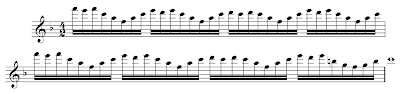
Here is, for instance, a bit of the Widor toccata. First you'll hear the opening bars of the right hand just as Widor wrote it, using just a couple of flute stops (already less impressive, isn't it? The volume is part of the piece's aura). Then I'm going to "subtract" the notes that do not change from group to group--that's most of them. The ones that are left in each group--three of them--, I'm going to play loudly on one manual, and for now you'll still be able to hear the remaining five notes in each group, played softly.
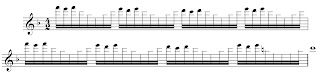
Now, Since the second note of that remaining group of three loud notes note is simply the lower neighbor tone and the third note is a repeat of the first note, I'll take those two notes away also and only play the first note of the entire group loudly, and the rest softly.
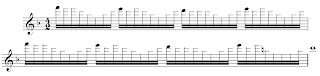
After that, I won't play the remaining notes at all. Now all the notes have disappeared except the backbone of the phrase.
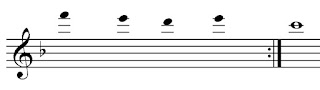
The last thing I did was to play that nine note tune in the pedals, which is actually what Widor himself does with it shortly after, and again at the triumphant return two-thirds of the way through the piece. The left hand, as it happens, also echoes this little tune. It's just three notes down, two back up to where we started, back down, back up, and a final C. And even that, it turns out, is the same thing twice. The first eight notes are really just four notes repeated with a C on the end.
Now let's listen to the entire process I've just described, with the subtractions done one at a time. It is a bit like listening to a "Cheshire toccata" with bits of it dispersing until only the grin is left.
That's right, the whole opening phrase--the whole piece, really--reduces to four notes.
Not that the other notes don't matter, of course. Music theorist Heinrich Schenker once showed pianist Arthur Schnabel his system for finding the most important notes in a piece of music. Under his system (unlike what I just did) entire pieces reduce to just a few structurally important notes. Schnabel's comment upon seeing this was that "you've taken away all my favorite notes!"
Don't worry; we'll put them back. Those rapidly fleeting notes create a visceral excitement. And when that simply tune comes rolling through the pedals it is a even a physical challenge to play them. Widor places them in double octaves at the extreme ends of the pedal board, meaning a short man like me can barely get his legs parted wide enough to play them. It feels like trying to straddle the universe.
And it is the difference between something that could easily be chanted by monks and what appears to be an epic organ toccata.
And yet, that outline is there all the same. And for those who can hear it, much less write something like it, it is a way to organize all of that information, and to understand it. It does not make it less fascinating. After all, I'm sure the designer of the Taj Majal knew the basic principles of architecture, but still created a masterpiece out of these simple ideas. So it is with the Widor. We could go on studying the piece, and I could point out how the it breaks into sentences and paragraphs and repeats those four notes in different keys and modes, again and again, and by the end we could marvel at how something that ---well, childish, really--could add up to something so impressive.
Because that kind of simplicity isn't lazy or ignorant, or unable to be complicated. It is the sign of a master at work, organized, methodical, and yet able to provide flashes of insight, exploration, genius.
It is a gift.
------------
After I wrote this I learned that the French would like to KEEP all those extra notes--and letters--thank you very much! This article is from The Guardian about attempts to simplify the French language and the controversy it is causing in France.
Here is, for instance, a bit of the Widor toccata. First you'll hear the opening bars of the right hand just as Widor wrote it, using just a couple of flute stops (already less impressive, isn't it? The volume is part of the piece's aura). Then I'm going to "subtract" the notes that do not change from group to group--that's most of them. The ones that are left in each group--three of them--, I'm going to play loudly on one manual, and for now you'll still be able to hear the remaining five notes in each group, played softly.
Now, Since the second note of that remaining group of three loud notes note is simply the lower neighbor tone and the third note is a repeat of the first note, I'll take those two notes away also and only play the first note of the entire group loudly, and the rest softly.
After that, I won't play the remaining notes at all. Now all the notes have disappeared except the backbone of the phrase.
The last thing I did was to play that nine note tune in the pedals, which is actually what Widor himself does with it shortly after, and again at the triumphant return two-thirds of the way through the piece. The left hand, as it happens, also echoes this little tune. It's just three notes down, two back up to where we started, back down, back up, and a final C. And even that, it turns out, is the same thing twice. The first eight notes are really just four notes repeated with a C on the end.
Now let's listen to the entire process I've just described, with the subtractions done one at a time. It is a bit like listening to a "Cheshire toccata" with bits of it dispersing until only the grin is left.
That's right, the whole opening phrase--the whole piece, really--reduces to four notes.
Not that the other notes don't matter, of course. Music theorist Heinrich Schenker once showed pianist Arthur Schnabel his system for finding the most important notes in a piece of music. Under his system (unlike what I just did) entire pieces reduce to just a few structurally important notes. Schnabel's comment upon seeing this was that "you've taken away all my favorite notes!"
Don't worry; we'll put them back. Those rapidly fleeting notes create a visceral excitement. And when that simply tune comes rolling through the pedals it is a even a physical challenge to play them. Widor places them in double octaves at the extreme ends of the pedal board, meaning a short man like me can barely get his legs parted wide enough to play them. It feels like trying to straddle the universe.
And it is the difference between something that could easily be chanted by monks and what appears to be an epic organ toccata.
And yet, that outline is there all the same. And for those who can hear it, much less write something like it, it is a way to organize all of that information, and to understand it. It does not make it less fascinating. After all, I'm sure the designer of the Taj Majal knew the basic principles of architecture, but still created a masterpiece out of these simple ideas. So it is with the Widor. We could go on studying the piece, and I could point out how the it breaks into sentences and paragraphs and repeats those four notes in different keys and modes, again and again, and by the end we could marvel at how something that ---well, childish, really--could add up to something so impressive.
Because that kind of simplicity isn't lazy or ignorant, or unable to be complicated. It is the sign of a master at work, organized, methodical, and yet able to provide flashes of insight, exploration, genius.
It is a gift.
------------
After I wrote this I learned that the French would like to KEEP all those extra notes--and letters--thank you very much! This article is from The Guardian about attempts to simplify the French language and the controversy it is causing in France.
Monday, February 1, 2016
The boring bit in the middle
Now let's turn to the part of the toccata that gets no respect: the middle part. It was referred to on one site I visited as "the boring bit in the middle."
Mssrs. Gigout and Widor avoided this part altogether--Gigout because his toccata was short and he didn't need a contrasting section, and Widor because he decided to make the entire toccata about one theme--though his entry did quiet down in the middle, and if anyone is going to fall asleep, that's when it would happen.
But any piece of a considerable length; say, more than three minutes, is likely to have a contrasting section. It usually falls in the middle, to give the whole piece a broad ABA architecture. And whereas the first section of a french toccata is generally loud, fast, in a continuous whirl of notes, and completely unsingable, the middle section is usually slow, stately, soft, and melodic.
Theodore Dubois' toccata is a good example of this. For the first three minutes, all is active--then the last triumphant chord dies away, and what we hear next is a hymnlike melody completely unlike anything that had happened before. Unfortunately, human beings often don't have patience for this sort of thing, particularly now that we are so accustomed to sensory overload. I once saw a video of Diane Bish playing this toccata, and when she got to the part in the middle, she began talking over the music, assuming her audience was going to zone out at that point and she'd better entertain them with pictures and stories about sightseeing in Europe until the fast part came back.
This was a shame, partly because it is a nice, if innocuous, little melody, but also because it really doesn't go on too long before something else happens--the first part begins to want some attention.
What begins to happen in this section is that the rapid theme from the beginning is revealed in little snippets--one measure here--then back to the slow melody--then another measure--then back to sleep--then again we here it. It is as if the piece is waking up again, or spring is springing, or something is gradually coming to life. It is a process. It will take some time, But it is not like watching grass grow. It will only be a minute or two. Wait for it. Long for it. Get excited. It's coming. And then--it's here!
Actually, there are several other ways you could describe this phenomenon. Maybe the two musical elements are fighting for supremacy. Maybe they are just negotiating. Maybe the music is trying to make up its mind. There are plenty of emotional conclusions you could draw from this--and you'll have plenty of chances, because this sort of thing happens in any number of pieces of music. Once you know to listen for this, you'll hear it often, particularly in French organ toccatas. Particularly in our next piece, the one by Alexander Guilmant
Like the Dubois, Mr. Guilmant makes it very clear when the second part begins. In fact, when the first part of the Dubois ends, you could easily think the piece is over! And if that architectural feature is obvious to you, keep it in mind. When the piece actually DOES end, When you've heard that entire opening section again to its conclusion, it will basically end the same way--except perhaps for a little additional tail (coda) at the end.
Mr. Guilmant, however, does not want us to make the mistake of thinking his piece is over so soon, so the chord he choose to end the section with (great chord, by the way) is noisy but inconclusive. And THEN the quiet, songful part begins.
It's not long, however, before the fast theme of the opening reappears. In fact, it is making little asides between each phrase of the long-breathed melody. Then gradually it starts to reassert itself, in different keys and registers, still alternating with the slow tune, and finally, thrusting itself back into the limelight, there is a very dramatic moment as the organ grows to full blast and the opening returns. Can you hear it? It's quiet now, but soon it will be in full force. You can be caught off guard by it, or you can notice it happening right from the start. It isn't as easy, or natural, to listen for, but can be very rewarding. And, with classical composers doing this all the time, it makes a lot of "boring parts" suddenly less boring.
Transition may be the least natural part of being human. We like to dance, to sing, and to react to what is happening right now, but we aren't very good at preparing for future events. Sometimes we like to deny them, like refusing to wear a coat out of the house because it isn't cold right now (but it will be in a few hours according to the weather forecast). This applies to larger social conditions as well. With gas prices their lowest in years, many Americans are lining up to by the same kinds of gas guzzling vehicles that caused so much pain at the pump the last time prices were high, setting themselves up for the same thing all over. When things are going well, people always think they are going to last forever...and when they aren't going well, it's the same story. But why plan ahead, anyway?
The point of my little sermon is that listening for process, for transition, for the start of something new or its return, isn't just something to keep us from being bored in the concert hall; it's also a life skill.
Guilmant: Allegro assai
Monday, January 18, 2016
At the top of the chute
"And they're all lining up for the start of the spring semester....they'll be running into gale force winds...it's really a beautiful day out there!"
It's always a good idea to have a strong opening. That's what each of today's panelists would tell me if they were still here to do it, and if they'd debase themselves by coming on this blog to being with. They are all very gifted French composers--were very gifted, anyhow. And they all knew how to lead with some arresting musical ideas.
This is something I could use right about now. The start of the "long semester" can be a bit daunting. While the fall semester seems short and intense, and usually involves cramming in a concert or two before the Christmas season, which runs from about Nov. 20 to the 1st of January, and includes every organization I work for putting on most of their shows for the year, the spring semester is less packed, though it seems to go on twice as long and largely takes places in the cold and dark of January and February and sometimes March. When it's not dark it's overcast.
I could use a new start, the sense of a fresh new beginning. That's where these consultants come in.
Why, we might inquire, do a series on flashy French organ toccatas in the middle of January?
Well, why not?
And then it hit me: maybe I need a little bit of a pick up. Maybe you do, too. So we'll let these fellows dazzle us with the loud and the flashy for a little bit, and by the end, we'll really know something about the institution of the French organ toccata.
Today we're really just interested in the opening. I'm going to post the entire recording of each one because it's just easier, but you can listen to the opening minute or so of each one and get the idea.
Notice how they all open: loud, fast, and with a continuous sense of momentum. Now, the idea here, to be blunt, is display. Organists know that if they pull one of these out of their hats the congregation will be impressed. Probably a little too much--most of the time these aren't as hard as they sound. But there is a sense of joy in the proceedings as well, is there not? And not simply in how fast the organist's fingers can go, I hope.
Let's sample a few. Here's one you might not have heard of unless you are an organist, but I'll bet it becomes one of your favorites:
Dubois: Toccata
That one goes on for seven minutes, but remember, don't spoil the ending. Just listen to the first minute. We'll get back to it.
That's a cheerful little guy, isn't it? How about something a bit different?
Guilmant: allegro assai
Points for your bloggist for noticing that, despite having a different name (namely a tempo marking) that it is, in fact, a toccata. No need trying to hide it, Alexander!
Alright, you probably have detected that these two pieces, being from the standard organ literature, are not that well known to the guy on the street (as is pretty much the fate of all the organ literature). There are a few pieces that have managed to transcend the boundaries of the organ loft, however. Surely you know this one. It's an Easter tradition at my church:
Widor: Toccata
Both the Guilmant and the Widor, by the way, happen to be the final movements of larger works. A grand sendoff.
While we're doing famous, how about the other toccata you've all heard of? Particularly, the opening (and remember, just the opening! No getting distracted and listening to the whole thing!)
Bach: Toccata and Fugue in d minor
OK. We've got a bit of a problem here. It's pretty obvious that this one doesn't even begin to sound like the others, and that's because it is an entirely different animal. Sure, it's got the same name as the others (toccata) but it's not similar at all; it has no more in common with the others than a water buffalo and a zebra.
So a quick definition before we go on. Toccata is from the Italian toccare, meaning to touch, and it involves digital display. The KIND of digital display however, may be rather different. The 19th century French had a very different idea of what that meant than the 18th century Germans, which means that yes, there are two kinds of toccatas, and that they are not very similar.
Sorry, Bach, but you get voted off our island. Besides, you're not French. But you can come back for our series on 18th century German Toccatas.
Now we've heard from three flashy 19th century french toccatas, and one that wasn't. (by the way, some folks like to call the piece I play at Easter the Widor Toccata and Fugue. It isn't. It's just a toccata. It doesn't have a fugue in it.)
What do they all have in common?
They are loud. And fast.
They maintain constant rhythm.
They would be hard to sing. If there is a melody, it is either buried in the midst of a lot of other notes or it comes in later in the pedals (like the Widor).
The fast, active part is pretty much the only thing going on (ie., no counterpoint or separate melodies going on at the same time)--except for a light, sprightly accompaniment.
They make the organ sound really terrific.
One more thing--They were all written by Frenchmen working at churches in Paris in the late 19th century. Charles-Marie Widor was organist at St. Sulpice from 1870 to 1933 (64 years!), Theodore Dubois was organist at La Madeleine (our lady) from 1877 to 1896, and Alexander Guilmant was organist at La Trinite from 1871 to 1901. Imagine all of those great organ toccatas pouring forth from all of those churches at the same time in the same city!
[listen]
Then again, perhaps it is a good thing that they normally keep the church doors closed.
Monday, December 14, 2015
Music in Space
I'd like to do something special for you this Christmas. I'm going to take you up to the pipe room.
If you're not an organist yourself, you've probably never been up in one. Even if you are, you may not have spent a whole lot of time up there.
 Careful on the ladder! This one's not bolted down.
By the way, don't tell our building manager we're doing this. He'll be worried about the liability issues. I'm not even sure whether our insurance covers virtual falls during virtual tours on the internet.
Great! We made it. Also that's what these pipes go to. The Great! ....nevermind.
We are surrounded by pipes. Careful! There are over a thousand of them, and some of them are pretty small; still, you can do quite a bit of damage to them if you fall on one. And to yourself, of course. No wonder we don't give tours regularly.

The reason we are up here is so we can get a little perspective. The piano is a pretty terrific instrument, but it doesn't take up three rooms like our organ does. And despite our organ's being on the large side of small, as pipe organs go, it has some 1200 pipes. Now, that takes up a lot of room. And when you are up here, you really get a feel for the size of the instrument. In fact, it is all around you. That console downstairs is only where the decisions are made. The sound comes from up here.
A year ago, when we got our playback system, I got to do something I couldn't do before. I could listen to myself play from somewhere other than the organ bench. So I made my way up here to listen from inside the instrument. It's quite something. And--aren't you lucky--I spent half an hour dragging my recording equipment up into the pipe room so I could make some recordings from in here as well. I'm going to share one of them (there are some others we can get to later).
This is a nice little Canzona (90 seconds) by Franz Tunder (1614-67) who was organist at St. Mary's in Lubeck before Dietrich Buxtehude, whom Bach traveled so far to hear. First I'll play it for you the way you would hear it in the sanctuary.
[listen]
Now, as it happens, I was able to record the very same performance from a wholly different angle. Notice the difference in sound. For one thing, it is dryer, there is no resonance, the pipes are close by, and you will distinctly be able to hear some of them coming from one or the other of your speakers--assuming you have two. I hope you are listening to this in stereo, because otherwise you will lose the effect.
In the opening section, it is just a single flute stop playing, so all of the notes will be coming out of one speaker. (the one on your left, I think. The other speaker is making blower noises because that's the side where the blower is located, in case you wondered what was making all that non-musical racket).

But in the next part of the piece, an even more curious thing happens. Although this is the part where I add several more stops and the piece becomes much louder, I've closed the shutters, which closes off the pipes in the front--the ones you can see from the sanctuary--from the ones back in the pipe room. That's at least 3/4 of the organ that the congregation never sees. The reason they are behind shutters is so you can make them louder or softer depending on whether or not you have opened or closed the shutters in front of them. However, we are now BEHIND the shutters, which makes things sound rather backwards.
You see, the foundation stops--the main stops of the organ, which are expected to have some volume--those are placed out in front, and are not able to be quieted by closing the shutters. But the rest of the pipes are affected by the shutters. Now, here, the stops that would normally be loudest are actually on the other side of the shutters. The ones that you will hear best are the ones in the back of the pipe room, nearest to us. It actually sounds like I am using a completely different registration to play the piece now, but that is only because we are listening to the organ from the opposite direction!
[listen]
Cool, huh?
By the way, this was recorded on a hot day in July, and if it sounds to you like one of the pipes was leaking some air, it sounded like that to me, too. I've think we've gotten that fixed by now. The tuner was just here a couple of weeks ago.
Sometimes it is nice to here things from a different angle and to realize how differently they can sound. If only humans could do that more often!
-------
for more perspectives, you can check out my recent podcast interview with host Vidas Pinkevicius on the "Secrets of Organ Playing" blog.
Also, coming tomorrow to the homepage of pianonoise.com: three hours of piano and organ music for the holidays. It will be up through Christmas.
If you're not an organist yourself, you've probably never been up in one. Even if you are, you may not have spent a whole lot of time up there.

By the way, don't tell our building manager we're doing this. He'll be worried about the liability issues. I'm not even sure whether our insurance covers virtual falls during virtual tours on the internet.
Great! We made it. Also that's what these pipes go to. The Great! ....nevermind.
We are surrounded by pipes. Careful! There are over a thousand of them, and some of them are pretty small; still, you can do quite a bit of damage to them if you fall on one. And to yourself, of course. No wonder we don't give tours regularly.

The reason we are up here is so we can get a little perspective. The piano is a pretty terrific instrument, but it doesn't take up three rooms like our organ does. And despite our organ's being on the large side of small, as pipe organs go, it has some 1200 pipes. Now, that takes up a lot of room. And when you are up here, you really get a feel for the size of the instrument. In fact, it is all around you. That console downstairs is only where the decisions are made. The sound comes from up here.
A year ago, when we got our playback system, I got to do something I couldn't do before. I could listen to myself play from somewhere other than the organ bench. So I made my way up here to listen from inside the instrument. It's quite something. And--aren't you lucky--I spent half an hour dragging my recording equipment up into the pipe room so I could make some recordings from in here as well. I'm going to share one of them (there are some others we can get to later).
This is a nice little Canzona (90 seconds) by Franz Tunder (1614-67) who was organist at St. Mary's in Lubeck before Dietrich Buxtehude, whom Bach traveled so far to hear. First I'll play it for you the way you would hear it in the sanctuary.
[listen]
Now, as it happens, I was able to record the very same performance from a wholly different angle.
 Notice the difference in sound. For one thing, it is dryer, there is no resonance, the pipes are close by, and you will distinctly be able to hear some of them coming from one or the other of your speakers--assuming you have two. I hope you are listening to this in stereo, because otherwise you will lose the effect.
In the opening section, it is just a single flute stop playing, so all of the notes will be coming out of one speaker. (the one on your left, I think. The other speaker is making blower noises because that's the side where the blower is located, in case you wondered what was making all that non-musical racket).

But in the next part of the piece, an even more curious thing happens. Although this is the part where I add several more stops and the piece becomes much louder, I've closed the shutters, which closes off the pipes in the front--the ones you can see from the sanctuary--from the ones back in the pipe room. That's at least 3/4 of the organ that the congregation never sees. The reason they are behind shutters is so you can make them louder or softer depending on whether or not you have opened or closed the shutters in front of them. However, we are now BEHIND the shutters, which makes things sound rather backwards.
You see, the foundation stops--the main stops of the organ, which are expected to have some volume--those are placed out in front, and are not able to be quieted by closing the shutters. But the rest of the pipes are affected by the shutters. Now, here, the stops that would normally be loudest are actually on the other side of the shutters. The ones that you will hear best are the ones in the back of the pipe room, nearest to us. It actually sounds like I am using a completely different registration to play the piece now, but that is only because we are listening to the organ from the opposite direction!
[listen]
Cool, huh?
By the way, this was recorded on a hot day in July, and if it sounds to you like one of the pipes was leaking some air, it sounded like that to me, too. I've think we've gotten that fixed by now. The tuner was just here a couple of weeks ago.
Sometimes it is nice to here things from a different angle and to realize how differently they can sound. If only humans could do that more often!
-------
for more perspectives, you can check out my recent podcast interview with host Vidas Pinkevicius on the "Secrets of Organ Playing" blog.
Also, coming tomorrow to the homepage of pianonoise.com: three hours of piano and organ music for the holidays. It will be up through Christmas.
Monday, October 19, 2015
Taking on a cliche
When I mentioned that I was going to play an organ recital last year at this time, people wanted to know if I was going to play the piece. You know, the FAMOUS one. The one that goes....
DADADAAAAAAA!!!!! deedeedeedee DUH! DAAAAAAAAA!!!!
In other words, the entirety of the known organ literature!
It can be tough to be an organist, or at least lonely. I've read that only about one in every two hundred people regularly attend classical music concerts. Of these, I'm betting that only about one in a hundred know or are interested in the pipe organ. That's a pretty small group, limited to mostly other organists.
On the other hand, it leaves quite a bit of virgin territory for those with missionary zeal, like a young John Wesley, who thought it would be a grand idea to leave England and go preach the gospel to the Indians on a continent he didn't know among a people he didn't know to bring them a religion they'd never heard of. Because why bother trying to convert your next door neighbor? That would be boring! He would have made a great organist (aside from not liking instrumental music). As it is, he will probably be rolling over in his grave a week from Friday, when I give my next organ concert.
Last year, having just refurbished the console of our organ at Faith to fix some longstanding issues with the relay system and some very outmoded parts, and having added a few bells and whistles into the bargain, we moved the console out onto the floor (the first time that was possible) and I invited the entire church and a large chunk of the community to come celebrate this exciting instrument in all of its relieved post-operative glory.
It's an organ recital, remember? Wasn't likely to have people knocking each other down to get in like a Black Friday sale at Walmart. We advertised how much fun it was going to be. I did my best to convince people that organ recitals really weren't that scary. And a large chunk of the community actually showed up, practically filling the sanctuary (upwards of 250?). It was the first time I'd seen that many people at an organ recital in this town. Not that I've been to more than a handful, but it's usually 30 to 50 people. And that enthusiastic throng was on their feet at the end, demanding an encore. I hadn't prepared one so it is a good thing I can improvise! Somebody called out a hymn and I gave them an energetic rendition of "I'll Fly Away!"
That concert was right before Halloween and people kept asking if I was going to play scary organ music. Part of me found this annoying. After all, why does the organ always have to be associated with the Phantom of the Opera and haunted houses? People who attend our "traditional" services know that it speaks with many voices. It can be majestic, consoling, humorous, full of vigor and enthusiasm, somber, melancholy--only the strength of our imaginations limit the possibilities.
On the other hand, I thought, the organ does scary pretty darn well. Better than any other instrument, in fact. So if people want scary, well, let them have it. And while I'm at it, I can mention that none of the pieces on the program were actually written for Halloween and what it is about the organ that has always provoked such a thrill and a shudder in its hearers, and what a pagan holiday like Halloween is even still doing in a (post) Christian world. I'm making this concert sound like a symposium, aren't I?
Well, it won't be. Just like last year, it will be a blend of erudition and slapstick; entertainment and thought provocation, and a variety of music from several times and places, with a few tricks up my sleeve. Unlike last year there will not be ensemble pieces but I do have a small cast of helpers. And the lights will be a lot lower. Also the concert is on Friday evening this time, because there is nothing at all scary about Sunday afternoon.
By taking on a cliché, I get to explore it, and to have some fun with it. Besides, there is still that kid in me that enjoyed the thrill of the Toccata and Fugue which I played as a teenager. And what organist doesn't enjoy the sound of the pedal reeds and the manuals on full, the organ blazing away at the finale of the Passacaglia in c minor?
I think we'll all have a scary good time. Stay tuned.
Monday, June 8, 2015
Let's go back to the beginning
Do you find old things exciting? Really old.
I find it fascinating that human beings have this special power: sure, ants can carry ten times their weight, grasshoppers can jump many times their height, cheetahs can run faster and whales are bigger, but human beings can throw their voices vast distances across time and space.
The music we are going to listen to today was written some 650 years ago. It is the earliest keyboard music that has been discovered to date. It is thought to date from the middle of the 14th century, and comes to us from a monastery in the little town of Robertsbridge, England, where some of the houses also date from the 14th century. It is known as the Robertsbridge Codex. In reality it is simply two leaves of music containing several pieces of music for voice (there are several of these that are older) and three "estampies" written for the organ. One of them, unfortunately, is incomplete. The two that are complete are available as sheet music online, and if you want to play them yourself, you need only search for them (they aren't on IMSLP, though; I think I got mine from the Medieval Music Database).
There are also several Youtube recordings, revealing different approaches to the pieces, including different opinions about how they are structured. This is because of the complexity of the roadmaps of the pieces, as I mentioned last week.
Once I got over my annoyance, I was able to record the second one, the Estampie Retrove, with no errors and without getting lost once! Which seems like something worth bragging about, at least if you've seen the music. It's not technically difficult, but you have to continually jump around to the appropriate spot.
This is my very 21st century interpretation on a 20th century organ. I am not an early music specialist. The dynamics and registrations are not in the music; I chose them myself. I also chose the tempi. Apparently scholars are divided on whether these piece were really intended as dances. I clearly favored the idea that they were. Probably nobody in the 14th century could have played them as quickly as I did, either; The instruments wouldn't have allowed it, nor did people get to practice as much. But then, it may be that an attempt to be more authentic would actually cause the piece to lose its message for us, denizens of a century in which everything is faster and technique is at a higher ebb. In any case, enjoy these renditions; then you can look for others on the web.
Estampie no. 1
Estampie Retrove
For my part, I've discovered yet another exciting corner of the repertoire: late Medieval. For an encore I'm going to look into the Faenza Codex (late 15th C.), and the Buxheimer organ book (c. 1460). Look for recordings of those this fall.
Monday, June 1, 2015
Roadmap

It is either very sobering, or slightly hysterical, to realize that a nightmare that has plagued any musician who has had to sight read pop music for a wedding is no new phenomenon, but has been going on apparently since the dawn of time. I'm talking about the joy of the roadmap.
For those of you not already smiling and nodding, this means that a piece of popular sheet music seldom, if ever, is to be played continuously from page one to page nine, but rather, some distance in, requires you to go back and repeat some music and then usually to leap forward and skip some of the music you just played. In other words, you end up playing pages one through 5, going page to page 3, then skipping from the middle of page 4 over to the last measure of page 6, only to go back to page 3 again, play two measures, and skipping over to page 7. Or something like that. It's supposed to be in the name of saving paper, which is a bit hard to imagine because the thing is already 9 pages long for a song that's only 3 minutes long and contains the same 3 chords in the same order about 55 times.
While the music is pretty simple, the thing that causes you to have to stay awake (nights) is the very real chance that you will mess up the "roadmap"--that is, get the pages out of order, or go to the wrong one at the wrong time. Musicians need their own version of Garmin to tell them, "in seven measures, go to the second ending. Then go back to page 3.....recalculating!"
If you've ever had the joy of acquiring somebody's favorite popular tune so that someone's cousin can sing it (slightly flat) for a wedding or funeral, you are aware that generally there are just a few more pages than can fit on a music stand and so arranging the music so that you can play it all continuously is one of the challenges of the job. It is certainly not the music itself.
I usually end up playing parts of measures with one hand while I either toss pages off to the side or grab them from the flat portion of the music rack and place them where I can see them, or, in some cases, just read them off of my lap until I get to the next page. The trick is to make sure you don't discard a page you will need later.
It is a pervasive myth that times used to be simple, and marvelous, that back in the mists of time life was easy, and they certainly wouldn't try to save paper by making you do crazy things like going back two pages just to play one measure and then leaping forward to page 5 unless the moon was full on a Tuesday in which case you'd skip that part and go to page 11. yeesh....
I've recently gotten around to rendering the earliest two pieces of surviving keyboard music, and let me tell you, the concept of the crazy roadmap exists from as early as we can know. These pieces are from the Robertsbridge Codex, thought to date from around 1360, discovered in the mid-19th century in Robertsbridge, England. They are two dances, and pretty tunes they are, too, but, man, what a road map!
The first one basically consists of a "chorus" and five verses. At the conclusion of each of the verses, you return to the same spot in the "chorus" and play what is apparently the "1st ending" each time before jumping to the start of the next verse (these all have numbers). After the last verse is done, you skip the "1st ending" (marked "overt") and go to the "clos." That, at least, is my interpretation. I've listened to three or four videos online and everyone does it differently. But I think the fellow who plays the historic organ and has the reputation does it correctly. There is another video that features a small, portative organ and a harp player doubling which is charming and seems historically authentic, though they only play the fourth verse twice, and skip the others.
The first dance is nice enough, but the second--puts all modern publishers and their crazy roadmap schemes to shame. It is called "Estampie Retrove" which thus far I have not been able to decipher --the title, that is. Retrove has got to have something to do with return, I assume, and indeed, that is the challenge. For, as in the first piece, one gets to the end of the "chorus" and jumps ahead to each of the five verses in turn, but the return is never to the same place in the "chorus"--instead, there are letters to tell you which measure, and indeed which beat of which measure, to return to. The result is that the "chorus" is a different length each time it is played. I would just like to brag that the recording you will hear on pianonoise was done without any editing and I managed to play the entire piece without getting lost once. Whew!
Wednesday, April 1, 2015
He's kidding, right?
Today is the First of April, commonly known as April Fool's Day. It is also Rachmaninoff's birthday.
That is a total coincidence.
If you know anything about Rachmaninoff at all, you also realize how ironic it is. Of all the composers who never smiled, he smiled the least. It is hard to imagine him joking about anything, even if he did once look down upon a young Leon Fleisher who had expressed interest in a concert career and dead pan in his thick accent, "music----baaaaadd business." He may have been in total earnest, but at least it's funny the way Fleisher tells it.
There is, however, another composer who practically no one ever accuses of being funny, one Johann Sebastian Bach. This, however, may be a mistake. Sure, he's not smiling in the portrait, but apparently family gatherings in the Bach family could be quite raucous. Besides, if you know anything about the history of April Fool's, or human nature, you know that pranks are not always of the completely harmless variety, nor are they quite malicion-free. And that just might describe what is happening here, in the piece I'm going to play for you.
Why? Well, for starters the musical material ain't all that grand. Bach takes for his theme a simple scale, and this windy exercise drives the joke. Several times in the piece the two-voices chase each other around the scale like a pair of squirrels who can't figure out what direction to run in. The rest of the material is a slowly descending chromatic scale which does not sound very light-hearted at all. Some commentators have suggested that here Bach was responding to critics who were complaining that his music was too serious and did not have enough charm and crowd appeal. Taking light and flimsy materials with which to build the kind of artifice that they would not have appreciated in the least may have been a kind of musical back-handed slap.
And after you listen to it, you just might come away thinking that Mr. Bach, the man you thought was so serious and dignified, really is pulling your leg, showing you what happens when you take an intentionally silly and empty theme and try to make it sound like a banquet of musical riches. The whole thing may function as a lugubrious cautionary tale--it is in a minor key, after all, and it isn't nearly as lighthearted as its neighbor, the second duet in the series, which is just as silly, and all smiles and sunshine. This one may not be so obviously humorous as its cousin. Call it a bit of dark humor, or bitter humor, but humor nevertheless. And the scales....
If that isn't enough to convince you, I've chosen a particularly hollow organ registration to drive the point home. It is missing its middle--a so-called "gapped" registration, in which the shiny mixture stops aren't sufficiently grounded with a full chorus of foundations. So if it also sounds a little odd aurally, that's why.
Enjoy Bach's little joke.
Bach: Duetto no. 1 in e minor
Friday, March 27, 2015
Chaos Sunday
I call it Chaos Sunday. Its real name is Palm/Passion Sunday.
The chaos comes from the fact that dozens of children whom we have not seen in a while descend on Faith church for the express purpose of being sugared up with donuts, then lined up, given palm leaves, instructed not to hit each other with them, then paraded down the aisle of the sanctuary and made to sing a few hosanna-related songs in front of the congregation. This is at the start of the service. It has the appearance of off-off-off-Broadway, meaning it could use a little more rehearsal (any at all, really). Our choir director has to physically pick some of the kids up and put them in their spots because they have no clue where they are going or what they are doing (or singing).
It's over soon after, to be repeated again at the later service. Meanwhile, I will have been experiencing the event as a kind of liturgical "Groundhog Day" because once the palm parade dissolves into the passion narrative and ends with the crucifixion, I go across the hall and start the process over--three times!
It is perhaps the most challenging Sunday of the year. More than Easter, I think.
For obvious reasons, our choir director would like to get the children on and off as soon as we can, so she always asks that I keep my opening voluntary as short as possible so the kids don't have long to wait. This year I completely did not do this.
But in order to honor her need to start the parade on time and also to make sure that the first service does not run past the time I need to be at the second service, I am starting it ten minutes before the service, ala the old days, when people talked over the organ music and half the congregation missed it completely, so that it will end in time for the announcements and the children. In case you are someone who didn't know the music was starting early this week (for some reason it didn't get into the church email) I'm sharing it with you here, along with anyone else who wants to listen in. It is the first movement (the majority) of the Third organ sonata by Felix Mendelssohn, which, for reasons I explain below, seemed entirely appropriate for the nature of our service; it functions almost like an overture for what is to come during worship on this unique Sunday of the church year. Here are my notes from the bulletin:
"Mendelssohn's sonata begins with a processional, as we would expect on this Palm Sunday. But a minute later the mood shifts. Now in a minor key the voices enter one by one building tension and drama. It is, for our purposes, foreshadowing: imagine Jesus on his donkey setting his face toward Jerusalem, in the midst of his triumph, knowing the tragedy that was to come. As the voices whirl above, Mendelssohn quotes a psalm tune in the pedals: "Out of the Depths I cry to You, O Lord." This section is the longest of the sonata; it culminates with a dramatic pedal solo which rises to the top of the pedal board, only to sink to its depths. But as it arrives at the bottom, the processional returns, grander than before. The premonition is gone; we are returned to the start of the service. There are tiny reminders of the psalm tune interleaved with the majestic phrases, but a final shout of acclamation carries the day. At least for now."
Here is the music. Happy Chaos Sunday!
Mendelssohn: Sonata in A Major: I. con moto maestoso
-----
A while back, someone noticed that Protestants don't go to church during Holy Week, thus hearing the Palm parade into Jerusalem part of Jesus' story and the Resurrection from the Grave part of the story the next week, and entirely skipping the part in between where he gets arrested, tried, and crucified. Since it lacks integrity to go "from triumph to triumph" and only get the "happy" parts, the church has attempted to cover both the readings traditionally given to Palm Sunday, and the "passion" narrative that follows, the portions that ought to be read during the week that follows, on Thursday and Friday. Since our church also has a service on Thursday, we go over the passion story twice (or in my case, four times). but since only around 100 of our 400 active members usually attend, the remaining three-quarters get their dose on Sunday, whether they like it or not!
Subscribe to:
Posts (Atom)