Last week I said I would furnish some support for my contention that J. S. Bach did not write the "8 little preludes and fugues" that were (or are) sometimes attributed to him. This plan of action is none too popular with some musicians, I've noticed. Whenever scholars make some sort of pronouncement about the authenticity of pieces of music, some folks like to simply roll their eyes and mutter under their breath. I think it shows more maturity and intellectual growth to read the arguments and consider what they've said rather than stubbornly cling to whatever we'd like to be right without informing ourselves of what they've said.
At the moment, however, I haven't read any of the literature yet, either, and I don't expect to get a chance in the very near future. I am, instead, offering my own thoughts on the matter, and, later, I can find out whether some of the people who have written scholarly articles on the subject have come to the same conclusions I have, or have things I haven't yet considered, or both.
As I wrote last week, part of the issue seems tied to the question of quality. If you think highly of these works you want them to have been written by Bach, particularly if you are an amateur organist, because these pieces are much easier to play than practically everything else that we can certainly attribute to Bach, and that way you can feel you are playing something by the great J. S. On the other hand, if you don't think much of these pieces, you might be willing to suggest, or even want to suggest, that someone else wrote the pieces. A large part of my argument today is the point out flaws in the compositions, to unpack what someone might mean when they suggest that the pieces are not of high quality. If you disagree, you may need a strong stomach for this one. I'm sorry to poke holes in your musical favorites, although I will say that growing as a musician often requires reassessing our most cherished opinions, and questioning what we know.
There is the matter of counterpoint. These pieces do not contain any parallel fifths or octaves that I can think of; however, there is often weak counterpoint nonetheless. For example, the opening of the G major prelude contains this passage in which the tenor voice gives out an A to G, and this is followed immediately by the alto voice, also with an A to G. The octaves are staggered: they do not occur at the same time. But they still sound like the independence of the two voices has been compromised, which is what is at the heart of the prohibition of parallel octaves and fifth. The counterpoint is less full and less rich because of it.
listen
When you listen to it it actually sounds like the same voice repeating itself because with various stops drawn each note is sounding at its own octave and the octave above, so it is harder to distinguish between the voices. This counterpoint doesn't help that any. It is not an example of a technical "theory class" infraction, but it is weak writing nevertheless.
Something that occurs toward the end of the same prelude is a very short dominant pedal point. This, to me, seems very abrupt, and I have a hard time believing that Bach, who was able to stretch such periods of tension before the final release to incredible lengths at times, would write a dominant pedal that has barely begun before it is over.
listen
These are two different kinds of defects, one related to the quality of the counterpoint, another to the handling of compositional structure. There are many places where the harmony is left incomplete so that one voice may double something that is in another voice, unnecessarily. I would list them but I seem to have left my scores on the organ. Can you trust me?
There are, of course, places in the same pieces where the counterpoint is stronger, and also where the structure is not so perfunctory. I am reminded of a long pedal point at the end of the A minor fugue, which, together with its prelude, is currently my favorite of the set, and may well be the best, from a compositional point of view as well. It also brings up the possibility that not all 8 necessarily came from the same source. Could Bach have written some but not others? Although I still am not sure I would assign the A minor prelude to Bach, it might be first in line if I changed my mind.
A large part of a musicologist's argument often tracks not whether the ideas a composer has are any good but what the composer does with them. This is often the difference between composers of genius and those who simply aren't half bad. Whether this kind of argument takes hold in you or not will depend on your ability to appreciate the working out of ideas rather than to just enjoy the presentation of the ideas themselves. I will state baldly that I have gone from one side to the other as I have grown in my musical ability, and so, I imagine, would anyone else. In other words, it takes a more developed person to appreciate arguments, whether in words or in music, that are well developed, and not simply to enjoy the tang of a catchy musical idea which is repeated many times with little development, as happens in most popular music.
For instance, as ebullient as the C major prelude is, the sequence of chords that follow the opening measures and get us into the new key are only impressive if you haven't heard them from any number of other sources (Vivaldi himself has given us several hundred examples!). It is a very quick and efficient way of getting us to G major, which is the necessary structural point of this sort of composition, but the chords, which, by the way, would furnish a simple example for a theory class learning secondary dominants to label for homework, don't go outside of this Baroque/classical cliche. It's pretty, says Kipling's devil, but is it art?
listen
One thing that those ready-made sequences suggest (other than that he could have gotten them from IKEA) is that this composer was not in command of a rich, abundant harmonic palette. Just as Shakespeare had an enormous vocabulary of over 600,000 words (many of which he created himself), Bach usually does quite a bit more than hand us a chord progression that could have been written by just about any composer, and not do anything unique with it. And that is the point: it is present here at the start of the F major prelude as well:
listen
It sounds to me as if part of the spirit of these pieces belong really to the generation after Bach, when simple harmonic outlines, short and elegant phrases, and less contrapuntal involvement were on the rise. It was a simpler time. Could that thought point us in the direction of who might have actually written the pieces? The two questions are related, though it should not be necessary for us to be certain who DID write the pieces even if we feel that Bach did not. Krebs, after all, was a student of Bach's, and much younger. Our scant Wikipedia research suggests he was stylistically attached to Bach and that his counterpoint was thought to be almost as good. All I can say to that at present is hmmm. I don't really buy it.
But the hour is growing late, and I have more rehearsals to run off to. Shall we carry this discussion over 'till next Monday?
Showing posts with label Krebs. Show all posts
Showing posts with label Krebs. Show all posts
Monday, October 28, 2013

Monday, October 21, 2013
Who really wrote the 8 short preludes and fugues?
I've been having an interesting stroll down memory lane this month. Something fellow blogger Vidas Pinkevicius wrote about the 300th anniversary of the birth of Johann Ludwig Krebs this month started a little investigation into the man's work because I'm a curious person who hadn't played any of his music before and I thought: why not play some of his music this month in church? The pastors are talking about stewardship, anyhow, which doesn't, so far as I know, lend itself to a lot of great organ music.
In the process, I wound up revisiting the "8 short preludes and fugues;" pieces that I hadn't played since I was a teenager, and then probably not well, and certainly not all of them, preludes and fugues together. I've gotten a whole lot more disciplined since then, with a better technical arsenal, and more time to spend at the organ as well. So it feels like at last I'm finishing something I started almost three decades ago, long before I learned to play the major Bach works of the past several years.
But this also brings with it a musicological question. Who wrote these pieces? When I first encountered them, at the age of 13, they were attributed (in my book) to J. S. Bach. I didn't know Bach's style very well, so I just went along with it. It was in a book, after all, so they must be right! Since then, I've changed my mind. Which is why, this weekend at church I'll play two of the pieces as part of my three week birthday celebration of Mr. Krebs. It would be a shame if I was celebrated the man's birthday with music he didn't actually write. But I'm pretty confident in my attribution.
Once I heard about the controversy, though, I wanted to find out about it. I'm pretty short on time these days, however, so all I've managed to do so far is go to Wikipedia. The article there was pretty biased in favor of Mr. Bach being the author. Why do I say that? Because all they will tell me is that there "used to be" "some" who thought that Krebs was the composer. Notice they don't name anybody. But now, they say, Bach is again thought to be the composer, and this time they list three scholars who are inclined to that opinion. [update: the article has undergone significant editing since this blog was written]
The only reason the article will give that Bach's authorship was challenged was that an unnamed somebody thought that the pieces didn't work well for the organ. Once another scholar pointed out that maybe they weren't written for the organ that apparently solved the entire problem. I have a hard time buying that. I'm going with Krebs' authorship not simply on instrumental grounds, but on stylistic grounds also.
Before I get to the stylistic grounds, though, I don't want to entirely gloss over the instrument argument. I've recently played several of Krebs' Chorale Preludes and noticed something. These pieces, all based on Lutheran Chorales, and presumably meant for the church, would, one might imagine, have been written for the organ. And yet they had no pedal parts at all. And they include rather un-organistic things like rolled chords and strange octave doublings, all things that apparently were noted when Bach's authorship of the "Eight" was challenged. Now Mr. Krebs, also according to Wikipedia, had trouble getting a church job for a while. Why does this matter? Because it makes it unlikely that he had regular access to an organ. If you don't have regular access to an organ, how effectively are you likely to write for one? And if you aren't connected to a church, it isn't likely that you are going to have an organ at home. Persons like Bach often had pedal harpsichords at home, but then, one's economic situation had to permit it. Even the "Eight" have very simple pedal parts. The a minor fugue contains only one pedal entrance toward the end. In the F major prelude, the pedal doubles the bass line, playing only the first beat of the bar. In the C major, the pedal nearly always moves with the other voices. In the fugue it shows independence, but the fugue is awfully short. This has always made the "Eight" useful for young organists who are still learning to use the pedals, but it makes it hard to mount an argument for Bach's authorship. Bach stuck out from other composers because he makes extensive use of the pedal. It is an integral part of his organ compositions, and it is one reason most of them are so difficult. Not to mention a more thorough working out of the material.
And that's the other thing. Whoever wrote these pieces kept the fugues pretty short. It's almost as if they were glad to get them over with. Bach seemingly loved the fugue. His fugues are generally pretty long and pretty involved. It just doesn't smell right.
Ok, he could, very occasionally, write a short fugue (the C# major in Book II of WTC, for instance). And it is possible that he was writing these pieces for a student, like one of his sons. But even there it seems odd. Even Bach's known student pieces, like the French Suites or the 2-part inventions, are pretty tricky stuff. These preludes and fugues are easier than those (particularly if you don't include pedal coordination issues), and they seem to be much less contrapuntally intricate than what Bach tended to write. Some of them, like the preludes in F major and g minor, mainly outline chords and behave in a much more style galant manner about them (which is basically accusing them of belonging to musical ideas that were in the air in the generation that came after Bach and that Bach resisted). Sure, there are the preludes in C and c minor (WTC I), but they explore harmony much more subtly, and delve into far more sophisticated regions than the I-IV-V/V-V kind of stuff you get in the F major prelude.
It isn't just pieces like the famous C Major prelude that show what kinds of harmonies Bach could come up with--the Piece d'Orgue has a nearly ridiculous ending where, over a very prolonged pedal note, Bach just keeps it up with harmony after harmony, on and on, thinking of one more and then one more and then one more. By contrast, the few chords that adorn pedal points in these works (and then mostly I and V) are quite pedestrian.
Maybe I'm being unfair by comparing these pieces to mature Bach. If I were trying to make a case for Bach's authorship of these pieces, I think I would place them quite early, alongside the Neumeister Chorales which Bach is said to have written as a teenager. These have less involved pedal, or no pedal, and are generally simpler to play. I don't know them very well; perhaps I should make a study of them and get back to you on this point.
In the end, though, it isn't merely the details that make me doubt that Bach wrote these pieces. It is the cumulative effect of these details. For instance, there are at least two pedal solos in the pieces, passages for the pedal alone, one in the G major and one in the Bb major prelude (I've only played 6 of them so far). While that seems to gainsay some of what I've said about the scant use of the pedal, these are still the only times the pedal has a very tricky or involved part--when it is playing completely alone, without commentary from the manuals. And the Bb prelude solo in particular, though it might pose some technical challenge, is pretty stiff. Repetitive, harmonically static, it sounds more like a pedal exercise than part of the musical argument. The Bb one reminds me of a paler version of the pedal solo in the Toccata Adagio and Fugue. Now a student of Bach might be expected to pick up some of the master's traits, namely a significant use of the pedal. But he would likely not be able to fully integrate that idea until much later, if at all.
A great many of these arguments, pro and con, cluster around one basic assumption. Just as I wrote when I discussed the possible Bach authorship of the famous Toccata and Fugue in D Minor, if one holds a high opinion of these pieces, one tends to assume they must have been written by the great Bach. If one is less enthusiastic about the pieces, it is easy to assign them to some lesser light of the Baroque era. I personally find them less appealing than I did as a youth. That was a time when the short, arresting ideas present in the A Minor Prelude were far more important to me than the working out (or lack) of those ideas, when the bounce and zest of the F major, and the ease of playing it, charmed, and the limited harmonic variation did not bother, when the rich sound of the C major prelude and the grave tone of the g minor seemed to capture something of my spirit in tones, and the awkwardness of construction did not give me pause. But as I've grown musically, the undeveloped totality of the pieces has come to my attention; I simply cannot appreciate them as much as I did in the days when the D Minor Toccata was interesting and the C Minor Passacaglia was too dense for me. Now it is the other way around: I understand and appreciate--no, love, many a piece written by a great composer later in life, when their craft was more fully developed. That is more likely to happen when a listener is also more fully developed. I still find these pieces charming, but they are not as they once were. Pity, I suppose, but then, a whole new musical ocean has opened up, much deeper than the shallow pool I left.
In order to give you some idea of what I mean, next week I'll offer several details about places in the "Eight" where I think Bach would have improved the music as it now stands, places that are testament to a composer who had some fine ideas and some charming means of working them out, but also stumbled occasionally. Either because the composer was not Bach, or was, as I've also suggested, a very young version of the eventual master, who would have learned from his own work as well as that of others, constantly improving his art, these items should give us some insight into what may separate a really fine composition from a merely good composition. The aim is not to denigrate the pieces, or to cast aspersions on Krebs, or whomever wrote them. The idea is to see what we can learn along the way in order to sharpen our own apprehension of the musical process. See you back here next week?
In the process, I wound up revisiting the "8 short preludes and fugues;" pieces that I hadn't played since I was a teenager, and then probably not well, and certainly not all of them, preludes and fugues together. I've gotten a whole lot more disciplined since then, with a better technical arsenal, and more time to spend at the organ as well. So it feels like at last I'm finishing something I started almost three decades ago, long before I learned to play the major Bach works of the past several years.
But this also brings with it a musicological question. Who wrote these pieces? When I first encountered them, at the age of 13, they were attributed (in my book) to J. S. Bach. I didn't know Bach's style very well, so I just went along with it. It was in a book, after all, so they must be right! Since then, I've changed my mind. Which is why, this weekend at church I'll play two of the pieces as part of my three week birthday celebration of Mr. Krebs. It would be a shame if I was celebrated the man's birthday with music he didn't actually write. But I'm pretty confident in my attribution.
Once I heard about the controversy, though, I wanted to find out about it. I'm pretty short on time these days, however, so all I've managed to do so far is go to Wikipedia. The article there was pretty biased in favor of Mr. Bach being the author. Why do I say that? Because all they will tell me is that there "used to be" "some" who thought that Krebs was the composer. Notice they don't name anybody. But now, they say, Bach is again thought to be the composer, and this time they list three scholars who are inclined to that opinion. [update: the article has undergone significant editing since this blog was written]
The only reason the article will give that Bach's authorship was challenged was that an unnamed somebody thought that the pieces didn't work well for the organ. Once another scholar pointed out that maybe they weren't written for the organ that apparently solved the entire problem. I have a hard time buying that. I'm going with Krebs' authorship not simply on instrumental grounds, but on stylistic grounds also.
Before I get to the stylistic grounds, though, I don't want to entirely gloss over the instrument argument. I've recently played several of Krebs' Chorale Preludes and noticed something. These pieces, all based on Lutheran Chorales, and presumably meant for the church, would, one might imagine, have been written for the organ. And yet they had no pedal parts at all. And they include rather un-organistic things like rolled chords and strange octave doublings, all things that apparently were noted when Bach's authorship of the "Eight" was challenged. Now Mr. Krebs, also according to Wikipedia, had trouble getting a church job for a while. Why does this matter? Because it makes it unlikely that he had regular access to an organ. If you don't have regular access to an organ, how effectively are you likely to write for one? And if you aren't connected to a church, it isn't likely that you are going to have an organ at home. Persons like Bach often had pedal harpsichords at home, but then, one's economic situation had to permit it. Even the "Eight" have very simple pedal parts. The a minor fugue contains only one pedal entrance toward the end. In the F major prelude, the pedal doubles the bass line, playing only the first beat of the bar. In the C major, the pedal nearly always moves with the other voices. In the fugue it shows independence, but the fugue is awfully short. This has always made the "Eight" useful for young organists who are still learning to use the pedals, but it makes it hard to mount an argument for Bach's authorship. Bach stuck out from other composers because he makes extensive use of the pedal. It is an integral part of his organ compositions, and it is one reason most of them are so difficult. Not to mention a more thorough working out of the material.
And that's the other thing. Whoever wrote these pieces kept the fugues pretty short. It's almost as if they were glad to get them over with. Bach seemingly loved the fugue. His fugues are generally pretty long and pretty involved. It just doesn't smell right.
Ok, he could, very occasionally, write a short fugue (the C# major in Book II of WTC, for instance). And it is possible that he was writing these pieces for a student, like one of his sons. But even there it seems odd. Even Bach's known student pieces, like the French Suites or the 2-part inventions, are pretty tricky stuff. These preludes and fugues are easier than those (particularly if you don't include pedal coordination issues), and they seem to be much less contrapuntally intricate than what Bach tended to write. Some of them, like the preludes in F major and g minor, mainly outline chords and behave in a much more style galant manner about them (which is basically accusing them of belonging to musical ideas that were in the air in the generation that came after Bach and that Bach resisted). Sure, there are the preludes in C and c minor (WTC I), but they explore harmony much more subtly, and delve into far more sophisticated regions than the I-IV-V/V-V kind of stuff you get in the F major prelude.
It isn't just pieces like the famous C Major prelude that show what kinds of harmonies Bach could come up with--the Piece d'Orgue has a nearly ridiculous ending where, over a very prolonged pedal note, Bach just keeps it up with harmony after harmony, on and on, thinking of one more and then one more and then one more. By contrast, the few chords that adorn pedal points in these works (and then mostly I and V) are quite pedestrian.
Maybe I'm being unfair by comparing these pieces to mature Bach. If I were trying to make a case for Bach's authorship of these pieces, I think I would place them quite early, alongside the Neumeister Chorales which Bach is said to have written as a teenager. These have less involved pedal, or no pedal, and are generally simpler to play. I don't know them very well; perhaps I should make a study of them and get back to you on this point.
In the end, though, it isn't merely the details that make me doubt that Bach wrote these pieces. It is the cumulative effect of these details. For instance, there are at least two pedal solos in the pieces, passages for the pedal alone, one in the G major and one in the Bb major prelude (I've only played 6 of them so far). While that seems to gainsay some of what I've said about the scant use of the pedal, these are still the only times the pedal has a very tricky or involved part--when it is playing completely alone, without commentary from the manuals. And the Bb prelude solo in particular, though it might pose some technical challenge, is pretty stiff. Repetitive, harmonically static, it sounds more like a pedal exercise than part of the musical argument. The Bb one reminds me of a paler version of the pedal solo in the Toccata Adagio and Fugue. Now a student of Bach might be expected to pick up some of the master's traits, namely a significant use of the pedal. But he would likely not be able to fully integrate that idea until much later, if at all.
A great many of these arguments, pro and con, cluster around one basic assumption. Just as I wrote when I discussed the possible Bach authorship of the famous Toccata and Fugue in D Minor, if one holds a high opinion of these pieces, one tends to assume they must have been written by the great Bach. If one is less enthusiastic about the pieces, it is easy to assign them to some lesser light of the Baroque era. I personally find them less appealing than I did as a youth. That was a time when the short, arresting ideas present in the A Minor Prelude were far more important to me than the working out (or lack) of those ideas, when the bounce and zest of the F major, and the ease of playing it, charmed, and the limited harmonic variation did not bother, when the rich sound of the C major prelude and the grave tone of the g minor seemed to capture something of my spirit in tones, and the awkwardness of construction did not give me pause. But as I've grown musically, the undeveloped totality of the pieces has come to my attention; I simply cannot appreciate them as much as I did in the days when the D Minor Toccata was interesting and the C Minor Passacaglia was too dense for me. Now it is the other way around: I understand and appreciate--no, love, many a piece written by a great composer later in life, when their craft was more fully developed. That is more likely to happen when a listener is also more fully developed. I still find these pieces charming, but they are not as they once were. Pity, I suppose, but then, a whole new musical ocean has opened up, much deeper than the shallow pool I left.
In order to give you some idea of what I mean, next week I'll offer several details about places in the "Eight" where I think Bach would have improved the music as it now stands, places that are testament to a composer who had some fine ideas and some charming means of working them out, but also stumbled occasionally. Either because the composer was not Bach, or was, as I've also suggested, a very young version of the eventual master, who would have learned from his own work as well as that of others, constantly improving his art, these items should give us some insight into what may separate a really fine composition from a merely good composition. The aim is not to denigrate the pieces, or to cast aspersions on Krebs, or whomever wrote them. The idea is to see what we can learn along the way in order to sharpen our own apprehension of the musical process. See you back here next week?
Friday, October 18, 2013
Serving two Masters
I was a little off yesterday. Can you tell?
[listen]
I hope not. Despite feeling a little peckish and having fingers that weren't quite as articulate as I would have liked, I like to think that they were trained enough to get down to business, suck it up, and do what needed to be done when it counted. Ten fingers, go! (and you feet, too).
By the way, that little piece was the first of a collection known to organists as the "8 Little Preludes and Fugues" and was once thought to have been written by J. S. Bach. Actually, depending on who you talk to it still is thought to be by Bach. But I'll get into that issue in next week.
I made this recording as a sort of "break" from learning a contemporary trumpet sonata. It's called "The Mysteries Remain" and is 28 pages of largely non-tonal writing, which requires me to essentially familiarize myself with all sorts of unusual clusters of notes, angular melodic cells, and so on. In a few days the piece will start to come around, and hopefully sound like music, but early this week it was making my head hurt so after a few days of kicking it around for four hours a day, and working on nothing else, I thought I'd take a break and do something simple and tonal.
It's my fault, really, for waiting too long to get started on a piece that I have to play in concert in exactly a month, busy schedule that I've had notwithstanding, and cramming the whole thing into my head in a few days had a predictable effect. But like I said, that should pay off by next week when I start rehearsing with the trumpet player. In the meanwhile I'm feeling rather worn out, mind and body. But then, I still managed to get the job done, and also to make a nice recording of another piece I had barely practiced. On a break. For stress relief. Not so bad, really.
I'm not trying to brag, especially if you are a person for whom learning a piece like the Prelude and Fugue in C and playing it for a recording is a major achievement. Sure, I learned and recorded it in about a day, but to start with, I've logged at least 10,000 hours of practice over my lifetime and spent over twelve years at music school just learning how to perform. And I still spend a large part of my day practicing. Besides a general reservoir of skill built up over years of patient labor, the reason I can even do things like that are that I've been dealing in large quantities of music on short deadlines for quite some time. I've acquired skills relating to preparing music well an in a hurry, and I've also learned to plan far ahead whenever possible, so that, in this case, the things I'm playing in church this month are already learned (they were easy) so I can focus all week on something I'm playing for a concert instead.
That doesn't mean there aren't conflicts. I've got three concerts coming up this remaining calendar year, with three programs of varying lengths, and, of course, about a dozen Sunday services to prepare for over that same stretch. That's a lot of music.
"Jesus said, "no one can serve two masters. Either he will hate one and love the other, or love the one and despise the other."
Then there is the old question about how much one musically "gives" to the church. Since I spent pretty much the whole week working on concert repertoire (my other "break" was to learn another piece to play on one of the other concerts, tonal, and easier on the mind, if not the fingers) that issue is on my mind today. My experience has been that quite often musicians spend most of their time preparing for concerts and other secular events, and then throwing stuff together on Sunday morning. It is a major reason that, as I suggested two weeks ago, most people don't expect a lot of quality out of their church music.
My experience may be anecdotal, but I can think of several historical examples as well. There is J. S. Bach, of course, who wrote a great deal of glorious, and difficult, instrumental (and choral) music for the church, at least half of his output, and clearly spent a lot of time at it. But there is his contemporary, Georg Telemann, who, as prolific as he was, dashed off a few short pieces for the organ and that's about it (instrumentally). They are charming, and well written, but it is pretty clear he wasn't really all that into church music. He'd decided, I suspect, that the way to advance a career and make a name was in the theater and the concert hall.
Other folks, like Mozart, who paid lip service to the organ but never wrote anything at all for it, or Gabriel Faure, who spent his entire like as a church organist and didn't write anything for his instrument, remind us of the bargain that often is struck. Sure, I work in a church, but that's not really where I put in my time. It's just a job.
That isn't my style. Sure, this entire month I'm playing easy literature, celebrating the 300th birthday of an obscure Bach student while simultaneously clearing time from my schedule to do other things, but I am planning to play well, putting in enough time and planning ahead. There is a big difference between simple done poorly and simple done well. I've heard enough organists clearly sight reading on Sunday morning, stumbling over passages and missing notes, organists with advanced degrees and plenty of experience who play much better than that on their organ recitals and in concerts, to know that.
The professional solution to all this is, ironically, to sound just as good when you haven't had much practice as you do when you are on full strength. Be consistent. Obviously practice time means something, but if you can really bring your A game under any circumstances you and everyone else are better off. And this is exactly what service in a church requires anyhow. There is never enough time to prepare everything. And next week is right around the corner. I think I once counted some 40 musical items I play in four church services every weekend. Some I have to sight read or play on only one short rehearsal. It's ironic that you have to prepare to learn how to not be able to prepare, but that's the long and short of it. Being able to handle more than you can handle and still managing to sound like you can handle it.
Which reminds me of something else Jesus said. Remember the parable with the three servants, two of whom invest their master's money when he goes away and a third who does not? The first two double their money and receive a commendation from the master when he returns, and...guess what. More work! "You have been faithful in a few things," he says, "now I'll put you in charge of more."
Is that really a happy ending? Talk about overload! But anybody who serves musically in a church knows how that works, don't they?
Which is why you have to be able to sight read like crazy. To play your own part with no discernible errors in it so that you can spend all your time focusing on the people you are playing with. To be able to help them with a well chosen note or two when they need it. To communicate quickly and effectively how you are going to start/stop/play the piece and also not to worry if they skip a beat because you can catch them and keep the music going without a hitch. And you will catch them, right? Adding a beat or two to a score at random is a must for a church musician. That, along with learning how to go on with no warning, no planning, no warm up time, and barely any concentration on your own thing because you have to concentrate on their thing--the complete opposite of all the things I would suggest contribute to quality--that is just what you have to do. Week after week. It's quite a challenge. If you want it to be, of course. If you accept the challenge, and try to figure out how to actually make all that impossible stuff work out well. You get 52 tries a year, if not more.
How do you learn all this? Just by doing it, week after week, with your ear to the ground, and making notes to yourself how to get better every day. And reading this blog, of course. :)
Because, on a tight schedule like ours, there is really no time for learning, there is only time for doing it well. And yet, simultaneously, there is all the time in the world.
[listen]
I hope not. Despite feeling a little peckish and having fingers that weren't quite as articulate as I would have liked, I like to think that they were trained enough to get down to business, suck it up, and do what needed to be done when it counted. Ten fingers, go! (and you feet, too).
By the way, that little piece was the first of a collection known to organists as the "8 Little Preludes and Fugues" and was once thought to have been written by J. S. Bach. Actually, depending on who you talk to it still is thought to be by Bach. But I'll get into that issue in next week.
I made this recording as a sort of "break" from learning a contemporary trumpet sonata. It's called "The Mysteries Remain" and is 28 pages of largely non-tonal writing, which requires me to essentially familiarize myself with all sorts of unusual clusters of notes, angular melodic cells, and so on. In a few days the piece will start to come around, and hopefully sound like music, but early this week it was making my head hurt so after a few days of kicking it around for four hours a day, and working on nothing else, I thought I'd take a break and do something simple and tonal.
It's my fault, really, for waiting too long to get started on a piece that I have to play in concert in exactly a month, busy schedule that I've had notwithstanding, and cramming the whole thing into my head in a few days had a predictable effect. But like I said, that should pay off by next week when I start rehearsing with the trumpet player. In the meanwhile I'm feeling rather worn out, mind and body. But then, I still managed to get the job done, and also to make a nice recording of another piece I had barely practiced. On a break. For stress relief. Not so bad, really.
I'm not trying to brag, especially if you are a person for whom learning a piece like the Prelude and Fugue in C and playing it for a recording is a major achievement. Sure, I learned and recorded it in about a day, but to start with, I've logged at least 10,000 hours of practice over my lifetime and spent over twelve years at music school just learning how to perform. And I still spend a large part of my day practicing. Besides a general reservoir of skill built up over years of patient labor, the reason I can even do things like that are that I've been dealing in large quantities of music on short deadlines for quite some time. I've acquired skills relating to preparing music well an in a hurry, and I've also learned to plan far ahead whenever possible, so that, in this case, the things I'm playing in church this month are already learned (they were easy) so I can focus all week on something I'm playing for a concert instead.
That doesn't mean there aren't conflicts. I've got three concerts coming up this remaining calendar year, with three programs of varying lengths, and, of course, about a dozen Sunday services to prepare for over that same stretch. That's a lot of music.
"Jesus said, "no one can serve two masters. Either he will hate one and love the other, or love the one and despise the other."
Then there is the old question about how much one musically "gives" to the church. Since I spent pretty much the whole week working on concert repertoire (my other "break" was to learn another piece to play on one of the other concerts, tonal, and easier on the mind, if not the fingers) that issue is on my mind today. My experience has been that quite often musicians spend most of their time preparing for concerts and other secular events, and then throwing stuff together on Sunday morning. It is a major reason that, as I suggested two weeks ago, most people don't expect a lot of quality out of their church music.
My experience may be anecdotal, but I can think of several historical examples as well. There is J. S. Bach, of course, who wrote a great deal of glorious, and difficult, instrumental (and choral) music for the church, at least half of his output, and clearly spent a lot of time at it. But there is his contemporary, Georg Telemann, who, as prolific as he was, dashed off a few short pieces for the organ and that's about it (instrumentally). They are charming, and well written, but it is pretty clear he wasn't really all that into church music. He'd decided, I suspect, that the way to advance a career and make a name was in the theater and the concert hall.
Other folks, like Mozart, who paid lip service to the organ but never wrote anything at all for it, or Gabriel Faure, who spent his entire like as a church organist and didn't write anything for his instrument, remind us of the bargain that often is struck. Sure, I work in a church, but that's not really where I put in my time. It's just a job.
That isn't my style. Sure, this entire month I'm playing easy literature, celebrating the 300th birthday of an obscure Bach student while simultaneously clearing time from my schedule to do other things, but I am planning to play well, putting in enough time and planning ahead. There is a big difference between simple done poorly and simple done well. I've heard enough organists clearly sight reading on Sunday morning, stumbling over passages and missing notes, organists with advanced degrees and plenty of experience who play much better than that on their organ recitals and in concerts, to know that.
The professional solution to all this is, ironically, to sound just as good when you haven't had much practice as you do when you are on full strength. Be consistent. Obviously practice time means something, but if you can really bring your A game under any circumstances you and everyone else are better off. And this is exactly what service in a church requires anyhow. There is never enough time to prepare everything. And next week is right around the corner. I think I once counted some 40 musical items I play in four church services every weekend. Some I have to sight read or play on only one short rehearsal. It's ironic that you have to prepare to learn how to not be able to prepare, but that's the long and short of it. Being able to handle more than you can handle and still managing to sound like you can handle it.
Which reminds me of something else Jesus said. Remember the parable with the three servants, two of whom invest their master's money when he goes away and a third who does not? The first two double their money and receive a commendation from the master when he returns, and...guess what. More work! "You have been faithful in a few things," he says, "now I'll put you in charge of more."
Is that really a happy ending? Talk about overload! But anybody who serves musically in a church knows how that works, don't they?
Which is why you have to be able to sight read like crazy. To play your own part with no discernible errors in it so that you can spend all your time focusing on the people you are playing with. To be able to help them with a well chosen note or two when they need it. To communicate quickly and effectively how you are going to start/stop/play the piece and also not to worry if they skip a beat because you can catch them and keep the music going without a hitch. And you will catch them, right? Adding a beat or two to a score at random is a must for a church musician. That, along with learning how to go on with no warning, no planning, no warm up time, and barely any concentration on your own thing because you have to concentrate on their thing--the complete opposite of all the things I would suggest contribute to quality--that is just what you have to do. Week after week. It's quite a challenge. If you want it to be, of course. If you accept the challenge, and try to figure out how to actually make all that impossible stuff work out well. You get 52 tries a year, if not more.
How do you learn all this? Just by doing it, week after week, with your ear to the ground, and making notes to yourself how to get better every day. And reading this blog, of course. :)
Because, on a tight schedule like ours, there is really no time for learning, there is only time for doing it well. And yet, simultaneously, there is all the time in the world.
Wednesday, October 16, 2013
Attack of the blobs
The last two Wednesdays we've been talking about musical interpretation in terms of groupings of notes on the page: the importance of recognizing such groups, whether or not the composer has given you some visual device such as a slur to band them together, and have just started to explore how that understanding can be of use to you as a performer.
Last week I posted a recording of a short piece I played at my church last week. It was a piece by the birthday boy Johann Ludwig Krebs, who turned 300 on or near October 12. I'll give you a chance to listen to it again, and remind you that this is not at all how I actually performed the piece. This is an attempt to make obvious some of the groupings of notes that I used to make the piece clearer both to me and my listeners. In trying to make that abundantly obvious, I made rather large pauses between some of the groups and really pounded out some parts to show where my ear was going at that point. In the actual performance, the pauses would have been much shorter (if they were there at all), to be replaced by at best slight breaks between some of the notes, and perhaps a very slight accelerando in some of the note groups. In other words, I would be much more subtle about everything. I don't want my listeners to get seasick!
listen
It was not such an easy thing to do on the fly, actually, but the point was that one should not get through even a line of music without a realization that some of the notes belong together the way some packets of sound belong together in a word, and that it is necessary, for reasons I'll elaborate on later, to make these judgments, even though doing so is usually an act of interpretation, since most composers are not so careful that they put slurs everywhere in their scores, or color code the notes that for them stand as a unit.
Then how to go about finding such units of notes? If there are rests on both sides of a bunch of notes, that seems like an obvious musical gesture, but what if there are no such markers? Well, in English, one often comes to an understanding of the value, or contribution, of a particular word to the overall meaning by the words that come after it. A preposition, for example, means little without a noun to go after it (into the......house.) And in music, this context is twice as important. I've grouped this particular batch of notes into a unit
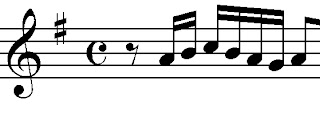
because right after them come this group of notes

which is, of course, a sequence. The notes from the first example have been repeated beginning a step lower. And in the following case we also have a kind of repetition:

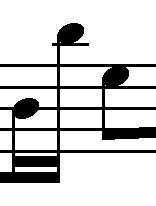
The only real activity, or movement, between the two groups is that the last note of the first group, the F#, has descended to an E at the end of the second group. There is thus, as there is so often, more apparent activity than there is actual activity. Most of the notes are simply holding place, and one of them is actually moving the musical line somewhere.
Repetition of some kind (complete or partial) is very important in most kinds of music and is an important indicator of musical "words." This appears to be a special, or at least more emphasized, quality of music, although it can exist in spoken words. My wife reminded me of that moments ago when, in preparing a poster for a conference at which she is presenting an academic paper, she referred to "little miniature" pictures adorning part of it. The two virtually identical adjectives are not necessary, of course, but in spoken English people often form redundancies because they apparently do not feel that one word of description is sufficient, that the moment is over too quickly if it is not made manifest through the use of more words to hold onto the significance of the phrase: a musical quality imported to spoken English.
So what is the benefit of all this? One does not necessarily create pauses between the groups of notes. One merely acknowledges their existence. But in doing so, a few things can happen. One is that in practice, and then later in performance, we are thinking in larger units and therefore do not have to constantly be coming to grips with new information, note by note. Our brains are calmer because we appear to be thinking more slowly because it will take longer for the fingers to spool out all of the information in a single impulse of our minds. Anyone who can read silently faster than they can out loud understands this phenomenon. There is a practical application to this: if you temporarily panic on the stage and lose your place, by the time your fingers have finished saying what you had already told them to say (your mind will be several notes ahead) you may have recovered your equilibrium and gotten back on track without any noticeable interruption in the music. The same holds true if you can't quite manage to get the page turned in time: any pause that is created by having to take a second swipe at the page, leaving the keyboard briefly unoccupied, will be between "words" and will appear to make sense. In other words, you will have paused where a pause might be welcome anyway. Any person who is fluent in this idea will always complete musical gestures in practice and thus will, even in case of an emergency, never stop in the midst of a phrase, for the simple idea that any phrase will never be started unless you see the end of it: all the notes are one unified block of information in your mind. Your fingers will not stumble in the middle, nor will there be rhythmic hesitancy except between groups, and that already will make you sound more competent, even if you are having a bad day at the keyboard.
Last week I posted a recording of a short piece I played at my church last week. It was a piece by the birthday boy Johann Ludwig Krebs, who turned 300 on or near October 12. I'll give you a chance to listen to it again, and remind you that this is not at all how I actually performed the piece. This is an attempt to make obvious some of the groupings of notes that I used to make the piece clearer both to me and my listeners. In trying to make that abundantly obvious, I made rather large pauses between some of the groups and really pounded out some parts to show where my ear was going at that point. In the actual performance, the pauses would have been much shorter (if they were there at all), to be replaced by at best slight breaks between some of the notes, and perhaps a very slight accelerando in some of the note groups. In other words, I would be much more subtle about everything. I don't want my listeners to get seasick!
listen
It was not such an easy thing to do on the fly, actually, but the point was that one should not get through even a line of music without a realization that some of the notes belong together the way some packets of sound belong together in a word, and that it is necessary, for reasons I'll elaborate on later, to make these judgments, even though doing so is usually an act of interpretation, since most composers are not so careful that they put slurs everywhere in their scores, or color code the notes that for them stand as a unit.
Then how to go about finding such units of notes? If there are rests on both sides of a bunch of notes, that seems like an obvious musical gesture, but what if there are no such markers? Well, in English, one often comes to an understanding of the value, or contribution, of a particular word to the overall meaning by the words that come after it. A preposition, for example, means little without a noun to go after it (into the......house.) And in music, this context is twice as important. I've grouped this particular batch of notes into a unit
because right after them come this group of notes
which is, of course, a sequence. The notes from the first example have been repeated beginning a step lower. And in the following case we also have a kind of repetition:
The only real activity, or movement, between the two groups is that the last note of the first group, the F#, has descended to an E at the end of the second group. There is thus, as there is so often, more apparent activity than there is actual activity. Most of the notes are simply holding place, and one of them is actually moving the musical line somewhere.
Repetition of some kind (complete or partial) is very important in most kinds of music and is an important indicator of musical "words." This appears to be a special, or at least more emphasized, quality of music, although it can exist in spoken words. My wife reminded me of that moments ago when, in preparing a poster for a conference at which she is presenting an academic paper, she referred to "little miniature" pictures adorning part of it. The two virtually identical adjectives are not necessary, of course, but in spoken English people often form redundancies because they apparently do not feel that one word of description is sufficient, that the moment is over too quickly if it is not made manifest through the use of more words to hold onto the significance of the phrase: a musical quality imported to spoken English.
So what is the benefit of all this? One does not necessarily create pauses between the groups of notes. One merely acknowledges their existence. But in doing so, a few things can happen. One is that in practice, and then later in performance, we are thinking in larger units and therefore do not have to constantly be coming to grips with new information, note by note. Our brains are calmer because we appear to be thinking more slowly because it will take longer for the fingers to spool out all of the information in a single impulse of our minds. Anyone who can read silently faster than they can out loud understands this phenomenon. There is a practical application to this: if you temporarily panic on the stage and lose your place, by the time your fingers have finished saying what you had already told them to say (your mind will be several notes ahead) you may have recovered your equilibrium and gotten back on track without any noticeable interruption in the music. The same holds true if you can't quite manage to get the page turned in time: any pause that is created by having to take a second swipe at the page, leaving the keyboard briefly unoccupied, will be between "words" and will appear to make sense. In other words, you will have paused where a pause might be welcome anyway. Any person who is fluent in this idea will always complete musical gestures in practice and thus will, even in case of an emergency, never stop in the midst of a phrase, for the simple idea that any phrase will never be started unless you see the end of it: all the notes are one unified block of information in your mind. Your fingers will not stumble in the middle, nor will there be rhythmic hesitancy except between groups, and that already will make you sound more competent, even if you are having a bad day at the keyboard.
Friday, October 11, 2013
Scenes from Adolescence
In November of 1984, 29 years ago next month, I played the organ in church for the first time. The regular organist for our little white church with a steeple was out having a baby. It was supposed to be a two week stint but turned into four after there were complications. I had achieved the grand old age of 13 and had a bit of trouble reaching the pedals, but no matter.
After that I served as a substitute organist to a lot of different churches of various denominations. In the Catholic church I had to sing and figure out which prayer the priest was using. For the Baptists it was enough to raise the roof with an enthusiastic pianistic shout. The Lutherans had their own set of doxologies and prayer responses. And of course the Methodists had more potluck dinners.
Back then there weren't a lot of musical resources available to me. I think I owned maybe two books of organ music, one of which purported to be the music of J. S. Bach, whom everybody's heard of whether they want to, or are able to, play his music or not. I wonder now where that book has gotten to.
Our local music store had things like Mel Bay's Big Note Guitar Method and possibly Mozart's Greatest Hits, but not a lot of organ music. Eventually my mother and I would go up to a large music store an hour away in the city.
But for now it was that little, very edited, book, which contained Eight Little Preludes and Fugues, topped off, I think, with the Little G Minor Fugue. I was pretty lazy, so I didn't bother learning the Fugues, which were harder, and besides, as I mentioned, I couldn't reach the pedals very well anyhow. So I played the things that were easy and required less coordination.
Boy was that a different era.
The little town where I grew up has become a sprawling endless burb and vast resources are available on that newfangled internet thing to anybody regardless of how small their community and I am now completely on the other side of college where I learned to discipline my mind and gained a pretty serious technical command of the instrument--the piano, anyhow, and later on, the organ. It was a long time ago, in a village far, far away.
And yet, here I am again. This week I made a recording of two of those little pieces that might well have been the first things I played on the organ as barely a teenager. I learned the fugues this time, too. I'm quite sure I played them significantly better than I did then, also. I certainly practiced them with more focus. The Fugues are a bit trickier than I would have thought but I still could get them licked in an hour or less.
I wasn't really planning on visiting the past like this. I assumed that past era and its repertoire was gone. I wasn't sure an organist who takes on large works of Widor and Vierne should even be playing these "little" preludes and fugues. But this week is the 300th anniversary of the birth of Johann Ludwig Krebs and I decided to go on another of my musical investigations into a composer I didn't know and it turns out that those 8 Little Preludes and Fugues by J. S. Bach might not be by J. S. Bach after all. Some scholars think, or thought, that they might have been written by Krebs. At the moment, I'm inclined to that opinion myself. I'll explain why in another post.
For now, I'll offer up a bit of the distant past as I experienced it. Pieces that are often among the first for young organists to tackle. It is kind of nice to get around to playing those fugues finally! And I do plan to play all eight of them this time. It's as though I'm finally injecting discipline and method that nobody grounded me in when I was growing up in that little village, playing on old uprights and small electronic organs. I'm finally finishing something I started a long time ago. It's been interesting visiting the past that way. Remembering the circumstances of life at the time, and rediscovering, or just discovering, the music. My entire orientation toward music and everything else has changed in the meantime.
I don't think these are masterpieces, but some of them are not too bad. There are awkward things in them, but they have some nice moments as well. I like them less now than I did then, but I've also found more to appreciate about them because I have a richer understanding of music in general. So I'll save my detailed appraisal of the pieces for another time. Besides, I don't want to be unkind toward Mr. Krebs on his birthday.
I like the fugues the best now. Is there any hope for me?
Prelude and Fugue in F
Prelude and Fugue in G Minor
After that I served as a substitute organist to a lot of different churches of various denominations. In the Catholic church I had to sing and figure out which prayer the priest was using. For the Baptists it was enough to raise the roof with an enthusiastic pianistic shout. The Lutherans had their own set of doxologies and prayer responses. And of course the Methodists had more potluck dinners.
Back then there weren't a lot of musical resources available to me. I think I owned maybe two books of organ music, one of which purported to be the music of J. S. Bach, whom everybody's heard of whether they want to, or are able to, play his music or not. I wonder now where that book has gotten to.
Our local music store had things like Mel Bay's Big Note Guitar Method and possibly Mozart's Greatest Hits, but not a lot of organ music. Eventually my mother and I would go up to a large music store an hour away in the city.
But for now it was that little, very edited, book, which contained Eight Little Preludes and Fugues, topped off, I think, with the Little G Minor Fugue. I was pretty lazy, so I didn't bother learning the Fugues, which were harder, and besides, as I mentioned, I couldn't reach the pedals very well anyhow. So I played the things that were easy and required less coordination.
Boy was that a different era.
The little town where I grew up has become a sprawling endless burb and vast resources are available on that newfangled internet thing to anybody regardless of how small their community and I am now completely on the other side of college where I learned to discipline my mind and gained a pretty serious technical command of the instrument--the piano, anyhow, and later on, the organ. It was a long time ago, in a village far, far away.
And yet, here I am again. This week I made a recording of two of those little pieces that might well have been the first things I played on the organ as barely a teenager. I learned the fugues this time, too. I'm quite sure I played them significantly better than I did then, also. I certainly practiced them with more focus. The Fugues are a bit trickier than I would have thought but I still could get them licked in an hour or less.
I wasn't really planning on visiting the past like this. I assumed that past era and its repertoire was gone. I wasn't sure an organist who takes on large works of Widor and Vierne should even be playing these "little" preludes and fugues. But this week is the 300th anniversary of the birth of Johann Ludwig Krebs and I decided to go on another of my musical investigations into a composer I didn't know and it turns out that those 8 Little Preludes and Fugues by J. S. Bach might not be by J. S. Bach after all. Some scholars think, or thought, that they might have been written by Krebs. At the moment, I'm inclined to that opinion myself. I'll explain why in another post.
For now, I'll offer up a bit of the distant past as I experienced it. Pieces that are often among the first for young organists to tackle. It is kind of nice to get around to playing those fugues finally! And I do plan to play all eight of them this time. It's as though I'm finally injecting discipline and method that nobody grounded me in when I was growing up in that little village, playing on old uprights and small electronic organs. I'm finally finishing something I started a long time ago. It's been interesting visiting the past that way. Remembering the circumstances of life at the time, and rediscovering, or just discovering, the music. My entire orientation toward music and everything else has changed in the meantime.
I don't think these are masterpieces, but some of them are not too bad. There are awkward things in them, but they have some nice moments as well. I like them less now than I did then, but I've also found more to appreciate about them because I have a richer understanding of music in general. So I'll save my detailed appraisal of the pieces for another time. Besides, I don't want to be unkind toward Mr. Krebs on his birthday.
I like the fugues the best now. Is there any hope for me?
Prelude and Fugue in F
Prelude and Fugue in G Minor
Monday, October 7, 2013
The Big 3 - 0....0.
Johann Ludwig Krebs turns 300 years old sometime this week.
Are you wondering who that is? (Hey, if there's cake, don't ask....)
Mr. Krebs was a student of a fellow named Johann Sebastian Bach. If you haven't at least heard of Mr. Bach I assume you've been living in a cave or were raised by wolves or both. Or that the aliens just put you back. Krebs, on the other hand, appears to have had some difficulty in securing recognition in life, on his way to becoming a composer whose name I had seen before in my reading but whose music I had never played until a couple of weeks ago when fellow organist and blogger Vidas Pinkevicius mentioned the upcoming anniversary. So don't feel too bad if the name doesn't ring bells for you.
Besides, that means I can introduce you to something new. In the process of investigating Mr. Krebs' legacy I can currently share with you several pieces based on Lutheran Chorale melodies which one generally assumes were written in connection with Krebs' job as a church organist. Krebs himself had a good bit of difficulty getting such a job, according to The Wikipedia, which I shamefacedly confess has been my only source of research to this point. When he actually did get a job, he got paid only in food to feed his family, in lieu of an actual salary. (By the way, getting part of your salary in foodstuffs was actually quite common at the time, although there was generally also a reasonable amount of money involved as well.)
Since I myself am a church organist, and with better luck than Mr. Krebs, apparently, in that I have a job and it pays actual money, I've chosen to play a handful of these works in my church over the next couple of weeks. I've also done what might seem like an odd thing and gone and prepared these works to perform on the piano. Since Monday is generally a day for listening to piano music on this blog that makes it just about perfect.
But why the piano? The beast was only invented about 1700. That means that Krebs probably had heard of one, and may have seen one (his teacher, Bach, tested an early prototype, and later on became a kind of sales rep for an associate who built them), but it's not very likely that he had one at home or was thoroughly acquainted with this newfangled instrument. Besides, these pieces are liturgical in nature, probably meant for church, and that means the organ, because in Europe in the 18th century pianos certainly did not live in churches.
Well, about that....being the impatient type, and with a lot to do these days, I found some scores at everybody's favorite website, the International Score Library Project, printed them out, and, being at home at the time, promptly went to my piano to try them out rather than waiting until I got to church. The first thing I noticed is that they don't have a pedal part. And that they can be played rather easily on one keyboard, so they work very well on the piano. They also sound very nicely on a piano. I wondering if they would perhaps not sound so nicely on the organ. There are some rolled chords and other types of writing that make me wonder, even though I haven't tried them that way yet.
So I wonder, in my non professional-musicologist, not-completely-up-to-speed-on-all-the Krebs-literature way, whether they were in fact intended for the harpsichord, because in my mind's ear they would sound quite well on the that instrument, and also because if Mr. Krebs didn't hold a church position for a good portion of his life, that would mean he didn't have regular access to an organ, a predicament I have grown to appreciate through my wanderings on the web and the comments I have read therein. Did he have difficulty conceiving music that took advantage of this rather unique king of instruments, or did he want something he could play on instruments he had access to? (By the way, the rather secular-minded non-organist-virtuoso Telemann also did not seem too wrapped up in conceiving his chorale-based pieces for the organ, although they do steer clear of specifically non-organistic things; they simply have no pedal parts and are short and uninvolved.)
These speculations will lead me to a rather unpopular conclusion in another week or so when I discuss the provenance of a set of short Preludes and Fugues I'll be playing the last week of October. But we'll cross that bridge when we get there. For now, here are a few very nice pieces by that student of Bach. Notice the chorale tune doesn't figure prominently at all in some of them. In others, those that seem to have two parts (most of them actually have three parts in the score, but in some cases I am only playing the first, and in others the first two, parts) a solemn, quarter note melody comes in only in the second verse. In the third part, the hymn tune is played like it would be sung in church. I wonder why he did that. At any rate, you can enjoy the music without being steeped in the tunes.
Krebs: selections from the first part of his Klavier Ubung (Keyboard Notebook):
Sei Lob und Ehr dem hochsten Gut Praise and Honor be to the Most High
Vater unser im Himmelreich Our Father in Heaven
Was Gott tut, das ist wohlgetan What God does is done well
Jesu, meine Freude Jesus my Joy
Are you wondering who that is? (Hey, if there's cake, don't ask....)
Mr. Krebs was a student of a fellow named Johann Sebastian Bach. If you haven't at least heard of Mr. Bach I assume you've been living in a cave or were raised by wolves or both. Or that the aliens just put you back. Krebs, on the other hand, appears to have had some difficulty in securing recognition in life, on his way to becoming a composer whose name I had seen before in my reading but whose music I had never played until a couple of weeks ago when fellow organist and blogger Vidas Pinkevicius mentioned the upcoming anniversary. So don't feel too bad if the name doesn't ring bells for you.
Besides, that means I can introduce you to something new. In the process of investigating Mr. Krebs' legacy I can currently share with you several pieces based on Lutheran Chorale melodies which one generally assumes were written in connection with Krebs' job as a church organist. Krebs himself had a good bit of difficulty getting such a job, according to The Wikipedia, which I shamefacedly confess has been my only source of research to this point. When he actually did get a job, he got paid only in food to feed his family, in lieu of an actual salary. (By the way, getting part of your salary in foodstuffs was actually quite common at the time, although there was generally also a reasonable amount of money involved as well.)
Since I myself am a church organist, and with better luck than Mr. Krebs, apparently, in that I have a job and it pays actual money, I've chosen to play a handful of these works in my church over the next couple of weeks. I've also done what might seem like an odd thing and gone and prepared these works to perform on the piano. Since Monday is generally a day for listening to piano music on this blog that makes it just about perfect.
But why the piano? The beast was only invented about 1700. That means that Krebs probably had heard of one, and may have seen one (his teacher, Bach, tested an early prototype, and later on became a kind of sales rep for an associate who built them), but it's not very likely that he had one at home or was thoroughly acquainted with this newfangled instrument. Besides, these pieces are liturgical in nature, probably meant for church, and that means the organ, because in Europe in the 18th century pianos certainly did not live in churches.
Well, about that....being the impatient type, and with a lot to do these days, I found some scores at everybody's favorite website, the International Score Library Project, printed them out, and, being at home at the time, promptly went to my piano to try them out rather than waiting until I got to church. The first thing I noticed is that they don't have a pedal part. And that they can be played rather easily on one keyboard, so they work very well on the piano. They also sound very nicely on a piano. I wondering if they would perhaps not sound so nicely on the organ. There are some rolled chords and other types of writing that make me wonder, even though I haven't tried them that way yet.
So I wonder, in my non professional-musicologist, not-completely-up-to-speed-on-all-the Krebs-literature way, whether they were in fact intended for the harpsichord, because in my mind's ear they would sound quite well on the that instrument, and also because if Mr. Krebs didn't hold a church position for a good portion of his life, that would mean he didn't have regular access to an organ, a predicament I have grown to appreciate through my wanderings on the web and the comments I have read therein. Did he have difficulty conceiving music that took advantage of this rather unique king of instruments, or did he want something he could play on instruments he had access to? (By the way, the rather secular-minded non-organist-virtuoso Telemann also did not seem too wrapped up in conceiving his chorale-based pieces for the organ, although they do steer clear of specifically non-organistic things; they simply have no pedal parts and are short and uninvolved.)
These speculations will lead me to a rather unpopular conclusion in another week or so when I discuss the provenance of a set of short Preludes and Fugues I'll be playing the last week of October. But we'll cross that bridge when we get there. For now, here are a few very nice pieces by that student of Bach. Notice the chorale tune doesn't figure prominently at all in some of them. In others, those that seem to have two parts (most of them actually have three parts in the score, but in some cases I am only playing the first, and in others the first two, parts) a solemn, quarter note melody comes in only in the second verse. In the third part, the hymn tune is played like it would be sung in church. I wonder why he did that. At any rate, you can enjoy the music without being steeped in the tunes.
Krebs: selections from the first part of his Klavier Ubung (Keyboard Notebook):
Sei Lob und Ehr dem hochsten Gut Praise and Honor be to the Most High
Vater unser im Himmelreich Our Father in Heaven
Was Gott tut, das ist wohlgetan What God does is done well
Jesu, meine Freude Jesus my Joy
Subscribe to:
Posts (Atom)