Some time ago I observed that people tend to value the spontaneous because they believe that to be more sincere. As long as something appears to be not to have been particularly premeditated, it has more value for a large number of us than something that seems to be well artistically manicured. In which case, there are a number of recordings on Pianonoise right now that ought to get kudos for not having the pale cast of premeditated thought sicklied over them.
That's because I often just do not have any doggone time.
The present recording, presented for your listening pleasure, is something that I just set eyes on this morning [which technically was last Thursday when I wrote this!]. I sight read it once, then turned on the microphone and played it twice. Then I discovered that yours truly had brilliantly failed to connect one of the microphone cables to the microphone itself, which, as genius as that sort of nonconformity might appear, nevertheless does not give us very good stereo. The microphone does not appreciate genius, in other words. So I plugged in the cable and did two more takes the regular way.
By this point I was on play-throughs numbers four and five, which I suppose made me an expert, but I still hadn't known the piece for more than twenty minutes by the time I was finished. In circumstances like that, one's reaction to a piece of music is just that--a gut reaction. The interpretation has to be, well, nearly spontaneous.
Hoping that you have some sort of way to keep chronological time with this recording, I'm going to point out something that happens at the 27 second mark: a slight hesitation on my part, and a flagging of the tempo for the next few measures. This is because I found it a little odd that Mr. Telemann was taking this little harmonic excursion. It seemed as though the music were leading us in one direction and then, without really preparing us for it, he decided to look at some harmonic flowers by the side of the road. So I pointed this out by taking my time there also.
I could be wrong; also I could change my mind about it later. But I didn't have any time to reconsider, so, if you are into honest reactions to things you haven't had time to think about, here you go. And at the moment, I still think it was the right thing to do. The question, I suppose, is does this interpretive decision get the point across adequately. And was this Mr. Telemann's point to begin with. I can't ask him since he's been dead for 250 years.
Because of my sense of how harmonic language is constructed and what constitutes the normal and the abnormal, it seemed to me there was a little surprise on the page waiting for me when I got there. And for all of the words I'm throwing at it, the result is really more emotional than logical. It is, in a word: surprise! You weren't expected that, were you?
Which is one of things that makes life fun.
[listen]
Showing posts with label grouping. Show all posts
Showing posts with label grouping. Show all posts
Monday, April 21, 2014

Wednesday, October 30, 2013
Some more haphazard thoughts about grouping
For the past four weeks I've been fixated on the concept of grouping notes together. To sum up, this is important for both the learning process and for the understanding and communication of music. You've got to take a breath somewhere! but....
Grouping is not the same as phrasing. Groups of notes are usually in smaller packages than phrases, and function more like words or phrases in English than sentences, which might be the equivalent of a musical phrase. They are smaller units. And one doesn't necessarily "breathe" after each group. However...
One needs to be able to breathe mentally. That is, you have to make a mental break between those groups, understanding them as separate units of music. Within those groups, however, it is important not to make breaks.
Here is something from a recording I made yesterday...
listen
Notice how the last three chords sound like one group. They even feel like one group, with a forward momentum that carries them through with one gesture. While my fingers have to play and release, moving up and down three times, my arm is moving forward only once, unifying the disparate motions of my fingers so that to me this entire grouping feels like one motion--toward the piano. This is the physical, technical side of grouping. The audience hears this as well, which makes aural interpretation much easier, since the mountain of material has already been sorted and grouped. It also makes it, in this case, more exciting to listen to, because the contents seem alive. Now I'll play you the whole passage. The musical selection itself will come next week!
listen
Finally, being able to group is an invaluable aid in the learning process. I can remember a 7-digit phone number much more easily if I group it into chunks of 3 and 4 digits. And while a seven digit number has been shown to be a limit for our immediate memory, there are no such limits for our long term capacity, however "Whereas a chain of letters like CBSMTVIRSSUVTNT might be difficult for labile memory to hang onto, once the letters are chunked into CBS-MTV-IRS-SUV-TNT, the task becomes much easier, and what would never have made it into stable memory has a greater chance of consolidating." point out four brilliant authors of "Individual and Collective Memory Consolidation" Anastasio, Ehrenberger, Watson, Zhang, 2012). Full disclosure: one of these brilliant authors is Mrs. Pianonoise.
In the example above, it turns out that chunking the information into 3-digit pieces produces recognizable acronyms. However, in musical interpretation, different players may come to quite different results. (How about if I group them so they all rhyme? CB-SMT-VIRSSUV-TNT! works as a cheer--has a nice chanting rhythm to it--and as a young person I may not recognize CBS anyhow!) Generally, however, the chunks are fairly short, sometimes they overlap (thus the final note of one may also be the beginning of the other) and they can often be found because of some relation they have with the preceding or succeeding material (such as a pure repetition, a sequence, some kind of development, or the start of a new chain of similar cells). Chunking is fun, chunking is a necessity, it is a way of life. It brings order to disparate elements, and ease of understanding. It separates professionals from amateurs, skilled interpreters from people who are just playing notes and don't sound like they know what they are musically "talking" about.
It is strange people didn't spend time talking about this at the conservatory. Still, you can hear an element of this in the practice room, as people take small bits of pieces and play them over and over in order to acquaint their fingers, wrists and arms with their routes. If the mind is engaged in the process, all the better. And all the difference.
Wednesday, October 16, 2013
Attack of the blobs
The last two Wednesdays we've been talking about musical interpretation in terms of groupings of notes on the page: the importance of recognizing such groups, whether or not the composer has given you some visual device such as a slur to band them together, and have just started to explore how that understanding can be of use to you as a performer.
Last week I posted a recording of a short piece I played at my church last week. It was a piece by the birthday boy Johann Ludwig Krebs, who turned 300 on or near October 12. I'll give you a chance to listen to it again, and remind you that this is not at all how I actually performed the piece. This is an attempt to make obvious some of the groupings of notes that I used to make the piece clearer both to me and my listeners. In trying to make that abundantly obvious, I made rather large pauses between some of the groups and really pounded out some parts to show where my ear was going at that point. In the actual performance, the pauses would have been much shorter (if they were there at all), to be replaced by at best slight breaks between some of the notes, and perhaps a very slight accelerando in some of the note groups. In other words, I would be much more subtle about everything. I don't want my listeners to get seasick!
listen
It was not such an easy thing to do on the fly, actually, but the point was that one should not get through even a line of music without a realization that some of the notes belong together the way some packets of sound belong together in a word, and that it is necessary, for reasons I'll elaborate on later, to make these judgments, even though doing so is usually an act of interpretation, since most composers are not so careful that they put slurs everywhere in their scores, or color code the notes that for them stand as a unit.
Then how to go about finding such units of notes? If there are rests on both sides of a bunch of notes, that seems like an obvious musical gesture, but what if there are no such markers? Well, in English, one often comes to an understanding of the value, or contribution, of a particular word to the overall meaning by the words that come after it. A preposition, for example, means little without a noun to go after it (into the......house.) And in music, this context is twice as important. I've grouped this particular batch of notes into a unit
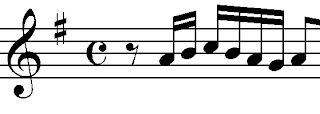
because right after them come this group of notes

which is, of course, a sequence. The notes from the first example have been repeated beginning a step lower. And in the following case we also have a kind of repetition:

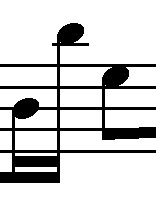
The only real activity, or movement, between the two groups is that the last note of the first group, the F#, has descended to an E at the end of the second group. There is thus, as there is so often, more apparent activity than there is actual activity. Most of the notes are simply holding place, and one of them is actually moving the musical line somewhere.
Repetition of some kind (complete or partial) is very important in most kinds of music and is an important indicator of musical "words." This appears to be a special, or at least more emphasized, quality of music, although it can exist in spoken words. My wife reminded me of that moments ago when, in preparing a poster for a conference at which she is presenting an academic paper, she referred to "little miniature" pictures adorning part of it. The two virtually identical adjectives are not necessary, of course, but in spoken English people often form redundancies because they apparently do not feel that one word of description is sufficient, that the moment is over too quickly if it is not made manifest through the use of more words to hold onto the significance of the phrase: a musical quality imported to spoken English.
So what is the benefit of all this? One does not necessarily create pauses between the groups of notes. One merely acknowledges their existence. But in doing so, a few things can happen. One is that in practice, and then later in performance, we are thinking in larger units and therefore do not have to constantly be coming to grips with new information, note by note. Our brains are calmer because we appear to be thinking more slowly because it will take longer for the fingers to spool out all of the information in a single impulse of our minds. Anyone who can read silently faster than they can out loud understands this phenomenon. There is a practical application to this: if you temporarily panic on the stage and lose your place, by the time your fingers have finished saying what you had already told them to say (your mind will be several notes ahead) you may have recovered your equilibrium and gotten back on track without any noticeable interruption in the music. The same holds true if you can't quite manage to get the page turned in time: any pause that is created by having to take a second swipe at the page, leaving the keyboard briefly unoccupied, will be between "words" and will appear to make sense. In other words, you will have paused where a pause might be welcome anyway. Any person who is fluent in this idea will always complete musical gestures in practice and thus will, even in case of an emergency, never stop in the midst of a phrase, for the simple idea that any phrase will never be started unless you see the end of it: all the notes are one unified block of information in your mind. Your fingers will not stumble in the middle, nor will there be rhythmic hesitancy except between groups, and that already will make you sound more competent, even if you are having a bad day at the keyboard.
Last week I posted a recording of a short piece I played at my church last week. It was a piece by the birthday boy Johann Ludwig Krebs, who turned 300 on or near October 12. I'll give you a chance to listen to it again, and remind you that this is not at all how I actually performed the piece. This is an attempt to make obvious some of the groupings of notes that I used to make the piece clearer both to me and my listeners. In trying to make that abundantly obvious, I made rather large pauses between some of the groups and really pounded out some parts to show where my ear was going at that point. In the actual performance, the pauses would have been much shorter (if they were there at all), to be replaced by at best slight breaks between some of the notes, and perhaps a very slight accelerando in some of the note groups. In other words, I would be much more subtle about everything. I don't want my listeners to get seasick!
listen
It was not such an easy thing to do on the fly, actually, but the point was that one should not get through even a line of music without a realization that some of the notes belong together the way some packets of sound belong together in a word, and that it is necessary, for reasons I'll elaborate on later, to make these judgments, even though doing so is usually an act of interpretation, since most composers are not so careful that they put slurs everywhere in their scores, or color code the notes that for them stand as a unit.
Then how to go about finding such units of notes? If there are rests on both sides of a bunch of notes, that seems like an obvious musical gesture, but what if there are no such markers? Well, in English, one often comes to an understanding of the value, or contribution, of a particular word to the overall meaning by the words that come after it. A preposition, for example, means little without a noun to go after it (into the......house.) And in music, this context is twice as important. I've grouped this particular batch of notes into a unit
because right after them come this group of notes
which is, of course, a sequence. The notes from the first example have been repeated beginning a step lower. And in the following case we also have a kind of repetition:
The only real activity, or movement, between the two groups is that the last note of the first group, the F#, has descended to an E at the end of the second group. There is thus, as there is so often, more apparent activity than there is actual activity. Most of the notes are simply holding place, and one of them is actually moving the musical line somewhere.
Repetition of some kind (complete or partial) is very important in most kinds of music and is an important indicator of musical "words." This appears to be a special, or at least more emphasized, quality of music, although it can exist in spoken words. My wife reminded me of that moments ago when, in preparing a poster for a conference at which she is presenting an academic paper, she referred to "little miniature" pictures adorning part of it. The two virtually identical adjectives are not necessary, of course, but in spoken English people often form redundancies because they apparently do not feel that one word of description is sufficient, that the moment is over too quickly if it is not made manifest through the use of more words to hold onto the significance of the phrase: a musical quality imported to spoken English.
So what is the benefit of all this? One does not necessarily create pauses between the groups of notes. One merely acknowledges their existence. But in doing so, a few things can happen. One is that in practice, and then later in performance, we are thinking in larger units and therefore do not have to constantly be coming to grips with new information, note by note. Our brains are calmer because we appear to be thinking more slowly because it will take longer for the fingers to spool out all of the information in a single impulse of our minds. Anyone who can read silently faster than they can out loud understands this phenomenon. There is a practical application to this: if you temporarily panic on the stage and lose your place, by the time your fingers have finished saying what you had already told them to say (your mind will be several notes ahead) you may have recovered your equilibrium and gotten back on track without any noticeable interruption in the music. The same holds true if you can't quite manage to get the page turned in time: any pause that is created by having to take a second swipe at the page, leaving the keyboard briefly unoccupied, will be between "words" and will appear to make sense. In other words, you will have paused where a pause might be welcome anyway. Any person who is fluent in this idea will always complete musical gestures in practice and thus will, even in case of an emergency, never stop in the midst of a phrase, for the simple idea that any phrase will never be started unless you see the end of it: all the notes are one unified block of information in your mind. Your fingers will not stumble in the middle, nor will there be rhythmic hesitancy except between groups, and that already will make you sound more competent, even if you are having a bad day at the keyboard.
Wednesday, October 9, 2013
Grouping
Last week I suggested that in order to make music effectively we need to know how to group notes into musical gestures. In searching for an example, we compared musical interpretation to the way we interpret words on a page if we say them out loud. This analogue actually lead to two rather different insights.
The first, rather basic, is that small packets of information are grouped together in English as well as in music. Letters grouped together become words. Words grouped together become sentences. Being adept at recognizing words and groups of words quickly makes reading significantly easier then if we were forced to come to terms with e a c h l e t t e r a s a s e p a r a t e t h i n g.
Besides helping to increase fluency, these packets of information rely on grouping for some of their impact. In other words, where you put the information has some bearing on its meaning.
But our little example led inadvertently to something else. Noting that when we read we often lump some words together, such that a non-native English speaker might think we were saying one very long word when in fact it was two or three short ones with no space in between, and that we sometimes pause where no visual indication is given, such as a comma or period, we found that in fact, sometimes an oral interpreter does Not parse elements the way they are presented on a page.
This is a particularly useful insight for music because of the methodically metrical way it is written. In English some words are longer than others; sentences and paragraphs are often unequal. But in music, measures are usually the same length, and notes are grouped together into beats or groups of two or three beats, and these groups are pretty consistently of the same time value. Looking at a page of music we might conclude from the well-trimmed sameness which which a row of consistently distributed sixteenth notes greets us that it was balance that was most important in music, not forward momentum. Stasis.
In fact, publishers go to some trouble to preserve the "aisles" between beats. Let's suppose a sixteenth is followed by an eighth note and another sixteenth. That's one beat grouping, in which the notes are all beamed together, with a break before the next beat. Suppose the second beat is identical to the first. Now imagine that the last sixteenth of the first group is tied to the first sixteenth of the last group. Why? Since the two sixteenths together add up to an eighth why not simply write an eighth note?
In this and many similar cases, the reason something is notated one way and not another, often necessitating ties rather then simply putting a longer note in there, is that this way one can easily spot the division between beat groups. It makes reading that rhythm much easier because you can always located the pulse at the beginning of the next grouping rather than in the middle of some note in the middle of a group. You can practically see it on the page.
However, when we perform we often work against that visual representation. I remember a teacher at the conservatory taking a pencil and re-beaming part of a Beethoven Sonata so that the last three of a group of four sixteenths was beamed to the first note of the next group, then the last three of the next hooked to the start of the following group and so on. The point was to subtly propel forward into the next beat, to keep the music moving, which meant actually rethinking the way the music was written.
Leon Fleischer once made a colleague of mine laugh (he often did at Mr. Fleischer's remarks) by suggesting that music should be written on toilet paper....(pause for effect, glasses on head)...so that it could be unrolled gradually.
You could write it on a scroll, too, but that image just wouldn't be arresting enough to remember years later.
Considering how many divisions there are on a page, it shouldn't surprise that radical countermeasures might be needed. Every 2 or four beats we have a huge vertical slash breaking the music into bits, every beat group is kept separate, full chords often stack the notes high and make us forget the horizontal axis, all working against that forward momentum needed to make the music go somewhere and make us want to ask where.
But you'll notice that that teacher of mine from the conservatory still broke the notes into groups, it just wasn't at the beat but after it. The idea, I think, is not to take actual liberty with the tempo (or none that is very noticeable) but to allow for a mental break--chunking the information, which is vital to the performer's comprehension of the piece, and also crucial to helping the audience "get" the flow of the piece. To give you an example, I've posted a little piece by our Birthday composer (Mr. Johann Friederich Krebs turns 300 this week) in which I make little pauses between groups of notes that I am thinking of as music units--musical words, perhaps. The gaps between the words are larger than I would make in an actual performance, and are designed simply to show how one might break up a piece into little components for understanding, for practice, and to be able to control the movement of the piece. Here it is:
Krebs: Our Father in Heaven
Next time I'll discuss this bit of strategy in more detail.
Subscribe to:
Posts (Atom)