Showing posts with label analysis. Show all posts

Friday, February 12, 2016

simplicity itself

This is the 5th part of the Flashy French Organ Toccata series which normally runs on Mondays. I'm putting it here (and interrupting our normally scheduled Friday series on Changing the Culture in Your Church) so I can run a special, more personal article this Monday. 

"Beyond the obvious facts that he has at some time done manual labour, that he takes snuff, that he is a Freemason, that he has been in China, and that he has done a considerable amount of writing lately, I can deduce nothing else."

Mr. Jabez Wilson started up in his chair...."How in the name of good fortune, did you know all that, Mr. Holmes?" he asked. "How did you know, for example, that I did manual labour..."

"Your hands, my dear sir. Your right hand is quite a size larger than your left. You have worked with it, and the muscles are more developed."

"Well, the snuff, then and the Freemasonry?"

"I won't insult your intelligence by telling you how I read that, especially as, rather against the rules of your order, you use an arc and compass breastpin."

"Ah, of course, I forgot that. But the writing?"

"What else can be indicated by that right cuff so very shiney for five inches, and the left one with the smooth patch near the elbow where you rest it upon the desk."....

Mr. Jabez laughed heartily. "Well, I never!" said he. "I thought at first that you had done something clever, but I see that there was nothing in it after all."

"I begin to think, Watson," said Holmes, "that I make a mistake in explaining...."

--The adventures of Sherlock Holmes, "The Redheaded League" by Arthur Conan Doyle

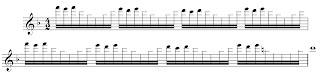
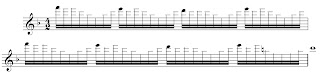
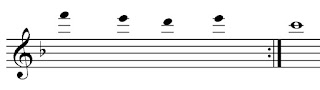
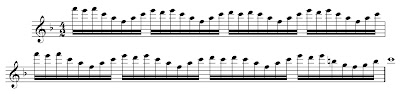
Last week I made the mistake of showing just how simple an outline Charle-Marie Widor used in his famous Toccata. It sounds like a sea of notes, a welter of sounds, a vast managerie of tones, but in the end, they can all be traced back to a very simple three-notes down, two-notes-back-up, repeat, end on a C, chant-like melody. The rest is harmonic filling in.

Strangely, it was not one of my most popular blogs, which didn't really surprise me, as I had opined at the time that people often don't care to know how something is done, or to have it simplified for them, thus apparently removing the mystery, or perhaps the charm of ignorance. Show them how such a piece is put together, separate the elements and explain how they were manipulated to produce a final result, and the response is 'is that all? Well, any idiot could have done that!' which is not true, actually, because idiots don't do that.

Why? Perhaps because simplicity isn't as simple as it seems. Certainly the discipline required to create a simple but powerful outline and then to flesh it out in an interesting way is rare. It requires a kind of compositional control few have.  And, of course, you have to have plenty of craft, which requires the ability to spend little time figuring out the details (because those are easy) and concentrate mainly on the heart of the matter, which is creating the structure. The rest, as movie Amadeus said, is just "scribbling and bibbling!"

If you ever plan to write a toccata yourself--at least, a good toccata, this kind of understanding is quite necessary, but it is also essential if you are a performer with only a few days to learn one. I usually find that toccatas of this sort only take a day or two to learn and are much easier than I had supposed. This is certainly handy if you are on a deadline (which is perpetually true in my case) but it is also a help for the impatient person who doesn't want to spend six months learning the Widor toccata.

As for the listener, how does this strange combination of simplicity and apparent complexity work its magic? Do we somehow, whether we know it or not, sense the outlines, or at least realize the simple elements in the constant repetition, uninterrupted babble of notes, or steady increase in volume? And does the spray of pitches then not seem like an incomprehensible, messy reality, but a welcome, dazzling effect? Somehow, these pieces, fast, loud, full of glittering detail but simple of construction, have held a mesmerizing effect on many a listener. An organist who plays them knows they have a very high yield in admiration, particularly because if you understand the fundamental makeup they do not take long to learn and yet the organist is seldom as popular as after playing the Widor toccata, or something similar.

I'll leave you with another example of a toccata I forgot about when I opened the series. It is a charming little number by Pietro Yon, known best for composing "Jesu, Bambino." This is a toccata for what he calls the "primitive organ" which means the use of only one flute stop. It is the only quiet toccata you are likely to hear, but it bubbles over with joy and good humor, which is also in Mr. Yon's long title. Toward the end (right before the return to the opening theme) there is a pause you can drive a truck through, and somebody outside our church unfortunately did, though you won't notice unless you've turned the volume way up or are listening through headphones.

Enjoy!

Yon: Humoresque "L'Organo Primitivo" (Toccatina for Flute)

----
p.s. Pietro Yon was an Italian who emigrated to the U.S. so I suppose the above doesn't qualify as a flashy french toccata--except by musical ancestry, which is really what matters.

Monday, February 8, 2016

The Gift to be Simple

If there is anything that is obvious to the average listener of these Flashy French organ toccatas, it's that they have a lot of notes, and those notes go by fast. I'm going to use my powers of musical deduction now to leave you as un-impressed as possible. Far from convincing you that I am using musical magic to get my fingers to move that fast, I want to slow down the musical maelstrom and show you the outline behind those notes. We're going to do it in steps, by a kind of musical subtraction, taking away the superfluous notes a step at a time.


Here is, for instance, a bit of the Widor toccata. First you'll hear the opening bars of the right hand just as Widor wrote it,  using just a couple of  flute stops (already less impressive, isn't it? The volume is part of the piece's aura). Then I'm going to "subtract" the notes that do not change from group to group--that's most of them. The ones that are left in each group--three of them--, I'm going to play loudly on one manual, and for now you'll still be able to hear the remaining five notes in each group, played softly.


Now, Since the second note of that remaining group of three loud notes note is simply the lower neighbor tone and the third note is a repeat of the first note, I'll take those two notes away also and only play the first note of the entire group loudly, and the rest softly.


After that, I won't play the remaining notes at all. Now all the notes have disappeared except the backbone of the phrase.


The last thing I did was to play that nine note tune in the pedals, which is actually what Widor himself does with it shortly after, and again at the triumphant return two-thirds of the way through the piece. The left hand, as it happens, also echoes this little tune. It's just three notes down, two back up to where we started, back down, back up, and a final C. And even that, it turns out, is the same thing twice. The first eight notes are really just four notes repeated with a C on the end.

Now let's listen to the entire process I've just described, with the subtractions done one at a time. It is a bit like listening to a "Cheshire toccata" with bits of it dispersing until only the grin is left.


That's right, the whole opening phrase--the whole piece, really--reduces to four notes.

Not that the other notes don't matter, of course. Music theorist Heinrich Schenker once showed pianist Arthur Schnabel his system for finding the most important notes in a piece of music. Under his system (unlike what I just did) entire pieces reduce to just a few structurally important notes. Schnabel's comment upon seeing this was that "you've taken away all my favorite notes!"

Don't worry; we'll put them back. Those rapidly fleeting notes create a visceral excitement. And when that simply tune comes rolling through the pedals it is a even a physical challenge to play them. Widor places them in double octaves at the extreme ends of the pedal board, meaning a short man like me can barely get his legs parted wide enough to play them. It feels like trying to straddle the universe.

And it is the difference between something that could easily be chanted by monks and what appears to be an epic organ toccata.

And yet, that outline is there all the same. And for those who can hear it, much less write something like it, it is a way to organize all of that information, and to understand it. It does not make it less fascinating. After all, I'm sure the designer of the Taj Majal knew the basic principles of architecture, but still created a masterpiece out of these simple ideas. So it is with the Widor. We could go on studying the piece, and I could point out how the it breaks into sentences and paragraphs and repeats those four notes in different keys and modes, again and again, and by the end we could marvel at how something that ---well, childish, really--could add up to something so impressive.

Because that kind of simplicity isn't lazy or ignorant, or unable to be complicated. It is the sign of a master at work, organized, methodical, and yet able to provide flashes of insight, exploration, genius.

It is a gift.

------------

After I wrote this I learned that the French would like to KEEP all those extra notes--and letters--thank you very much! This article is from The Guardian about attempts to simplify the French language and the controversy it is causing in France.

Monday, July 14, 2014

1001 themes

From theory class to theory class, every professor who wants to be worth his salt always makes this brilliant observation: it's about economy of material.

A gifted composer, taking just four little notes (three of them the same) makes an entire symphonic movement out of just that little theme and no more. Hardly a note exists anywhere on those pages that can't be traced back to the main theme. That's economy.

It isn't easy to do, either. To constantly keep the 'purpose' in view, and not to just wander off whenever you can't concentrate anymore; furthermore, to be able to see a wealth of characteristic possibilities in such a tiny musical idea, to see it from all sides and envision it travelling in all directions: it's still what it was in the beginning, but it has also become something else.

Maybe the rhythm is kept, and the melody is changed. Or just one little interval. Or it's been turned upside down, played backwards, inside out, both upside down AND backwards, elongated, shortened, made to fit a new harmony, tried in a new register (high or low) or a new tone color (on the bassoon instead of the clarinet). It involved experimentation, and innovation, and yet at the same time, being able to never lose sight of that little theme.

It's an amazing way to compose.

Today's little sonata isn't about that method. At all.

Instead, Mr. Haydn pretty much gives us something new to think about every two measures, as if he couldn't stop coming up with new, incongruous little ideas, and festooning his happy little piece with them. Joy, profusion, excitement, and a complete lack of discipline. Which is really odd for Haydn, who is known for making his entire sonata movements be about ONE theme, when nearly everybody else, even the most gifted, would give it at least two.

And yet, eventually, during the traditional "development" section, our prodigious composer does develop a couple of themes. Most of his ideas come and go, replaced by others as fast as he can think of them. But a few stick around and begin to germinate into something else. All the more interesting, then, because the occasion for my recent performance of this work was a church service on the morning when the scripture lesson was Jesus' "parable of the sower." The sower scatters his seed indiscriminately, flinging them everywhere, and most of them fail to grow. But a few do, and produce an amazing crop. My very bright composition student, sitting behind me, caught on to this without my having to tell him.

I think Haydn must have had fun writing this, even if it isn't his best work. A few people pointed out afterward that I seemed to enjoy playing it. I think they enjoyed listening to it, too.

Now it's your turn.

Haydn: Sonata in G, Hob. 6: I. Allegro

Monday, January 13, 2014

New Year's Eve at the Virginia (part seven)

We now return to our regularly scheduled rag sonata, already in progress.

The last of the three movements of William Albright's "Grand Sonata in Rag" is modestly entitled "Ragtime Behemoth" and it is certainly a monster. Mr. Albright lets us know that right away, with this reference to Liszt's "Dante" Sonata. Dante's story of obsession obsessed 19th century composers, particularly the bit about making a pact with the devil (turns out to have been a bad idea; who knew?), and Liszt begins his sonata with a musical illustration based on the tritone, an interval so bizarre to Medieval minds they referred to it as "the devil in music."

[listen]

It gets the point across that something sinister is going to happen, doesn't it?

Now for Mr. Albright's version, which is simultaneously more diabolical and more fun at the same time:

[listen]

We can tell right away we are dealing with something a bit on the wild side. A Behemoth is not really a very nice animal, after all.

Then the composer takes us on a wild ride through something that sounds like it was made for the vaudeville stage. It starts out nicely enough; then it turns into this:

[listen]

Writing at least 75 years after ragtime began, Mr. Albright has the luxury of mixing, matching, and generally amplifying various influences and voices that we now know as ragtime, stride, jazz, novelty, even various references to Hollywoodish entertainment. I present for your inspection this little number from later in the piece, which somehow reminds me of the Dick van Dyke show:

[listen]

This is a long way from Scott Joplin's idea of dignified ragtime--clearly he's lost control, here! As entertaining as it is, The Monster seems to have won. This may be a "Ragtime" sonata, but ragtime purists will have started scratching their heads a long time ago.

But it isn't as if Bill Albright doesn't know his history--in fact, he's practically giving us a pellmell rundown on the whole thing in just a few minutes!

One of the trends in ragtime was for a pianist to take a well-known tune and "rag" it. Making even classical tunes, popular songs, whatever you could find, sound like ragtime. I recently demonstrated this at a party to general laughter when someone called out the tune for "Amazing Grace." Being able to do this on the spot was kind of a way of demonstrating your "chops." Another thing that ragtimers and popular entertainers ever since have done was to make fun of serious music by ragging it. And so, for the second time in the same evening (the first was when the writers of "The Girl in 14G" worked in a reference to "Tristan and Isolde") on the program was a bit of fun at Richard Wagner's expense. Richard Wagner was a composer so serious that even other serious composers like to make fun of him, which tells you something!

Anyhow, listen to this bit from Wagner's "Ring" cycle--an ethereal progression of just four chords, followed by an outburst of horribly uncouth ragtime:

[listen]

This happens three times, and the third time Mr. Wagner appears to be very upset!

[listen]

In the end, a fairly jaunty, Joplinesque tune has us heading for home, and we get there with a bang!

[listen]

One of the problems with writing a long series that runs well into January is you have to get on with the rest of the schedule. Which means this is the end of the line, even if it could have used a little more of a wrap up. Thank you for reading!

Friday, December 27, 2013

New Year's Eve at the Virginia (part one)

Let me share with you this terrific piano piece I'm playing at the Virginia on New Year's Eve. It's called "Grand Sonata in Rag" by William Albright. Technically, it is a classical piano sonata. I say technically, because--well, here is how it beings:

[listen]

That's not how Beethoven would begin a piano sonata, for sure. Sounds more like a saloon than a salon. And then, after a slight pause for suspense, out breaks:

[listen]

Again, not the best behaved sonata in the world. And that is at the root of it. This is a wild, exuberant excursion into the music of ragtime, something that respectable people and religious societies of a hundred years ago thought was the music of sin and/or having too good a time. Music and social movements go together, and there are always people on the bottom rungs of the ladder that the others look down upon as inferiors. And they have their music. At one time, this was it.

But there is more going on here. The first movement is called "Scott Joplin's Victory" and thereby hangs a tale.

Scott Joplin was a man who valued art, and dignity. He wanted his music to stand for both. In an era when ragtime, and the African Americans who played it, were looked on as refuse, he wanted to show the world that his music was worthy of honor, and a good listen. One of the ways he went about that was to ask that his music be played slowly. Most of his published rags contain little boxes that warn the pianist against playing the music too fast because "it is NEVER right to play ragtime fast."

See a problem with the raucous opening of our sonata? But don't worry, Mr. Joplin will have his turn.

You see, a sonata is a bit like an argument. First one side gets a chance to speak, then the other. Eventually there is a chance for them both to develop their arguments, or talk at once, which is often the case both with the Sunday morning shows and the sonata, and then finally the dust clears and the two sides are heard presenting their arguments for the last time.

Joplin will get to speak, but first we have to establish the other guys. Those other guys weren't just critics, they were pianists. Ragtimers themselves. They like their ragtime with a little more kick. And fast. You really can't get a bunch of pianists together in a room and not expect some of them to try to play as fast and as loud as they can just to show off. Joplin be darned.

So this first part of our narrative is going to be fast and wildly exciting. After a short first section, the parts just tumble out, one after another. You heard just a bit of the second section as the last example faded out. I'll leave the rest of that to your imagination.

Then in comes a third idea, which reminds me of a bit from The Nutcracker. Those jarring chords are just the way the composer wrote them!

[listen]

Then a chance to lose our balance by way of an odd time signature or two:

[listen]

At this point, the phrases are just tripping over each other to get out, sprawling headlong into the ragtime rush, and it will take a bit of good old oompah-oompah in the bass just to restore order:

[listen]

You'll notice that even here there is a bit of the bizarre. Those upper crunchy chords that jump out at you are just as the composer wrote them. Mr. Albright sticks those bone rattling harmonic jolts everywhere. He explained once to us that one of the things that drives his music is humor, and there seems to be plenty of it in supply here, making this at times a loving send-up of the genre. And with the headlong rushing tempo and measures with various beats lopped off the ends, the whole thing is getting a bit out of control. So Mr. Albright tries to calm things down the way a classical composer would calm things down, namely, with a little symmetry. It is time to return to the beginning, which is something a ragtime composer wouldn't do, but Beethoven would. Notice the end of that example I just played for you. Here it is again:

[listen]

It doesn't really work, does it? Establishing a feeling of repose, I mean. Not when you've got an opening theme like that. But then, subito, in strides Mr. Joplin, the epitome of cool. Maybe our composer has him confused with a guy named Tex:

[listen]

It isn't subtle, this change of tempo, and mood. It is as if the slow movement couldn't wait and began right in the middle of the fast one. It is pretty chic, though, and eventually, after a few episodes, culminates in a section titled "cakewalk in the sky:"

[listen]

This is actually the first section that sounds like Joplin maybe, just maybe, could have written it. It is also the end of the section. In comes the same music we heard at the very beginning, and then, slowly, inevitably.....

[listen]

Oh no! They're back! Those crazy New Yorkers with their New Yorkified ways! And the music is fast! and Loud! and people love it! Oh dear....

(by the way, I love that little gesture that near the end of the example (:32) that glues it to the next section. That little "tata tum tum." I've played a lot of Joplin and he seriously overuses that little rhythm as a way to get from section to section. It's a ragtime cliche that Mr. Albright cattily inserts here.)

Now there are two things still to check off our list if we want this to get certified as a sonata by the Sonata Association of America and one of them is there needs to be development. In other words we need to take at least one of the themes, namely that little rocket we heard right in example two, right up at the beginning of the sonata itself (after the slow introduction):


and develop the heck out of it, which basically means chop it up, slice it, dice it, play it in different keys, make it part of a horrific symphonic maelstrom:

[listen]

Now see if you can find those bits of thematic development in the midst of the storm:

[listen]

Ok, check. That is the hardest thing for people to listen for and the part they often find the least rewarding. But clever composers can be counted upon to do it anyway.

Now we heard for home.

I told you earlier that a sonata was like an argument with two sides vying to see how would win. I might as well tell you now that the contest is rigged. The first one to speak always wins. (don't be that way: when we watch a movie the good guy always beats the bad guy but we are still immersed in the drama the entire time as if it were really a question.) In a sonata the two sides are heard in order at the beginning, and again at the end, which you might think would give some weight to the second fella, but by then it is being done in the key and the mood of the first theme, so the amicable understanding they have come to is really all about the second accommodating the first. And we get a nice sense of well-roundedness and symmetrical civility.

But unlike a sonata a rag doesn't end up where it started. It leaves the home key and never comes back. Funny thing about the rules being different that way. This being a "Sonata" you'd expect that if you heard from Mr. Joplin again at all, he would have given up and played his music fast and loud and in the same key as the other guys. Sonata accommodation and all that.

But...surprise! Our second theme, Mr. Joplin's "cakewalk in the sky" comes back for a bow, no compromises at all in mood or tempo, except that it is quite loud for a few moments, making its grand, overstated entrance, and then, once it safely has the floor, it abruptly becomes sweet and lovely, and leaves us with the a smile at the end.

[listen]

I've been a little busy this month, so I'll have to bring you a complete recording in January. For now if you want to hear the whole thing uncut, come to the Virginia Theater in Champaign, Illinois at 7pm on Dec 31st. And to think that this is only the first movement! I'll be back to blog about the rest next week.


Monday, October 28, 2013

Who really wrote the 8 little preludes and fugues? (part two)

Last week I said I would furnish some support for my contention that J. S. Bach did not write the "8 little preludes and fugues" that were (or are) sometimes attributed to him. This plan of action is none too popular with some musicians, I've noticed. Whenever scholars make some sort of pronouncement about the authenticity of pieces of music, some folks like to simply roll their eyes and mutter under their breath. I think it shows more maturity and intellectual growth to read the arguments and consider what they've said rather than stubbornly cling to whatever we'd like to be right without informing ourselves of what they've said.

At the moment, however, I haven't read any of the literature yet, either, and I don't expect to get a chance in the very near future. I am, instead, offering my own thoughts on the matter, and, later, I can find out whether some of the people who have written scholarly articles on the subject have come to the same conclusions I have, or have things I haven't yet considered, or both.

As I wrote last week, part of the issue seems tied to the question of quality. If you think highly of these works you want them to have been written by Bach, particularly if you are an amateur organist, because these pieces are much easier to play than practically everything else that we can certainly attribute to Bach, and that way you can feel you are playing something by the great J. S. On the other hand, if you don't think much of these pieces, you might be willing to suggest, or even want to suggest, that someone else wrote the pieces. A large part of my argument today is the point out flaws in the compositions, to unpack what someone might mean when they suggest that the pieces are not of high quality. If you disagree, you may need a strong stomach for this one. I'm sorry to poke holes in your musical favorites, although I will say that growing as a musician often requires reassessing our most cherished opinions, and questioning what we know.

There is the matter of counterpoint. These pieces do not contain any parallel fifths or octaves that I can think of; however, there is often weak counterpoint nonetheless. For example, the opening of the G major prelude contains this passage in which the tenor voice gives out an A to G, and this is followed immediately by the alto voice, also with an A to G. The octaves are staggered: they do not occur at the same time. But they still sound like the independence of the two voices has been compromised, which is what is at the heart of the prohibition of parallel octaves and fifth. The counterpoint is less full and less rich because of it.

listen

When you listen to it it actually sounds like the same voice repeating itself because with various stops drawn each note is sounding at its own octave and the octave above, so it is harder to distinguish between the voices. This counterpoint doesn't help that any. It is not an example of a technical "theory class" infraction, but it is weak writing nevertheless.

Something that occurs toward the end of the same prelude is a very short dominant pedal point. This, to me, seems very abrupt, and I have a hard time believing that Bach, who was able to stretch such periods of tension before the final release to incredible lengths at times, would write a dominant pedal that has barely begun before it is over.

listen

These are two different kinds of defects, one related to the quality of the counterpoint, another to the handling of compositional structure.  There are many places where the harmony is left incomplete so that one voice may double something that is in another voice, unnecessarily. I would list them but I seem to have left my scores on the organ. Can you trust me?

There are, of course, places in the same pieces where the counterpoint is stronger, and also where the structure is not so perfunctory. I am reminded of a long pedal point at the end of the A minor fugue, which, together with its prelude, is currently my favorite of the set, and may well be the best, from a compositional point of view as well. It also brings up the possibility that not all 8 necessarily came from the same source. Could Bach have written some but not others? Although I still am not sure I would assign the A minor prelude to Bach, it might be first in line if I changed my mind.

A large part of a musicologist's argument often tracks not whether the ideas a composer has are any good but what the composer does with them. This is often the difference between composers of genius and those who simply aren't half bad. Whether this kind of argument takes hold in you or not will depend on your ability to appreciate the working out of ideas rather than to just enjoy the presentation of the ideas themselves. I will state baldly that I have gone from one side to the other as I have grown in my musical ability, and so, I imagine, would anyone else. In other words, it takes a more developed person to appreciate arguments, whether in words or in music, that are well developed, and not simply to enjoy the tang of a catchy musical idea which is repeated many times with little development, as happens in most popular music.

For instance, as ebullient as the C major prelude is, the sequence of chords that follow the opening measures and get us into the new key are only impressive if you haven't heard them from any number of other sources (Vivaldi himself has given us several hundred examples!). It is a very quick and efficient way of getting us to G major, which is the necessary structural point of this sort of composition, but the chords, which, by the way, would furnish a simple example for a theory class learning secondary dominants to label for homework, don't go outside of this Baroque/classical cliche. It's pretty, says Kipling's devil, but is it art?

listen

One thing that those ready-made sequences suggest (other than that he could have gotten them from IKEA) is that this composer was not in command of a rich, abundant harmonic palette. Just as Shakespeare had an enormous vocabulary of over 600,000 words (many of which he created himself), Bach usually does quite a bit more than hand us a chord progression that could have been written by just about any composer, and not do anything unique with it. And that is the point: it is present here at the start of the F major prelude as well:

listen

It sounds to me as if part of the spirit of these pieces belong really to the generation after Bach, when simple harmonic outlines, short and elegant phrases, and less contrapuntal involvement were on the rise. It was a simpler time. Could that thought point us in the direction of who might have actually written the pieces? The two questions are related, though it should not be necessary for us to be certain who DID write the pieces even if we feel that Bach did not. Krebs, after all, was a student of Bach's, and much younger. Our scant Wikipedia research suggests he was stylistically attached to Bach and that his counterpoint was thought to be almost as good. All I can say to that at present is hmmm. I don't really buy it.

But the hour is growing late, and I have more rehearsals to run off to. Shall we carry this discussion over 'till next Monday?

Monday, March 25, 2013

A Musical Mountain (conclusion)

This is the conclusion to a six-part series. If you're new here, you can catch up with the first five parts of the series here: one two three four five.

The idea has been to take us all through a large piece of music, a part at a time, discussing various aspects of the composition as we went. I suppose some of us would just rather listen to the piece itself without all the preliminary discussion: in that case, you'll like today's installment, in which I simply post a recording of the entire piece.

Why the build up? As I said at the beginning, a musician spends a great deal of time studying any piece of music he or she performs, particularly if it is of unusual artistic merit. There are always things to learn, secrets of uncover, ways of hearing things that we didn't notice before. But for non-musicians there is seldom time to do this, and rarely do people encourage this approach anyway. You are just supposed to listen and pick up whatever you can at the time. The odd thing about this is that it is upside down. The professional concert givers have spent all kinds of time listening to the music--why would we expect the amateur concert goer to be able to figure it all out on the fly?

It reminds me of a story an old pastor of mine told while I was growing up. His family had just hiked up a mountain trail and were enjoying the view. It seemed tremendous; not only an accomplishment to be at the summit, but also greatly rewarding with a spectacular view. Then another family drove up in a car. They got out, tired, bored, looked around for 30 seconds, got back in the car, still looking uninterested, and left. The journey had apparently made all the difference.

Similarly, you can hear things, and then you can hear things. A major part of the artist's job is to try to get people to notice things around them. Otherwise you can be surrounded by the greatest inheritance and not enjoy any of it. Just the way a musical climax can be the final link in a great struggle or a great story, or it can simply be a bunch of loud sounds which may (or may not) be thrilling nonetheless, to the senses, but maybe not the mind or the soul. And if the music goes on for very long you are more likely to start looking at your watch under those conditions.

So for whatever naivete or misguided remarks of which I am guilty, that was the plan--really being able to hear things in the music because you've heard some of the parts and you know they are there. And to experience the journey as we make our way through the whole thing, part by part. And now we stand on the summit. For me, the final two minutes of this epic piece cause a greater thrill because I know how we got there, and what we're hearing. Of course, this is just a broad outline of the piece. We could easily spend six more blogs on it, and maybe someday we will. But there are other pieces in the musical firmament, many of them written for the piano, and I promise to actually return to the piano literature now that this series is over.

Having said all that, here is the complete recording of Cesar Franck's Choral no. 3 in A Minor for organ, which I made last Thursday. I was pretty worn out already from a long series of Lenten music, and the piece is still new to me. Nevertheless, I think it turned out pretty well. Now, for the rest of my natural life I can continue to study this piece and come to new insights and achieve new levels of comfort and fluidity in the playing as well. Enjoy the last leg of the journey, and thank you for reading, and listening.

Franck: Choral no. 3 in A Minor


Friday, March 22, 2013

A Musical Mountain (part five)

This is the fifth of a six part series on Cesar Frank's Choral no. 3 in A Minor for organ. The first four parts can be accessed here: one  two  three  four

After introducing the various ideas present in the piece in the first three parts, part four began an account of what happens as the piece unfolds. We are currently right in the middle of it!

And now the thrilling denoument....

after building to an awesome climax at the end of the "slow movement" Franck immediately lets the music die away on a single low E so that it can build again. When he starts the gradual ascent, it is to a transformed version of that restless figure from the very opening of the piece to which he turns:

listen

As in so much Romantic period music, this piece progresses in waves. Large ones, like the five minute section through which we've just passed, and now a series of small ones, getting progressively louder:

listen

And as that wave builds, Franck calls on something else. A first time listener might not notice this when it went by so I'm going to underline it. Do you remember that "sacrificial suffering" theme from way back at the beginning of this series? Now hints of it begin to become enmeshed in the musical fabric.

listen

Often, when two such themes, the restless, dramatic one, and the tragic, lyric one, are opposed to one another, twin sides of the same piece of music but with vastly different profiles, it is a question of the dramatic machinery as to which one will win. Which theme will be left standing at the end, triumphant over the other one. Who gets the last word? And yet here a curious, sensational thing happens:

listen

both! together! And from a purely musical (architectural) perspective,  why not? One, a slowly moving melody, the other really no melody at all, rather an accompaniment figure. One with very little motion, the other all motion. One taking nearly a minute to unfold, the other a protean cell that goes by in a second and can be transformed into any harmonic guise with ease. Why not? And just like that, the dramatic worldly theme and the 'love of God' theme collide head on, and yet neither is obliterated. If anything the dramatic theme is made to fit the progression of the other so that the Lordly tune can sing out above all else.

And then the wrenching conclusion. Because this is not a triumph--at least, not yet. The "suffering" theme still suffers, even though it is now grand and majestic. As the last lights go out in our sanctuary, the music this year will be loud, and awful. And right at the end, as the struggle reaches it apotheosis  right on the last chord--it is finished--, we will be engulfed in darkness.

But it will be a major chord.

on Monday, I'll post a recording of the entire work. See you then!

Monday, March 18, 2013

A Musical Mountain (part four)

Now that the thematic "characters" of this symphonic drama have been introduced in parts one, two and three of our six part series on Cesar Franck's epic organ Choral no. 3 in A Minor, let's get to the musical structure itself:, as the narrative unfolds:

We begin with an agitated, busy (almost violently so) theme, which, as we've observed, culminated in a very organistic buildup of sound.

listen

The tense silence (it is one of the loudest silences in the music literature) is broken by a repeat of the same agitated material, in a new key, along with the same crescendo--this time there is a sudden release, an evocation of something far away, and gradually the music subsides. At this point the soprano notes are headed downward (while the pedal bass rises to meet it)--it is the sonic buildup in reverse, both in volume and in the direction of the notes. Keep this in mind--we will hear it again, much later.

listen

Now that that short section has ended, we hear, for the first time, a melodious theme which would likely have been a preexisting chorale (or "hymn") tune (the piece, after all, is called a "Choral(e)") had not Mr. Franck written it himself, an unusual move for a piece with this kind of title.

listen

It is a beautiful, haunting melody, but apparently it is not enough to tame the forces that gave rise to the first theme. Instead of moving to a new place, musically, we start the process over again. The same agitated theme from the beginning takes the floor. It builds again, but not to a climax. Instead we hear:

listen

It is the same pleading melody from before, which does what most of us do when we think no one is listening to us and we have something important to say. It says it louder. Last time the score was marked mezzo forte--this time it is forte.

Now we are going to get a taste of what is to come. The agitated, dramatic figure returns, but this time it seems more frenetic because it has another melodic line with it. That line is almost a slowed down version of the agitated figure itself. (listen)--at least, it has the same melodic profile: It rises and falls similarly, but it is like an echo of the first--late and slow. Mr. Franck has provided his own compositional reverberation.

With the cumulative weight of three large-scale repetitions of the agitated figure surrounding two iterations of the pleading Choral theme, it must be time to develop something new. And, indeed, this is heralded by three more of those grand sonic build-up gestures we discussed in part two. Now the music crescendos to something we hope will be really grand.


I've heard several musicians tell me that they can't stand an unresolved 7th chord. At the risk of seeming like a very bad child, let's see how you get along until Friday, when we discuss the piece's exciting conclusion.

on to part five


Friday, March 15, 2013

A Musical Mountain (part three)

This is part three of a six-part series. Here are parts one and two.

I said on Monday that we were going to take a music detour. That's because after introducing the dramatic, tense opening theme and the subdued, lyrical theme and having them hold the floor for about five minutes, Franck give us an entirely different melody, with a different character, as a tender interlude during the middle of the large piece before hurtling on toward the majestic conclusion as the two earlier themes continue their opposite aims. Which one will dominate, we will wonder, as the tension builds.

But for now, a respite. And a chance for theological reflection. In past years on Palm-Passion Sunday at the conclusion of the service, I have played Marcel Dupre's Crucifixion movement from the Symphonie-Passion. Given the programmatic name, it is not surprising that it is a hair-raising, dramatic piece with a single narrative arc and a terrifying climax, followed by a numbing conclusion. We leave the sanctuary in darkness and silence afterward and you can hear why.

Franck's piece comes from the same larger tradition but is cast in quite a different vein. We sing a piece of music in our church which contains a reference to the "wrath of God" which one of our pastors has changed to "love of God." This emphasis on God's love rather than God's wrath could be said to have its musical reflection in this year's selection. As the altar gets stripped and the sanctuary darkens it won't be simply dissonant, tense music that is heard, but also this:

listen

Much as I labelled the theme we encountered in part one of the series the "suffering" theme, I'm calling this one the "for God so loved the world" theme. It is actually contained within this broad, spacious middle episode, and after it leaves, we won't hear it again. Remember, we are using our homiletic imaginations here. It isn't that Franck actually specified that that was what he meant when he wrote this piece. Also, as we're labeling things this way we are also listening for the musical argument. One of the things that bothers many musicians is the thought that we'll be so busy hearing our own meanings in a piece of music we'll forget about the music itself.

About halfway through this long, luxurious episode come a few bars of something we've heard before:

listen

that something is our "sacrificial suffering" theme, the slow Choral-like tune we discussed back in the first blog, only now it has been transformed into a major key. Music's ability to make these transformations could prove fertile ground for theologians. You'll also want to keep your ears on what Mr. Franck does with that theme in the next two installments of this series.

The music swells, building on thematic scraps from the seemingly endless melody we heard at the start of the section. Grandly it sings out in a triumphant major key, and then suddenly shifts to minor where we get another glimpse of the "suffering" theme in the soprano....

listen

and finally, no longer much a "hint" and more of a baseball bat--the theme booms out in the pedals...

listen

before we are at last poised on the brink of what seems like a cosmic battle. Now the music reaches its loudest point yet--but that final chord isn't a final chord; it lurches us forward to meet the final struggle....

on to part four

Monday, March 11, 2013

A Musical Mountain (part two)

On Mondays and Fridays I'm blogging a six-part series on one tremendous piece of music. This is part two. You can catch part one here.

On Friday we started to explore Cesar Franck's epic Choral no. 3 in A minor. I introduced you to the tragic, lyrical tune that is at the heart of this amazing piece. Today, we'll delve into the other strand of this Choral's thematic heritage:

Listen

It is actually the very first thing you will hear when the piece begins, and, like the tune from Friday, you will also hear it return in many guises. But I'd also like to comment on the theme's paternity. It reminds me of something:

Listen

That is the opening of a Prelude in A Minor by J. S. Bach. I've only played the opening of it because it's been a few years since the last time I played it and I don't have a recording. Besides, we don't want to get distracted. (Although, if you want to listen to it later, its catalog number is Bwv 543. James Kibbie has recorded the entire Bach catalog and put it online which is a good place to look for it.)

Now then, that opening salvo is followed immediately by this sonic buildup, which also reminds me of a little Bach:

Listen

That's from the famous Toccata and Fugue in D minor, again right near the opening. I bring this up because I want you to be aware of how frequently composers speak from within their traditions; conscious of the great contributions of the past, Franck seems to be almost quoting from it, though he will soon use the material in a new way.

Now that we've been introduced to the dramatis personae it is time to see how they interact to bring us this musical narrative. But first we need to take a little detour into one major episode that we haven't covered yet but will absorb our attention for nearly five minutes in the piece's middle. That's on Friday.

go to part three

Friday, March 8, 2013

A Musical Mountain (part one)

Last time I said we'd do a little mountain climbing. The peak I've got in mind is Cesar Franck's Choral no. 3 in A minor. It's one of the cornerstones of the organ literature and I'm playing it this year for Lent.

Often these musical riches go by in one sudden rush for the listener. While the performer has spent weeks, months, years, thinking about the music he or she is playing, the rest of us get one listen. And if you've never heard the piece before, that's a lot to absorb. So for the next six blogs, Monday and Friday (on Wednesdays I'm going to write about something else) I'm going to take you into the world of this incredible piece of music.

We'll start with a tune. Franck is considered by many to be the most important composer of organ music since Bach, which is interesting in that he only wrote a dozen pieces for the instrument. But what epics many of them are! The three Chorals (the French spelling of Chorale leaves off the E for some reason) are the last pieces he wrote. Unlike other pieces with the same title, these Chorals aren't based on pre-existing hymn (or Chorale) tunes. Franck wrote the tunes himself. I'll play what is perhaps the most important tune in this 3rd Choral without any supporting harmonies:

Listen

It is a haunting, beautiful melody. You will hear it several times over the course of the near 15-minute long piece.   Because I'm going to be playing the piece in church as part of the passion I'm inviting us to use our homiletic imaginations. I've decided to call this tune the tune of 'sacrifice' or 'suffering'or perhaps 'sacrificial love.' You'll understand why in subsequent installments. For now, it is enough to get the tune in our heads.

Now for those of us sensitive to harmony Mr. Franck has an exquisite way of presenting this tune. I'll play it for you now with the supports underneath:

Listen

This is how we'll hear it the first time it is presented in the piece, about 45 seconds or so in.

Now as I mentioned a few posts ago in an observation about sonatas (the sonata principle) pieces like this usually have a musical foil, an opposite theme, running in a different direction. Just like in a good story, the antagonism between the two conflicting ideas often sets up drama and propels the story forward. Next time we'll meet the other side of this Choral's dual personality.

on to part two