This is the final installment in the flashy French Organ Toccata series. The rest of the posts are here: part 1 part 2 part 3 part 4 and part 5
Steve thought he'd have a little fun. I was conducting a small group of singers from The Chorale from a seated position on the living room floor (I told someone it felt like being a cross between a conductor and a Rabbi). The singers were seated on couches and chairs or standing behind them. When I cut everybody off at the end, Steve kept right on holding the note. I turned to him and said, "so you're the guy during the Hallelujah chorus...!"
That joke immediately registers with singers, who recognize the spot toward the end of the piece when, after eight repetitions of the word "hallelujah!"--suddenly, there is a pause. Dead silence. Unless, of course, someone hasn't been counting their hallelujahs and sings an impromptu solo. woops.
The silence, of course, is followed by the grand conclusion, loud, majestic, and very slow. As we wrap up our series on Flashy French Organ Toccatas this is the last feature I want to point out--what happens at the end. We've noted that all of these toccatas are very busy--that there is a constant stream of notes, that most of them are very loud, that some of them have contrasting melodic sections in the middle before returning to the atmosphere of the opening, that the overall plan of these pieces is actually very simple but the shower of notes makes them sound complicated, and that they usually get louder toward the end, crescendoing to a mighty climax.
But all good things must come to an end. And if the piece is chugging along at 80 musical miles an hour, how is it going to seem over when it's over? How can you just suddenly stop a piece that hasn't even come up for air in several minutes and not seem as if you'd suddenly slammed into a brick wall?
Handel found the answer. Silence. It is such an arresting feature, after the constant babel, that it alerts us that what follows will not be business as usual, but instead the grand finale. Apparently, some of our French Toccatanist liked that idea so much they used it in the their own creations, 150 years later.
I'm going to post all six of the pieces we've talked about here, a grand review of the mighty French organ toccata, consisting of the piece which, for one reason and another, I happened to have recordings of (in case you were wondering about the criteria). In light of our present analysis, note the ending of the famous Widor Toccata. The recording follows the first edition--Widor later changed it so the high F continues to sound through the pause so that there isn't absolute silence before the final chords. The Yon follows the pattern. The Gigout follows the pattern. The Guilmant does not. The Dubois does not. He finds a way to apply the brakes by bringing back a snatch of the melodic middle section, as does Guilmant more fully. Some people like to pump the brakes; others come to a stop more smoothly.
Enjoy!
Widor: Toccata
Yon: Toccatina for flute
Guilmant: Allegro Assai
Gigout: Toccata in b minor
Dubois: Toccata
Showing posts with label flashy. Show all posts
Showing posts with label flashy. Show all posts
Monday, February 22, 2016

Friday, February 12, 2016
simplicity itself
This is the 5th part of the Flashy French Organ Toccata series which normally runs on Mondays. I'm putting it here (and interrupting our normally scheduled Friday series on Changing the Culture in Your Church) so I can run a special, more personal article this Monday.
Last week I made the mistake of showing just how simple an outline Charle-Marie Widor used in his famous Toccata. It sounds like a sea of notes, a welter of sounds, a vast managerie of tones, but in the end, they can all be traced back to a very simple three-notes down, two-notes-back-up, repeat, end on a C, chant-like melody. The rest is harmonic filling in.
Strangely, it was not one of my most popular blogs, which didn't really surprise me, as I had opined at the time that people often don't care to know how something is done, or to have it simplified for them, thus apparently removing the mystery, or perhaps the charm of ignorance. Show them how such a piece is put together, separate the elements and explain how they were manipulated to produce a final result, and the response is 'is that all? Well, any idiot could have done that!' which is not true, actually, because idiots don't do that.
Why? Perhaps because simplicity isn't as simple as it seems. Certainly the discipline required to create a simple but powerful outline and then to flesh it out in an interesting way is rare. It requires a kind of compositional control few have. And, of course, you have to have plenty of craft, which requires the ability to spend little time figuring out the details (because those are easy) and concentrate mainly on the heart of the matter, which is creating the structure. The rest, as movie Amadeus said, is just "scribbling and bibbling!"
If you ever plan to write a toccata yourself--at least, a good toccata, this kind of understanding is quite necessary, but it is also essential if you are a performer with only a few days to learn one. I usually find that toccatas of this sort only take a day or two to learn and are much easier than I had supposed. This is certainly handy if you are on a deadline (which is perpetually true in my case) but it is also a help for the impatient person who doesn't want to spend six months learning the Widor toccata.
As for the listener, how does this strange combination of simplicity and apparent complexity work its magic? Do we somehow, whether we know it or not, sense the outlines, or at least realize the simple elements in the constant repetition, uninterrupted babble of notes, or steady increase in volume? And does the spray of pitches then not seem like an incomprehensible, messy reality, but a welcome, dazzling effect? Somehow, these pieces, fast, loud, full of glittering detail but simple of construction, have held a mesmerizing effect on many a listener. An organist who plays them knows they have a very high yield in admiration, particularly because if you understand the fundamental makeup they do not take long to learn and yet the organist is seldom as popular as after playing the Widor toccata, or something similar.
I'll leave you with another example of a toccata I forgot about when I opened the series. It is a charming little number by Pietro Yon, known best for composing "Jesu, Bambino." This is a toccata for what he calls the "primitive organ" which means the use of only one flute stop. It is the only quiet toccata you are likely to hear, but it bubbles over with joy and good humor, which is also in Mr. Yon's long title. Toward the end (right before the return to the opening theme) there is a pause you can drive a truck through, and somebody outside our church unfortunately did, though you won't notice unless you've turned the volume way up or are listening through headphones.
Enjoy!
Yon: Humoresque "L'Organo Primitivo" (Toccatina for Flute)
----
p.s. Pietro Yon was an Italian who emigrated to the U.S. so I suppose the above doesn't qualify as a flashy french toccata--except by musical ancestry, which is really what matters.
"Beyond the obvious facts that he has at some time done manual labour, that he takes snuff, that he is a Freemason, that he has been in China, and that he has done a considerable amount of writing lately, I can deduce nothing else."
Mr. Jabez Wilson started up in his chair...."How in the name of good fortune, did you know all that, Mr. Holmes?" he asked. "How did you know, for example, that I did manual labour..."
"Your hands, my dear sir. Your right hand is quite a size larger than your left. You have worked with it, and the muscles are more developed."
"Well, the snuff, then and the Freemasonry?"
"I won't insult your intelligence by telling you how I read that, especially as, rather against the rules of your order, you use an arc and compass breastpin."
"Ah, of course, I forgot that. But the writing?"
"What else can be indicated by that right cuff so very shiney for five inches, and the left one with the smooth patch near the elbow where you rest it upon the desk."....
Mr. Jabez laughed heartily. "Well, I never!" said he. "I thought at first that you had done something clever, but I see that there was nothing in it after all."
"I begin to think, Watson," said Holmes, "that I make a mistake in explaining...."
--The adventures of Sherlock Holmes, "The Redheaded League" by Arthur Conan Doyle
Last week I made the mistake of showing just how simple an outline Charle-Marie Widor used in his famous Toccata. It sounds like a sea of notes, a welter of sounds, a vast managerie of tones, but in the end, they can all be traced back to a very simple three-notes down, two-notes-back-up, repeat, end on a C, chant-like melody. The rest is harmonic filling in.
Strangely, it was not one of my most popular blogs, which didn't really surprise me, as I had opined at the time that people often don't care to know how something is done, or to have it simplified for them, thus apparently removing the mystery, or perhaps the charm of ignorance. Show them how such a piece is put together, separate the elements and explain how they were manipulated to produce a final result, and the response is 'is that all? Well, any idiot could have done that!' which is not true, actually, because idiots don't do that.
Why? Perhaps because simplicity isn't as simple as it seems. Certainly the discipline required to create a simple but powerful outline and then to flesh it out in an interesting way is rare. It requires a kind of compositional control few have. And, of course, you have to have plenty of craft, which requires the ability to spend little time figuring out the details (because those are easy) and concentrate mainly on the heart of the matter, which is creating the structure. The rest, as movie Amadeus said, is just "scribbling and bibbling!"
If you ever plan to write a toccata yourself--at least, a good toccata, this kind of understanding is quite necessary, but it is also essential if you are a performer with only a few days to learn one. I usually find that toccatas of this sort only take a day or two to learn and are much easier than I had supposed. This is certainly handy if you are on a deadline (which is perpetually true in my case) but it is also a help for the impatient person who doesn't want to spend six months learning the Widor toccata.
As for the listener, how does this strange combination of simplicity and apparent complexity work its magic? Do we somehow, whether we know it or not, sense the outlines, or at least realize the simple elements in the constant repetition, uninterrupted babble of notes, or steady increase in volume? And does the spray of pitches then not seem like an incomprehensible, messy reality, but a welcome, dazzling effect? Somehow, these pieces, fast, loud, full of glittering detail but simple of construction, have held a mesmerizing effect on many a listener. An organist who plays them knows they have a very high yield in admiration, particularly because if you understand the fundamental makeup they do not take long to learn and yet the organist is seldom as popular as after playing the Widor toccata, or something similar.
I'll leave you with another example of a toccata I forgot about when I opened the series. It is a charming little number by Pietro Yon, known best for composing "Jesu, Bambino." This is a toccata for what he calls the "primitive organ" which means the use of only one flute stop. It is the only quiet toccata you are likely to hear, but it bubbles over with joy and good humor, which is also in Mr. Yon's long title. Toward the end (right before the return to the opening theme) there is a pause you can drive a truck through, and somebody outside our church unfortunately did, though you won't notice unless you've turned the volume way up or are listening through headphones.
Enjoy!
Yon: Humoresque "L'Organo Primitivo" (Toccatina for Flute)
----
p.s. Pietro Yon was an Italian who emigrated to the U.S. so I suppose the above doesn't qualify as a flashy french toccata--except by musical ancestry, which is really what matters.
Monday, February 8, 2016
The Gift to be Simple
If there is anything that is obvious to the average listener of these Flashy French organ toccatas, it's that they have a lot of notes, and those notes go by fast. I'm going to use my powers of musical deduction now to leave you as un-impressed as possible. Far from convincing you that I am using musical magic to get my fingers to move that fast, I want to slow down the musical maelstrom and show you the outline behind those notes. We're going to do it in steps, by a kind of musical subtraction, taking away the superfluous notes a step at a time.
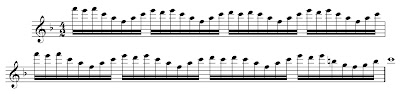
Here is, for instance, a bit of the Widor toccata. First you'll hear the opening bars of the right hand just as Widor wrote it, using just a couple of flute stops (already less impressive, isn't it? The volume is part of the piece's aura). Then I'm going to "subtract" the notes that do not change from group to group--that's most of them. The ones that are left in each group--three of them--, I'm going to play loudly on one manual, and for now you'll still be able to hear the remaining five notes in each group, played softly.
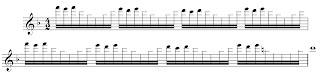
Now, Since the second note of that remaining group of three loud notes note is simply the lower neighbor tone and the third note is a repeat of the first note, I'll take those two notes away also and only play the first note of the entire group loudly, and the rest softly.
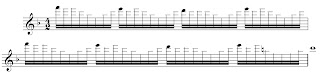
After that, I won't play the remaining notes at all. Now all the notes have disappeared except the backbone of the phrase.
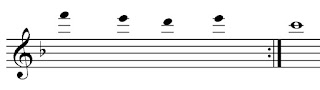
The last thing I did was to play that nine note tune in the pedals, which is actually what Widor himself does with it shortly after, and again at the triumphant return two-thirds of the way through the piece. The left hand, as it happens, also echoes this little tune. It's just three notes down, two back up to where we started, back down, back up, and a final C. And even that, it turns out, is the same thing twice. The first eight notes are really just four notes repeated with a C on the end.
Now let's listen to the entire process I've just described, with the subtractions done one at a time. It is a bit like listening to a "Cheshire toccata" with bits of it dispersing until only the grin is left.
That's right, the whole opening phrase--the whole piece, really--reduces to four notes.
Not that the other notes don't matter, of course. Music theorist Heinrich Schenker once showed pianist Arthur Schnabel his system for finding the most important notes in a piece of music. Under his system (unlike what I just did) entire pieces reduce to just a few structurally important notes. Schnabel's comment upon seeing this was that "you've taken away all my favorite notes!"
Don't worry; we'll put them back. Those rapidly fleeting notes create a visceral excitement. And when that simply tune comes rolling through the pedals it is a even a physical challenge to play them. Widor places them in double octaves at the extreme ends of the pedal board, meaning a short man like me can barely get his legs parted wide enough to play them. It feels like trying to straddle the universe.
And it is the difference between something that could easily be chanted by monks and what appears to be an epic organ toccata.
And yet, that outline is there all the same. And for those who can hear it, much less write something like it, it is a way to organize all of that information, and to understand it. It does not make it less fascinating. After all, I'm sure the designer of the Taj Majal knew the basic principles of architecture, but still created a masterpiece out of these simple ideas. So it is with the Widor. We could go on studying the piece, and I could point out how the it breaks into sentences and paragraphs and repeats those four notes in different keys and modes, again and again, and by the end we could marvel at how something that ---well, childish, really--could add up to something so impressive.
Because that kind of simplicity isn't lazy or ignorant, or unable to be complicated. It is the sign of a master at work, organized, methodical, and yet able to provide flashes of insight, exploration, genius.
It is a gift.
------------
After I wrote this I learned that the French would like to KEEP all those extra notes--and letters--thank you very much! This article is from The Guardian about attempts to simplify the French language and the controversy it is causing in France.
Here is, for instance, a bit of the Widor toccata. First you'll hear the opening bars of the right hand just as Widor wrote it, using just a couple of flute stops (already less impressive, isn't it? The volume is part of the piece's aura). Then I'm going to "subtract" the notes that do not change from group to group--that's most of them. The ones that are left in each group--three of them--, I'm going to play loudly on one manual, and for now you'll still be able to hear the remaining five notes in each group, played softly.
Now, Since the second note of that remaining group of three loud notes note is simply the lower neighbor tone and the third note is a repeat of the first note, I'll take those two notes away also and only play the first note of the entire group loudly, and the rest softly.
After that, I won't play the remaining notes at all. Now all the notes have disappeared except the backbone of the phrase.
The last thing I did was to play that nine note tune in the pedals, which is actually what Widor himself does with it shortly after, and again at the triumphant return two-thirds of the way through the piece. The left hand, as it happens, also echoes this little tune. It's just three notes down, two back up to where we started, back down, back up, and a final C. And even that, it turns out, is the same thing twice. The first eight notes are really just four notes repeated with a C on the end.
Now let's listen to the entire process I've just described, with the subtractions done one at a time. It is a bit like listening to a "Cheshire toccata" with bits of it dispersing until only the grin is left.
That's right, the whole opening phrase--the whole piece, really--reduces to four notes.
Not that the other notes don't matter, of course. Music theorist Heinrich Schenker once showed pianist Arthur Schnabel his system for finding the most important notes in a piece of music. Under his system (unlike what I just did) entire pieces reduce to just a few structurally important notes. Schnabel's comment upon seeing this was that "you've taken away all my favorite notes!"
Don't worry; we'll put them back. Those rapidly fleeting notes create a visceral excitement. And when that simply tune comes rolling through the pedals it is a even a physical challenge to play them. Widor places them in double octaves at the extreme ends of the pedal board, meaning a short man like me can barely get his legs parted wide enough to play them. It feels like trying to straddle the universe.
And it is the difference between something that could easily be chanted by monks and what appears to be an epic organ toccata.
And yet, that outline is there all the same. And for those who can hear it, much less write something like it, it is a way to organize all of that information, and to understand it. It does not make it less fascinating. After all, I'm sure the designer of the Taj Majal knew the basic principles of architecture, but still created a masterpiece out of these simple ideas. So it is with the Widor. We could go on studying the piece, and I could point out how the it breaks into sentences and paragraphs and repeats those four notes in different keys and modes, again and again, and by the end we could marvel at how something that ---well, childish, really--could add up to something so impressive.
Because that kind of simplicity isn't lazy or ignorant, or unable to be complicated. It is the sign of a master at work, organized, methodical, and yet able to provide flashes of insight, exploration, genius.
It is a gift.
------------
After I wrote this I learned that the French would like to KEEP all those extra notes--and letters--thank you very much! This article is from The Guardian about attempts to simplify the French language and the controversy it is causing in France.
Monday, February 1, 2016
The boring bit in the middle
Now let's turn to the part of the toccata that gets no respect: the middle part. It was referred to on one site I visited as "the boring bit in the middle."
Mssrs. Gigout and Widor avoided this part altogether--Gigout because his toccata was short and he didn't need a contrasting section, and Widor because he decided to make the entire toccata about one theme--though his entry did quiet down in the middle, and if anyone is going to fall asleep, that's when it would happen.
But any piece of a considerable length; say, more than three minutes, is likely to have a contrasting section. It usually falls in the middle, to give the whole piece a broad ABA architecture. And whereas the first section of a french toccata is generally loud, fast, in a continuous whirl of notes, and completely unsingable, the middle section is usually slow, stately, soft, and melodic.
Theodore Dubois' toccata is a good example of this. For the first three minutes, all is active--then the last triumphant chord dies away, and what we hear next is a hymnlike melody completely unlike anything that had happened before. Unfortunately, human beings often don't have patience for this sort of thing, particularly now that we are so accustomed to sensory overload. I once saw a video of Diane Bish playing this toccata, and when she got to the part in the middle, she began talking over the music, assuming her audience was going to zone out at that point and she'd better entertain them with pictures and stories about sightseeing in Europe until the fast part came back.
This was a shame, partly because it is a nice, if innocuous, little melody, but also because it really doesn't go on too long before something else happens--the first part begins to want some attention.
What begins to happen in this section is that the rapid theme from the beginning is revealed in little snippets--one measure here--then back to the slow melody--then another measure--then back to sleep--then again we here it. It is as if the piece is waking up again, or spring is springing, or something is gradually coming to life. It is a process. It will take some time, But it is not like watching grass grow. It will only be a minute or two. Wait for it. Long for it. Get excited. It's coming. And then--it's here!
Actually, there are several other ways you could describe this phenomenon. Maybe the two musical elements are fighting for supremacy. Maybe they are just negotiating. Maybe the music is trying to make up its mind. There are plenty of emotional conclusions you could draw from this--and you'll have plenty of chances, because this sort of thing happens in any number of pieces of music. Once you know to listen for this, you'll hear it often, particularly in French organ toccatas. Particularly in our next piece, the one by Alexander Guilmant
Like the Dubois, Mr. Guilmant makes it very clear when the second part begins. In fact, when the first part of the Dubois ends, you could easily think the piece is over! And if that architectural feature is obvious to you, keep it in mind. When the piece actually DOES end, When you've heard that entire opening section again to its conclusion, it will basically end the same way--except perhaps for a little additional tail (coda) at the end.
Mr. Guilmant, however, does not want us to make the mistake of thinking his piece is over so soon, so the chord he choose to end the section with (great chord, by the way) is noisy but inconclusive. And THEN the quiet, songful part begins.
It's not long, however, before the fast theme of the opening reappears. In fact, it is making little asides between each phrase of the long-breathed melody. Then gradually it starts to reassert itself, in different keys and registers, still alternating with the slow tune, and finally, thrusting itself back into the limelight, there is a very dramatic moment as the organ grows to full blast and the opening returns. Can you hear it? It's quiet now, but soon it will be in full force. You can be caught off guard by it, or you can notice it happening right from the start. It isn't as easy, or natural, to listen for, but can be very rewarding. And, with classical composers doing this all the time, it makes a lot of "boring parts" suddenly less boring.
Transition may be the least natural part of being human. We like to dance, to sing, and to react to what is happening right now, but we aren't very good at preparing for future events. Sometimes we like to deny them, like refusing to wear a coat out of the house because it isn't cold right now (but it will be in a few hours according to the weather forecast). This applies to larger social conditions as well. With gas prices their lowest in years, many Americans are lining up to by the same kinds of gas guzzling vehicles that caused so much pain at the pump the last time prices were high, setting themselves up for the same thing all over. When things are going well, people always think they are going to last forever...and when they aren't going well, it's the same story. But why plan ahead, anyway?
The point of my little sermon is that listening for process, for transition, for the start of something new or its return, isn't just something to keep us from being bored in the concert hall; it's also a life skill.
Guilmant: Allegro assai
Mssrs. Gigout and Widor avoided this part altogether--Gigout because his toccata was short and he didn't need a contrasting section, and Widor because he decided to make the entire toccata about one theme--though his entry did quiet down in the middle, and if anyone is going to fall asleep, that's when it would happen.
But any piece of a considerable length; say, more than three minutes, is likely to have a contrasting section. It usually falls in the middle, to give the whole piece a broad ABA architecture. And whereas the first section of a french toccata is generally loud, fast, in a continuous whirl of notes, and completely unsingable, the middle section is usually slow, stately, soft, and melodic.
Theodore Dubois' toccata is a good example of this. For the first three minutes, all is active--then the last triumphant chord dies away, and what we hear next is a hymnlike melody completely unlike anything that had happened before. Unfortunately, human beings often don't have patience for this sort of thing, particularly now that we are so accustomed to sensory overload. I once saw a video of Diane Bish playing this toccata, and when she got to the part in the middle, she began talking over the music, assuming her audience was going to zone out at that point and she'd better entertain them with pictures and stories about sightseeing in Europe until the fast part came back.
This was a shame, partly because it is a nice, if innocuous, little melody, but also because it really doesn't go on too long before something else happens--the first part begins to want some attention.
What begins to happen in this section is that the rapid theme from the beginning is revealed in little snippets--one measure here--then back to the slow melody--then another measure--then back to sleep--then again we here it. It is as if the piece is waking up again, or spring is springing, or something is gradually coming to life. It is a process. It will take some time, But it is not like watching grass grow. It will only be a minute or two. Wait for it. Long for it. Get excited. It's coming. And then--it's here!
Actually, there are several other ways you could describe this phenomenon. Maybe the two musical elements are fighting for supremacy. Maybe they are just negotiating. Maybe the music is trying to make up its mind. There are plenty of emotional conclusions you could draw from this--and you'll have plenty of chances, because this sort of thing happens in any number of pieces of music. Once you know to listen for this, you'll hear it often, particularly in French organ toccatas. Particularly in our next piece, the one by Alexander Guilmant
Like the Dubois, Mr. Guilmant makes it very clear when the second part begins. In fact, when the first part of the Dubois ends, you could easily think the piece is over! And if that architectural feature is obvious to you, keep it in mind. When the piece actually DOES end, When you've heard that entire opening section again to its conclusion, it will basically end the same way--except perhaps for a little additional tail (coda) at the end.
Mr. Guilmant, however, does not want us to make the mistake of thinking his piece is over so soon, so the chord he choose to end the section with (great chord, by the way) is noisy but inconclusive. And THEN the quiet, songful part begins.
It's not long, however, before the fast theme of the opening reappears. In fact, it is making little asides between each phrase of the long-breathed melody. Then gradually it starts to reassert itself, in different keys and registers, still alternating with the slow tune, and finally, thrusting itself back into the limelight, there is a very dramatic moment as the organ grows to full blast and the opening returns. Can you hear it? It's quiet now, but soon it will be in full force. You can be caught off guard by it, or you can notice it happening right from the start. It isn't as easy, or natural, to listen for, but can be very rewarding. And, with classical composers doing this all the time, it makes a lot of "boring parts" suddenly less boring.
Transition may be the least natural part of being human. We like to dance, to sing, and to react to what is happening right now, but we aren't very good at preparing for future events. Sometimes we like to deny them, like refusing to wear a coat out of the house because it isn't cold right now (but it will be in a few hours according to the weather forecast). This applies to larger social conditions as well. With gas prices their lowest in years, many Americans are lining up to by the same kinds of gas guzzling vehicles that caused so much pain at the pump the last time prices were high, setting themselves up for the same thing all over. When things are going well, people always think they are going to last forever...and when they aren't going well, it's the same story. But why plan ahead, anyway?
The point of my little sermon is that listening for process, for transition, for the start of something new or its return, isn't just something to keep us from being bored in the concert hall; it's also a life skill.
Guilmant: Allegro assai
Monday, January 25, 2016
OK, but when is this thing gonna be over?
Last time on "Flashy French Organ Toccatas" we met three of the flashiest, loudest, most aurally attractive pieces your ears will ever have the pleasure to meet. And they're modest, too!
Actually, modest is the one thing they are not. They don't steal subtly on the ear; they claim their ground right away. All is a rush of activity and exuberance right from the start, and at the finish, too.
In between?
This is where many a classical music listener gets lost. Novelty wears off after a while. In which case, it helps to have some sense of the "plot" of a piece of music, its structure. What's supposed to happen? What do I want to happen? Getting the key to that will unlock several secrets and make even the longest piece interesting. Or, at the very least, keep you from looking at your watch every few minutes.
Although, in this case, that's less likely to happen. One of the things that must make these toccatas so appealing to the average listener is that they are pretty easy to follow. That's because they often take the most basic shape. They get louder, they reach a climax, they conclude.
By the way, they don't rise to a crescendo. You may have heard that expression a great deal, but it is really a lot of nonsense. A crescendo means GETTING louder, not BEING louder. it is a process, not a goal. You don't rise to a rise.
In the middle of posting the blog last time I discovered that I had left out one very important Flashy French Organ Toccata. This is something I played in concert last fall. It is the shortest of the toccatas, and was one of two pieces its composer, Eugene Gigout, was asked to play at every appearance. He always obliged. You can listen to the entire toccata if you like--it's only three minutes. It does something that tends to make piece popular--it gets louder throughout. Unlike the other toccatas, which began loud, this one begins in a whisper, and then begins its crescendo.
Gigout: Toccata
Like the others, it consists of a continuous flurry of notes. The reason it is over so quickly is because it has all the formal complexity of a musical tapeworm. There is one simple tick-tock idea right at the beginning (hear it?) which lasts about 20 seconds. Then it is repeated. This time, the pedals add a long ominous note to the bass, while the hands play the same music as before. At this point, (:42) the harmonies change more quickly because some motion has been introduced into the piece. When the pedals come back a few seconds later (:52), they alternate long notes, wrapping around the dominant note of the old order; then they choose one very low note (1:00) and sit on it while the harmony settles in to prepare to its return to the beginning. The music grows louder, and when we start the whole journey over again, (1:11) the pedals have taken over the melody that used to be on top. This entire process (stasis, movement, setup) repeats, and then does so a third time (2:12); we hear it on full organ (this time our composer has filled in that opening tick-tock interval, still in the pedals, with the note between which makes it sound more melodic). Finally we settle in on the home note in the key of b minor (drummed again and again in the pedals at 2:29) and one final move takes us to the thrilling conclusion. When a composer stops on a dime like that, after non-stop motion the entire piece, you know it's nearly over.
And that's it!
While the paragraph above may make your eyes glaze over--it may even seem like excessive analysis for such a short piece--I've managed to describe virtually everything of any importance that happens in the entire run of the piece! I don't plan to do that with its close cousin, the Widor Toccata, a piece which is twice as long, though in some respects no more complex.
I do hope you'll notice, however, that there are several things the two pieces have in common. Although the Widor begins loudly, it gets quiet in the middle, and then gradually builds again to its conclusion. Also, its beginning is very similar to the Gigout. It too begins with the hands alone for about 45 seconds, and then repeats the same block of music, but this time with booming octaves in the pedals (just like the Gigout). Although the Widor is much more harmonically complex than the Gigout (rather than repeating the same interval again and again and staying in the same key the entire time, Mr. Widor goes on a long, twisting harmonic journey, changing keys and modes frequently), it still returns to its beginning for a louder, grander run at the same material. This time the pedal octaves sound together, rather than apart. And again, at the end, the motion stops, and in the pause (which Widor changed to a sounding high F in later editions--one of several occasions on which he changed his mind about pieces he'd already written) we prepare for the final triumphant chords.
Widor's piece is much loved, and previously in this space I speculated about why. I assumed some of it had to do with the exuberance, the major key, the loud volume, the constant activity, and the fact that there is really only one idea in the entire piece which simply changes harmonically again and again, which requires little adjustment from the brain. However, his can also make the piece seem rather long. A large scale softening (it takes what, a full minute of decrescendo to reach the quietest point in the piece?) and then an equally long, if not longer, crescendo, can require some patience on the part of the listener, who must appreciate how the piece unfolds, slowly becoming something, rather than being, at every moment, full of interest and activity. It asks us to wait a little. In some ways, while it is one of the structurally simplest of the toccatas, it may make more demands (and unlike the Gigout, it runs the risk of being long enough for the scarcity of material to matter). It does not offer any contrast (except dynamically) to give our ears some relief from the same idea presented over and over.
That contrast, which will be the subject of the next installment, can be a welcome relief: but it holds its own challenges for the ears.
Actually, modest is the one thing they are not. They don't steal subtly on the ear; they claim their ground right away. All is a rush of activity and exuberance right from the start, and at the finish, too.
In between?
This is where many a classical music listener gets lost. Novelty wears off after a while. In which case, it helps to have some sense of the "plot" of a piece of music, its structure. What's supposed to happen? What do I want to happen? Getting the key to that will unlock several secrets and make even the longest piece interesting. Or, at the very least, keep you from looking at your watch every few minutes.
Although, in this case, that's less likely to happen. One of the things that must make these toccatas so appealing to the average listener is that they are pretty easy to follow. That's because they often take the most basic shape. They get louder, they reach a climax, they conclude.
By the way, they don't rise to a crescendo. You may have heard that expression a great deal, but it is really a lot of nonsense. A crescendo means GETTING louder, not BEING louder. it is a process, not a goal. You don't rise to a rise.
In the middle of posting the blog last time I discovered that I had left out one very important Flashy French Organ Toccata. This is something I played in concert last fall. It is the shortest of the toccatas, and was one of two pieces its composer, Eugene Gigout, was asked to play at every appearance. He always obliged. You can listen to the entire toccata if you like--it's only three minutes. It does something that tends to make piece popular--it gets louder throughout. Unlike the other toccatas, which began loud, this one begins in a whisper, and then begins its crescendo.
Gigout: Toccata
Like the others, it consists of a continuous flurry of notes. The reason it is over so quickly is because it has all the formal complexity of a musical tapeworm. There is one simple tick-tock idea right at the beginning (hear it?) which lasts about 20 seconds. Then it is repeated. This time, the pedals add a long ominous note to the bass, while the hands play the same music as before. At this point, (:42) the harmonies change more quickly because some motion has been introduced into the piece. When the pedals come back a few seconds later (:52), they alternate long notes, wrapping around the dominant note of the old order; then they choose one very low note (1:00) and sit on it while the harmony settles in to prepare to its return to the beginning. The music grows louder, and when we start the whole journey over again, (1:11) the pedals have taken over the melody that used to be on top. This entire process (stasis, movement, setup) repeats, and then does so a third time (2:12); we hear it on full organ (this time our composer has filled in that opening tick-tock interval, still in the pedals, with the note between which makes it sound more melodic). Finally we settle in on the home note in the key of b minor (drummed again and again in the pedals at 2:29) and one final move takes us to the thrilling conclusion. When a composer stops on a dime like that, after non-stop motion the entire piece, you know it's nearly over.
And that's it!
While the paragraph above may make your eyes glaze over--it may even seem like excessive analysis for such a short piece--I've managed to describe virtually everything of any importance that happens in the entire run of the piece! I don't plan to do that with its close cousin, the Widor Toccata, a piece which is twice as long, though in some respects no more complex.
I do hope you'll notice, however, that there are several things the two pieces have in common. Although the Widor begins loudly, it gets quiet in the middle, and then gradually builds again to its conclusion. Also, its beginning is very similar to the Gigout. It too begins with the hands alone for about 45 seconds, and then repeats the same block of music, but this time with booming octaves in the pedals (just like the Gigout). Although the Widor is much more harmonically complex than the Gigout (rather than repeating the same interval again and again and staying in the same key the entire time, Mr. Widor goes on a long, twisting harmonic journey, changing keys and modes frequently), it still returns to its beginning for a louder, grander run at the same material. This time the pedal octaves sound together, rather than apart. And again, at the end, the motion stops, and in the pause (which Widor changed to a sounding high F in later editions--one of several occasions on which he changed his mind about pieces he'd already written) we prepare for the final triumphant chords.
Widor's piece is much loved, and previously in this space I speculated about why. I assumed some of it had to do with the exuberance, the major key, the loud volume, the constant activity, and the fact that there is really only one idea in the entire piece which simply changes harmonically again and again, which requires little adjustment from the brain. However, his can also make the piece seem rather long. A large scale softening (it takes what, a full minute of decrescendo to reach the quietest point in the piece?) and then an equally long, if not longer, crescendo, can require some patience on the part of the listener, who must appreciate how the piece unfolds, slowly becoming something, rather than being, at every moment, full of interest and activity. It asks us to wait a little. In some ways, while it is one of the structurally simplest of the toccatas, it may make more demands (and unlike the Gigout, it runs the risk of being long enough for the scarcity of material to matter). It does not offer any contrast (except dynamically) to give our ears some relief from the same idea presented over and over.
That contrast, which will be the subject of the next installment, can be a welcome relief: but it holds its own challenges for the ears.
Monday, January 18, 2016
At the top of the chute
"And they're all lining up for the start of the spring semester....they'll be running into gale force winds...it's really a beautiful day out there!"
It's always a good idea to have a strong opening. That's what each of today's panelists would tell me if they were still here to do it, and if they'd debase themselves by coming on this blog to being with. They are all very gifted French composers--were very gifted, anyhow. And they all knew how to lead with some arresting musical ideas.
This is something I could use right about now. The start of the "long semester" can be a bit daunting. While the fall semester seems short and intense, and usually involves cramming in a concert or two before the Christmas season, which runs from about Nov. 20 to the 1st of January, and includes every organization I work for putting on most of their shows for the year, the spring semester is less packed, though it seems to go on twice as long and largely takes places in the cold and dark of January and February and sometimes March. When it's not dark it's overcast.
I could use a new start, the sense of a fresh new beginning. That's where these consultants come in.
Why, we might inquire, do a series on flashy French organ toccatas in the middle of January?
Well, why not?
And then it hit me: maybe I need a little bit of a pick up. Maybe you do, too. So we'll let these fellows dazzle us with the loud and the flashy for a little bit, and by the end, we'll really know something about the institution of the French organ toccata.
Today we're really just interested in the opening. I'm going to post the entire recording of each one because it's just easier, but you can listen to the opening minute or so of each one and get the idea.
Notice how they all open: loud, fast, and with a continuous sense of momentum. Now, the idea here, to be blunt, is display. Organists know that if they pull one of these out of their hats the congregation will be impressed. Probably a little too much--most of the time these aren't as hard as they sound. But there is a sense of joy in the proceedings as well, is there not? And not simply in how fast the organist's fingers can go, I hope.
Let's sample a few. Here's one you might not have heard of unless you are an organist, but I'll bet it becomes one of your favorites:
Dubois: Toccata
That one goes on for seven minutes, but remember, don't spoil the ending. Just listen to the first minute. We'll get back to it.
That's a cheerful little guy, isn't it? How about something a bit different?
Guilmant: allegro assai
Points for your bloggist for noticing that, despite having a different name (namely a tempo marking) that it is, in fact, a toccata. No need trying to hide it, Alexander!
Alright, you probably have detected that these two pieces, being from the standard organ literature, are not that well known to the guy on the street (as is pretty much the fate of all the organ literature). There are a few pieces that have managed to transcend the boundaries of the organ loft, however. Surely you know this one. It's an Easter tradition at my church:
Widor: Toccata
Both the Guilmant and the Widor, by the way, happen to be the final movements of larger works. A grand sendoff.
While we're doing famous, how about the other toccata you've all heard of? Particularly, the opening (and remember, just the opening! No getting distracted and listening to the whole thing!)
Bach: Toccata and Fugue in d minor
OK. We've got a bit of a problem here. It's pretty obvious that this one doesn't even begin to sound like the others, and that's because it is an entirely different animal. Sure, it's got the same name as the others (toccata) but it's not similar at all; it has no more in common with the others than a water buffalo and a zebra.
So a quick definition before we go on. Toccata is from the Italian toccare, meaning to touch, and it involves digital display. The KIND of digital display however, may be rather different. The 19th century French had a very different idea of what that meant than the 18th century Germans, which means that yes, there are two kinds of toccatas, and that they are not very similar.
Sorry, Bach, but you get voted off our island. Besides, you're not French. But you can come back for our series on 18th century German Toccatas.
Now we've heard from three flashy 19th century french toccatas, and one that wasn't. (by the way, some folks like to call the piece I play at Easter the Widor Toccata and Fugue. It isn't. It's just a toccata. It doesn't have a fugue in it.)
What do they all have in common?
They are loud. And fast.
They maintain constant rhythm.
They would be hard to sing. If there is a melody, it is either buried in the midst of a lot of other notes or it comes in later in the pedals (like the Widor).
The fast, active part is pretty much the only thing going on (ie., no counterpoint or separate melodies going on at the same time)--except for a light, sprightly accompaniment.
They make the organ sound really terrific.
One more thing--They were all written by Frenchmen working at churches in Paris in the late 19th century. Charles-Marie Widor was organist at St. Sulpice from 1870 to 1933 (64 years!), Theodore Dubois was organist at La Madeleine (our lady) from 1877 to 1896, and Alexander Guilmant was organist at La Trinite from 1871 to 1901. Imagine all of those great organ toccatas pouring forth from all of those churches at the same time in the same city!
[listen]
Then again, perhaps it is a good thing that they normally keep the church doors closed.
It's always a good idea to have a strong opening. That's what each of today's panelists would tell me if they were still here to do it, and if they'd debase themselves by coming on this blog to being with. They are all very gifted French composers--were very gifted, anyhow. And they all knew how to lead with some arresting musical ideas.
This is something I could use right about now. The start of the "long semester" can be a bit daunting. While the fall semester seems short and intense, and usually involves cramming in a concert or two before the Christmas season, which runs from about Nov. 20 to the 1st of January, and includes every organization I work for putting on most of their shows for the year, the spring semester is less packed, though it seems to go on twice as long and largely takes places in the cold and dark of January and February and sometimes March. When it's not dark it's overcast.
I could use a new start, the sense of a fresh new beginning. That's where these consultants come in.
Why, we might inquire, do a series on flashy French organ toccatas in the middle of January?
Well, why not?
And then it hit me: maybe I need a little bit of a pick up. Maybe you do, too. So we'll let these fellows dazzle us with the loud and the flashy for a little bit, and by the end, we'll really know something about the institution of the French organ toccata.
Today we're really just interested in the opening. I'm going to post the entire recording of each one because it's just easier, but you can listen to the opening minute or so of each one and get the idea.
Notice how they all open: loud, fast, and with a continuous sense of momentum. Now, the idea here, to be blunt, is display. Organists know that if they pull one of these out of their hats the congregation will be impressed. Probably a little too much--most of the time these aren't as hard as they sound. But there is a sense of joy in the proceedings as well, is there not? And not simply in how fast the organist's fingers can go, I hope.
Let's sample a few. Here's one you might not have heard of unless you are an organist, but I'll bet it becomes one of your favorites:
Dubois: Toccata
That one goes on for seven minutes, but remember, don't spoil the ending. Just listen to the first minute. We'll get back to it.
That's a cheerful little guy, isn't it? How about something a bit different?
Guilmant: allegro assai
Points for your bloggist for noticing that, despite having a different name (namely a tempo marking) that it is, in fact, a toccata. No need trying to hide it, Alexander!
Alright, you probably have detected that these two pieces, being from the standard organ literature, are not that well known to the guy on the street (as is pretty much the fate of all the organ literature). There are a few pieces that have managed to transcend the boundaries of the organ loft, however. Surely you know this one. It's an Easter tradition at my church:
Widor: Toccata
Both the Guilmant and the Widor, by the way, happen to be the final movements of larger works. A grand sendoff.
While we're doing famous, how about the other toccata you've all heard of? Particularly, the opening (and remember, just the opening! No getting distracted and listening to the whole thing!)
Bach: Toccata and Fugue in d minor
OK. We've got a bit of a problem here. It's pretty obvious that this one doesn't even begin to sound like the others, and that's because it is an entirely different animal. Sure, it's got the same name as the others (toccata) but it's not similar at all; it has no more in common with the others than a water buffalo and a zebra.
So a quick definition before we go on. Toccata is from the Italian toccare, meaning to touch, and it involves digital display. The KIND of digital display however, may be rather different. The 19th century French had a very different idea of what that meant than the 18th century Germans, which means that yes, there are two kinds of toccatas, and that they are not very similar.
Sorry, Bach, but you get voted off our island. Besides, you're not French. But you can come back for our series on 18th century German Toccatas.
Now we've heard from three flashy 19th century french toccatas, and one that wasn't. (by the way, some folks like to call the piece I play at Easter the Widor Toccata and Fugue. It isn't. It's just a toccata. It doesn't have a fugue in it.)
What do they all have in common?
They are loud. And fast.
They maintain constant rhythm.
They would be hard to sing. If there is a melody, it is either buried in the midst of a lot of other notes or it comes in later in the pedals (like the Widor).
The fast, active part is pretty much the only thing going on (ie., no counterpoint or separate melodies going on at the same time)--except for a light, sprightly accompaniment.
They make the organ sound really terrific.
One more thing--They were all written by Frenchmen working at churches in Paris in the late 19th century. Charles-Marie Widor was organist at St. Sulpice from 1870 to 1933 (64 years!), Theodore Dubois was organist at La Madeleine (our lady) from 1877 to 1896, and Alexander Guilmant was organist at La Trinite from 1871 to 1901. Imagine all of those great organ toccatas pouring forth from all of those churches at the same time in the same city!
[listen]
Then again, perhaps it is a good thing that they normally keep the church doors closed.
Subscribe to:
Posts (Atom)