"Hello. Good morning, everyone. Nice to see all of you. It is a pleasure to be here. [feedback from microphone] woops! Pete, would you turn down the gain in the back? Thanks. Well, it is really great to be here. Now I just want to acquaint you with this year's program. We are going to really wake up this little church! Are you excited? [scattered applause] My name is the Holy Spirit. In a few moments, you are going to hear the sound of a rushing wind, and little tongues of flame are going to descend on each of your heads. Then you are going to be able to preach the gospel in all kinds of different languages. Does that sound like fun? And don't forget, when it's over, we have a nice potluck supper for you, so y'all come back. Now, there have been some concerns about the tongues of flame. Just let me assure you that they are purely symbolic. You will barely notice they are there. And the rushing wind is really going to be more of a zephyr. We discussed this at our meeting last week and decided that 5 miles an hour was good enough to get the point across. So use your imaginations. Besides, we don't want to knock over any of that delicious punch and cookies the ladies of the church worked so hard to prepare. So, are there any questions? Oh, yes, I nearly forgot. Pete is going to make a speech afterward. Have you decided what language you are going to address the crowd in yet, Pete? I'm sure we'll have lots of interpreters. Well, let's have at it, then!"
If you are familiar with the story of Pentecost as told in the 2nd chapter of the book of Acts, you know that isn't exactly the way it happened. I've adapted it for the Methodist church in the 21st century, or maybe the 19th, or the 20th. Even if you aren't Methodist, you might recognize it as what would happen if Pentecost were to come to a little church near you.
I find some amusement writing about our local Pentecost celebration each year. Our church has a committee that plans our traditional worship services, and every year for Pentecost they try to do something special. For the past five years or so, it is generally been close to the same thing, involving a kind of recreation of the original story, with different languages being spoken, and flame colored streamers, or banners, or persons being asked to wear flame colored clothing to church. One year we processed into the church to a really jazzy rendition of "Come, Creator Spirit" composed by a Dutch organist a couple of years ago that I found online. Sometimes we even try to get the sound of the wind in there--not always convincingly.
This usually occurs at the start of the service, and often leads into, or comes out of, the opening voluntary. Last year it happened during the handshaking that occurs before the service, and the idea was to just suddenly have all of these languages pop out of nowhere and unexpectedly take over. Our pastor, being Methodist, pretty much told everybody what was going to happen ahead of time, but it still took some people by surprise, including a woman on our committee, who expressed concern at this year's meeting that it hadn't been sufficiently prepared last year. I tried to explain that that had actually been the point, but...you know. Surprises are exactly what we are trying to avoid when we go to church.
When I got home I looked up the Pentecost story again, just to make sure I remembered it right, and sure enough, the people at the original "happening" were "amazed" and "perplexed" and asked one another "what does this mean?" Apparently they did not think to be annoyed at the event planner for insufficiently explaining to everyone what was happening ahead of time.
And, of course, surprise is relative. If you know the story, and if you've been around the church for a while, and you know it is Pentecost, and you suddenly hear people speaking in different languages, how much of a shock is that, really? It depends, I suppose, if you are one of those kids in Sunday school who didn't remember that the answer to every question was "Jesus" or you only go to church once or twice a year and don't know much about this Pentecost thing. I mean, it does only happen once a year, so I'll give you that.
And Pentecost is a largely unknown holiday among the general population. It is the birthday of the Christian church, which makes it a pretty major event within the church, but in the world at large it isn't recognized. That's probably because it is a Christian takeover of a Jewish holiday, rather than a pagan one, which would give it more name recognition. The merchants haven't picked up on it yet, either, and unlike Christmas or Easter, with Santa Claus and the Easter Bunny, there is no Pentecost Pete giving away candy or toys to our children, so, shorn of anything not church-related, a lot of people have no idea it happens at all. It doesn't happen during any major change of the seasons, either, like solstice or the spring or autumn equinox (Easter and Halloween get those, more or less), marking the transitions of the climate and the ends of the growing season, and changes in our behavior as a result of living on this mercurial planet. In short, it's just itself, which isn't enough if you want to get the attention of the vast masses of humanity, who aren't going to pay attention to something unless it is on fire, blinking, or promises a lot for virtually nothing. An abstract holiday with no presents or silly customs you can do with your kids? It's a wonder it's still around. Even if few of us make much of it.
But Pentecost is getting fairly predictable around here, so, when another committee member offered this year that we've been concentrating on the "chaotic" elements of Pentecost for the last several years and maybe it was time to dial it back a little, I didn't protest. We've had a pretty good run, after all. Last year, I think we even managed to get people to speak in the different languages ALL AT ONCE! instead of politely waiting their turn so that languages were spoken one at a time in an otherwise silent room. It was pretty crazy, man! It took a while (as in a few years) to get people to realize that the Holy Spirit isn't just a gentle dove (that's how He appears at Christ's baptism, but not at Pentecost) and to overcome the natural inclination to make every event in the Christian calendar seem nice and pretty and gentle and soothing and predictable and calm. But we did it. The door may be closing on that, but, for a group of church folks, that was a stretch. And it happened. So I guess we can go back to doing things "decently and in order."
So if the Holy Spirit reads our blogs: please try not to do anything unexpected at our church this year. We've been stretched enough for one decade. No new songs, or new plans, or re-visioning for us for a while. We're just going to enjoy things the way they are.
But I can't speak for the folks down the street. They're Lutheran, so I probably wouldn't get too wild with them, either, but you never know....
Friday, May 15, 2015

Wednesday, May 13, 2015
pictures from the festival concert weekend
Before the adventure that is Chorale Festival concert weekend even begins, there is much setup to be done. Therefore, I'd like to thank the committee on Riser Setup, and the first pictures are for (and of) them:


Once Friday evening comes it is time to rehearse! Off we go...

On Saturday, the orchestra comes to take all of my favorite notes away. I still got to keep a few, as there is an organ part in the score. But, alak! How am I going to even see the conductor through all of the people that will soon occupy the risers! Good thing we moved the orchestra down a step later on so the angle was such that I could see Dr. Jessop.


Although he is a very active individual, the folks at Google decided to jazz up this picture a bit by making everything (including the immobile objects) move. This was just too funny not to post.
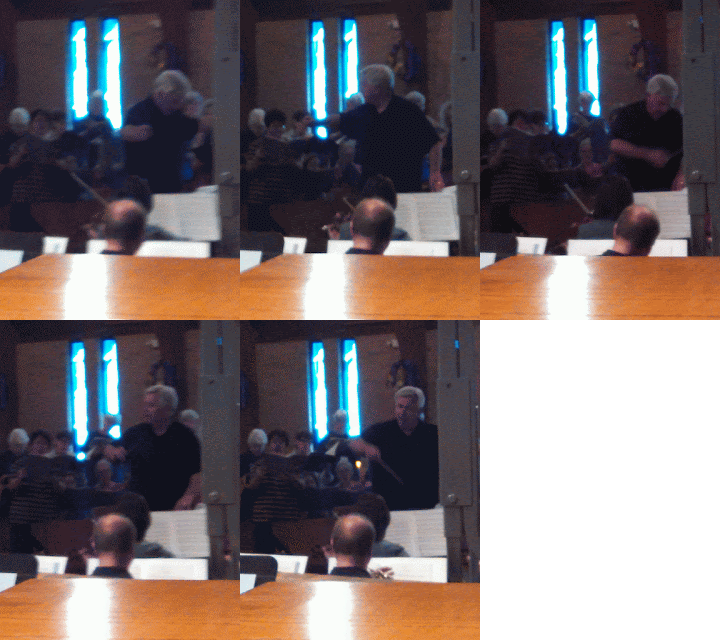
Late on Saturday we got a short break while the Maestro told us a story:

Our Founding Director, Ms. Julie Beyler, and our Principle Guest Conductor, Dr. Craig Jessop, in conversation.

Meanwhile, Ginny tries to conduct The Chorale (actually, I think she was just giving instructions)


There are much better pictures on The Chorale's Facebook page, taken by our official photographer, Eric Frahm (yeah, Eric!). These are just from my phone, when I wasn't busy playing. I did manage to get one of the audience from my perch at the organ. And, when it was all over, a picture of the stillness of the sanctuary, and the last piece on the program, still on the organ the next morning when I came in to resume the rest of the journey....


Once Friday evening comes it is time to rehearse! Off we go...

On Saturday, the orchestra comes to take all of my favorite notes away. I still got to keep a few, as there is an organ part in the score. But, alak! How am I going to even see the conductor through all of the people that will soon occupy the risers! Good thing we moved the orchestra down a step later on so the angle was such that I could see Dr. Jessop.


That's better!
Although he is a very active individual, the folks at Google decided to jazz up this picture a bit by making everything (including the immobile objects) move. This was just too funny not to post.

Late on Saturday we got a short break while the Maestro told us a story:

Our Founding Director, Ms. Julie Beyler, and our Principle Guest Conductor, Dr. Craig Jessop, in conversation.

Meanwhile, Ginny tries to conduct The Chorale (actually, I think she was just giving instructions)


There are much better pictures on The Chorale's Facebook page, taken by our official photographer, Eric Frahm (yeah, Eric!). These are just from my phone, when I wasn't busy playing. I did manage to get one of the audience from my perch at the organ. And, when it was all over, a picture of the stillness of the sanctuary, and the last piece on the program, still on the organ the next morning when I came in to resume the rest of the journey....


Monday, May 11, 2015
The Simple Life
This morning I'll tell you about this fantasy I have. Do we know each other well enough for this? Don't worry, it's rated G. Maybe it should even be rated N for nerd.
I'm on my bicycle, riding to church. I imagine I am a simple man, who lives alone with a cat, is rather old, lives in a little village in Europe, and basically does nothing but play the parish organ on Sundays. The little road from my little house goes directly to the little church. It is very peaceful in the morning. The little church probably has only a dozen or so parishioners. I probably only know 5 hymns. I play the single service; I ride home again. I have lunch. It is probably the same thing every week. Life is very basic. And it is a little like a French art film.
Here is the real story. I live in a town of about 100,000. It is not a major metropolitan area, but it is small enough that at times it can pass for a small town, especially at 6:30 on a Sunday morning. I live only a mile and a half from church. When the whether is fine, from May through October, I often ride my bike to church. So fantasy and reality are not really that separate. And I have a cat. But I am not that old, and I know more than 5 hymns.
When I get to the church, things get a lot more complicated. There are usually about 400 in attendance, and we have three services. I play the organ and the piano at the two traditional services, and we have a praise band for the 9 am service. I play the piano and the keyboard for that one also. From the time I enter the building until I leave four and a half hours later I am basically on the run. It is exhilarating. And challenging. There are a lot of things going on. Good things, mostly. And then, when it is over, my wife and I ride home together, discussing the sermon and the day on the way. It is not a bad routine.
But at 6:30 am, all you can hear are the birds. And I like that. I am a sucker for solitude, and for silence, particularly when I know it is about to be in short supply. So before the action begins for the day, I contemplate life as if it were a simple thing, which, ultimately, I suppose it is. Why I have to add to that I don't know. Perhaps in the imagining I don't have to prepare for the sudden intrusion of noise and activity into that simple moment; I can pretend it will go on forever.
It is fun to be someone else for a moment, even though, ultimately, I always realize I would much rather be exactly where I am doing exactly what I do. Truth is, I'd be bored at a little parish church playing only 5 hymns and having coffee with only a dozen people every week after only one service. But you know how complex people are; we like to romanticize simplicity, even if we know it's partially advertising.
Anyway, I'd better get my bike fixed so I can ride it next Sunday. The cap on one of the tires went missing. I hope there is a bicycle shop in my little village so I can get it repaired. Otherwise it will be a major catastrophe, and I rarely ever have to deal with those in my routine, halcyon existence.
You can call me Pierre.
I'm on my bicycle, riding to church. I imagine I am a simple man, who lives alone with a cat, is rather old, lives in a little village in Europe, and basically does nothing but play the parish organ on Sundays. The little road from my little house goes directly to the little church. It is very peaceful in the morning. The little church probably has only a dozen or so parishioners. I probably only know 5 hymns. I play the single service; I ride home again. I have lunch. It is probably the same thing every week. Life is very basic. And it is a little like a French art film.
Here is the real story. I live in a town of about 100,000. It is not a major metropolitan area, but it is small enough that at times it can pass for a small town, especially at 6:30 on a Sunday morning. I live only a mile and a half from church. When the whether is fine, from May through October, I often ride my bike to church. So fantasy and reality are not really that separate. And I have a cat. But I am not that old, and I know more than 5 hymns.
When I get to the church, things get a lot more complicated. There are usually about 400 in attendance, and we have three services. I play the organ and the piano at the two traditional services, and we have a praise band for the 9 am service. I play the piano and the keyboard for that one also. From the time I enter the building until I leave four and a half hours later I am basically on the run. It is exhilarating. And challenging. There are a lot of things going on. Good things, mostly. And then, when it is over, my wife and I ride home together, discussing the sermon and the day on the way. It is not a bad routine.
But at 6:30 am, all you can hear are the birds. And I like that. I am a sucker for solitude, and for silence, particularly when I know it is about to be in short supply. So before the action begins for the day, I contemplate life as if it were a simple thing, which, ultimately, I suppose it is. Why I have to add to that I don't know. Perhaps in the imagining I don't have to prepare for the sudden intrusion of noise and activity into that simple moment; I can pretend it will go on forever.
It is fun to be someone else for a moment, even though, ultimately, I always realize I would much rather be exactly where I am doing exactly what I do. Truth is, I'd be bored at a little parish church playing only 5 hymns and having coffee with only a dozen people every week after only one service. But you know how complex people are; we like to romanticize simplicity, even if we know it's partially advertising.
Anyway, I'd better get my bike fixed so I can ride it next Sunday. The cap on one of the tires went missing. I hope there is a bicycle shop in my little village so I can get it repaired. Otherwise it will be a major catastrophe, and I rarely ever have to deal with those in my routine, halcyon existence.
You can call me Pierre.
Friday, May 8, 2015
The text of John Rutter's Magnificat
This evening another magical and exhausting concert weekend begins here in Champaign-Urbana as our esteemed guest, Dr. Craig Jessop, comes to lead the Chorale in the music of John Rutter. We rehearse Friday evening, all morning and afternoon on Saturday, including with the orchestra, then on Sunday afternoon, and finally the concert arrives on Sunday at 7pm. If you are in the area come see us at Faith United Methodist Church, 1719 S. Prospect Rd. The concert is free, and the conductor, formerly of the Mormon Tabernacle Choir, manages to pull some pretty extraordinary sounds from a choir made up of non-auditioned regular folks who like to sing and are willing to commit to long hours of rehearsal (did I say regular? Maybe I should rethink that). The pieces are mainly for chorus and orchestra, except for the two whose accompaniments feature the group's handsome organist.
The main work on the program is Rutter's "Magnificat," which, I can tell you, is 85-pages long and in 7 movements. I'm not sure how long it runs in performance, but I doubt you'll be looking at your watch. It is filled with moments of great beauty and power, some intriguing text setting, and infectious dance rhythms. I was quite honored and touched that the group dedicated this piece to me, particularly as I have grown quite fond of it.
(I should explain: the Chorale has a custom whereby Chorale members can dedicate any piece in the library to someone, friend or relative, for a fee, which I think goes to the scholarship fund, or to purchase more music for the library; this dedication is read at rehearsal and a sticker is affixed to everyone's copy of that piece)
The work begins with a festive tune that you'll hear again later; a pageant of ideas pours forth in this dance movement which is fully a quarter of the work's length. I confess that it did not make a very good impression on me the first day I sat at the piano and read through it; then its Spanish elements and celebratory nature won me over.
It is followed by the most sonorously stunning part of the work, a medieval-sounding piece set to a 15-century English poem, that is hauntingly beautiful in its simplicity. The several stanzas of the poem each explain the symbolism behind the five branches of the rose (that doesn't need to be botanically accurate, does it?). Besides the sheer beauty of the melodic ideas (cast in dorian and mixolydian modes, which were big in the Middle Ages and vanished in the 17th century to return only in the 20th) is the interesting text setting that Rutter employs here. Sometimes he seems intent on accenting just the wrong syllable to give the piece an ancient feel--either because the syllabification shouldn't feel too familiar or too easy the gloss over, or to highlight the rhyme scheme.
It is odd, perhaps, that Mary should just have begun her magnificent hymn of praise and then have it interrupted by a hymn TO her, but it does illustrate her last point in the movement above, that "all generations shall call me blessed." Here some of them are, doing just that. And it is a mark of modern composers that often liturgical works borrow from other sources as well. The third movement begins with part of the Ordinary of the Mass, which is, of course, not part of the Magificat text from the gospel of Luke either. But it fits well here, because Mary is extolling God, and says "holy is his name." The choir fills out the thought with the Sanctus that surrounds it, also a hymn of praise to God, beginning with the thrice-repeated "holy" and continuing the praise over "all the earth." And here are the trumpets and drums, or in this case, since we are using the chamber version with organ and only one horn, is the organ's first big moment.
Actually, I don't get to play the first or second movements at all, as the organ remains silent. It is always interesting as I make the sudden switch on Festival Concert weekends from rehearsal accompanist to member of the orchestra how many of my favorite notes get taken away! But it will also be a pleasure letting someone else do the heavy lifting by Sunday evening. And the tonal variety will surely be a breath of fresh air for the Chorale after having merely an out-of-tune piano doing the honors the entire semester!
The fourth movement is also quite beautiful, and tricky, as the Chorale found out, for it is a simple repetition of the same one-measure figure, but in various modes and keys, through all kinds of progressions, from darkness to light, tension and release, and the shifting harmonies require the ear to hear them beforehand. There is a lovely soprano solo atop the choir.
But it is probably the fifth movement that is the most interesting. It begins with the phrase" God's mighty power." Now how would you set that to music? Trumpets, drums, loud, powerful chords?
Not Mr. Rutter. The opening of this movement sounds more like a spy thriller. It is jazzy and syncopated, but it starts very quietly. The first entrances for the basses and tenors are at pianissimo.
I once suggested to the basses that it should sound like they were trying to steal a diamond without being detected. To get the point across, at another rehearsal I played the theme from Mission Impossible.
So what's going on here?
Suppose you had a message that you didn't think was going to be very popular--even dangerous.
Dangerous?
If you're not familiar with Mary's Magnificat--the entire text, not just the "nice" part at the beginning, you may be completely surprised to learn that there are some very subversive political overtones. Now in this country, if you use terms like "social justice" or talk about raising the minimum wage, you can be accused of "class warfare." But that's not even a fraction of what Mary is saying. Not only does she think that God "exalts the humble (poor)" but that He is going to bring down the powerful. Those folks that make billions of dollars by exploiting their workers and polluting the environment--they're gonna pay for that. Those political leaders who are only concerned with hanging on to their own power and influence and don't look out for the ones who don't have it so easy--your time is coming.
That's not the sort of message you can deliver in broad daylight, especially if you are in a particularly oppressive situation. It reminds me of how black slaves sent their messages in coded songs so their masters wouldn't understand--masters who were already on the lookout for signs of rebellion and did everything they could to keep slaves from being able to conspire with one another because they knew it could bring trouble for them. If you are in power, the last thing you want to hear from a disposed underclass is how unhappy they are and how God--or anybody--is going to do something about it. And if you are in power, of course, you are also in the best position to retaliate harshly against such talk. So if you are being oppressed you've got to spread your message quietly. psst...God's going to make sure justice gets done here...pass it on.
so....quietly at first, the secret message of God's justice, but then it builds, and finally, over hammered fortissimo Ds, the voices sing about the day that is coming, great and terrible. It eventually subsides somewhat, but even the final harmony is not really resolved. It leads directly into
another beautiful movement. The first word, "esurientes" sounds like Spanish, but is actually Latin. The reason for the segue from the previous movement is that Mary isn't finished with her thought. In the fifth movement she proclaims, "He hath put down the mighty from their seat.." BUT
"He hath filled the hungry with good things..."
It is a two-part thought, and Mr. Rutter is sensitive to this, which is why one piece glides seamlessly into the other, as the harshness of the one becomes a beautiful and uncomplicated vision of the other. Mary can't quite finish one thought before beginning the other, so the actual text bobs back and forth (many texts from the Bible are stubborn like this!) but the composer wants to give both visions a piece of their own, and in due season.
Finally, a montage of texts to conclude the work. The seventh movement begins with the organ fanfare from the third movement. The text is from the "Gloria Patri," which we'll hear the rest of after we take a short break for this prayer to the Virgin. Mary has stopped speaking; she has concluded at the end of the sixth movement when she remembers God has promised all of this to "Abraham and his seed forever." There isn't much for her to say after that.
But a musical work must have a more satisfying conclusion. A climax is not an end. So after Mary's approstrophe old themes are brought back to round out the work. At the words "as it was in the beginning" what do we hear but the music that was at the beginning--of the entire Magnificat. It is a nice touch--if you can remember back half-an-hour and know your Latin. And, with a few tongue-tripping exceptions, the whole opening section returns for a bow and a triumphant series of amens.
It is quite a journey. I hope you are able to take it with us this Sunday evening at 7.

Erasmus, seen here studying the score, was under the mistaken impression that the piece was about a "magnificent cat."
The main work on the program is Rutter's "Magnificat," which, I can tell you, is 85-pages long and in 7 movements. I'm not sure how long it runs in performance, but I doubt you'll be looking at your watch. It is filled with moments of great beauty and power, some intriguing text setting, and infectious dance rhythms. I was quite honored and touched that the group dedicated this piece to me, particularly as I have grown quite fond of it.
(I should explain: the Chorale has a custom whereby Chorale members can dedicate any piece in the library to someone, friend or relative, for a fee, which I think goes to the scholarship fund, or to purchase more music for the library; this dedication is read at rehearsal and a sticker is affixed to everyone's copy of that piece)
The work begins with a festive tune that you'll hear again later; a pageant of ideas pours forth in this dance movement which is fully a quarter of the work's length. I confess that it did not make a very good impression on me the first day I sat at the piano and read through it; then its Spanish elements and celebratory nature won me over.
It is followed by the most sonorously stunning part of the work, a medieval-sounding piece set to a 15-century English poem, that is hauntingly beautiful in its simplicity. The several stanzas of the poem each explain the symbolism behind the five branches of the rose (that doesn't need to be botanically accurate, does it?). Besides the sheer beauty of the melodic ideas (cast in dorian and mixolydian modes, which were big in the Middle Ages and vanished in the 17th century to return only in the 20th) is the interesting text setting that Rutter employs here. Sometimes he seems intent on accenting just the wrong syllable to give the piece an ancient feel--either because the syllabification shouldn't feel too familiar or too easy the gloss over, or to highlight the rhyme scheme.
It is odd, perhaps, that Mary should just have begun her magnificent hymn of praise and then have it interrupted by a hymn TO her, but it does illustrate her last point in the movement above, that "all generations shall call me blessed." Here some of them are, doing just that. And it is a mark of modern composers that often liturgical works borrow from other sources as well. The third movement begins with part of the Ordinary of the Mass, which is, of course, not part of the Magificat text from the gospel of Luke either. But it fits well here, because Mary is extolling God, and says "holy is his name." The choir fills out the thought with the Sanctus that surrounds it, also a hymn of praise to God, beginning with the thrice-repeated "holy" and continuing the praise over "all the earth." And here are the trumpets and drums, or in this case, since we are using the chamber version with organ and only one horn, is the organ's first big moment.
Actually, I don't get to play the first or second movements at all, as the organ remains silent. It is always interesting as I make the sudden switch on Festival Concert weekends from rehearsal accompanist to member of the orchestra how many of my favorite notes get taken away! But it will also be a pleasure letting someone else do the heavy lifting by Sunday evening. And the tonal variety will surely be a breath of fresh air for the Chorale after having merely an out-of-tune piano doing the honors the entire semester!
The fourth movement is also quite beautiful, and tricky, as the Chorale found out, for it is a simple repetition of the same one-measure figure, but in various modes and keys, through all kinds of progressions, from darkness to light, tension and release, and the shifting harmonies require the ear to hear them beforehand. There is a lovely soprano solo atop the choir.
But it is probably the fifth movement that is the most interesting. It begins with the phrase" God's mighty power." Now how would you set that to music? Trumpets, drums, loud, powerful chords?
Not Mr. Rutter. The opening of this movement sounds more like a spy thriller. It is jazzy and syncopated, but it starts very quietly. The first entrances for the basses and tenors are at pianissimo.
I once suggested to the basses that it should sound like they were trying to steal a diamond without being detected. To get the point across, at another rehearsal I played the theme from Mission Impossible.
So what's going on here?
Suppose you had a message that you didn't think was going to be very popular--even dangerous.
Dangerous?
If you're not familiar with Mary's Magnificat--the entire text, not just the "nice" part at the beginning, you may be completely surprised to learn that there are some very subversive political overtones. Now in this country, if you use terms like "social justice" or talk about raising the minimum wage, you can be accused of "class warfare." But that's not even a fraction of what Mary is saying. Not only does she think that God "exalts the humble (poor)" but that He is going to bring down the powerful. Those folks that make billions of dollars by exploiting their workers and polluting the environment--they're gonna pay for that. Those political leaders who are only concerned with hanging on to their own power and influence and don't look out for the ones who don't have it so easy--your time is coming.
That's not the sort of message you can deliver in broad daylight, especially if you are in a particularly oppressive situation. It reminds me of how black slaves sent their messages in coded songs so their masters wouldn't understand--masters who were already on the lookout for signs of rebellion and did everything they could to keep slaves from being able to conspire with one another because they knew it could bring trouble for them. If you are in power, the last thing you want to hear from a disposed underclass is how unhappy they are and how God--or anybody--is going to do something about it. And if you are in power, of course, you are also in the best position to retaliate harshly against such talk. So if you are being oppressed you've got to spread your message quietly. psst...God's going to make sure justice gets done here...pass it on.
so....quietly at first, the secret message of God's justice, but then it builds, and finally, over hammered fortissimo Ds, the voices sing about the day that is coming, great and terrible. It eventually subsides somewhat, but even the final harmony is not really resolved. It leads directly into
another beautiful movement. The first word, "esurientes" sounds like Spanish, but is actually Latin. The reason for the segue from the previous movement is that Mary isn't finished with her thought. In the fifth movement she proclaims, "He hath put down the mighty from their seat.." BUT
"He hath filled the hungry with good things..."
It is a two-part thought, and Mr. Rutter is sensitive to this, which is why one piece glides seamlessly into the other, as the harshness of the one becomes a beautiful and uncomplicated vision of the other. Mary can't quite finish one thought before beginning the other, so the actual text bobs back and forth (many texts from the Bible are stubborn like this!) but the composer wants to give both visions a piece of their own, and in due season.
Finally, a montage of texts to conclude the work. The seventh movement begins with the organ fanfare from the third movement. The text is from the "Gloria Patri," which we'll hear the rest of after we take a short break for this prayer to the Virgin. Mary has stopped speaking; she has concluded at the end of the sixth movement when she remembers God has promised all of this to "Abraham and his seed forever." There isn't much for her to say after that.
But a musical work must have a more satisfying conclusion. A climax is not an end. So after Mary's approstrophe old themes are brought back to round out the work. At the words "as it was in the beginning" what do we hear but the music that was at the beginning--of the entire Magnificat. It is a nice touch--if you can remember back half-an-hour and know your Latin. And, with a few tongue-tripping exceptions, the whole opening section returns for a bow and a triumphant series of amens.
It is quite a journey. I hope you are able to take it with us this Sunday evening at 7.
Erasmus, seen here studying the score, was under the mistaken impression that the piece was about a "magnificent cat."
Wednesday, May 6, 2015
five, six, seven, eight....
This weekend our esteemed friend Dr. Craig Jessop comes to Champaign to lead The Chorale in concert on Sunday evening at 7 at Faith UMC (1719 S. Prospect Rd) in works by John Rutter for chorus and orchestra.
Since part of this blog's function is to give you a back-stage pass to the glamorous life of a concert artist, I'll sneak you in a couple of days early and show you how I am preparing for this august event.
First, the page turning! (oh, no, not again, say both of my regular readers....)
I am, unfortunately, quite handicapped as an organist by the sad fact that I was born with only two hands and two feet. I have tried to find various ways to overcome this. Having fewer arms than Vishnu (who despite his obvious qualifications in this regard would have not been likely to pursue a career as a church organist for various reasons, such as being a Hindu deity) I nevertheless soldier on, but I find that at times getting through a piece of music without an assistant (many of whom, like Vishnu, are also reluctant to get involved with church organs) requires careful planning.
Two of our pieces this year involve only the organ and the choir. I have been playing them for the choir all semester on the piano at our rehearsal facility, but transferring them to the organ is quite different. Now I have two manuals and a variety of stop changes to deal with as well as page turns. I will have to be very precise in my choreography or there will be a disaster at the concert. Here is my plan.


 Wait...I am thinking of the other piece. Never mind. In this one, I simply use the last available pause to pull the mixture stop on the swell for the final push. I need the extra-extra copied page because I had been practicing trying to turn the left hand copy to the last page to avoid the final page turn once the last section started but found it really uncomfortable trying to turn two pages and pulling a stop all in about 3 seconds, even if there is an allargando at the top of the first page there (who knows how much time he will allow?).
Since part of this blog's function is to give you a back-stage pass to the glamorous life of a concert artist, I'll sneak you in a couple of days early and show you how I am preparing for this august event.
First, the page turning! (oh, no, not again, say both of my regular readers....)
I am, unfortunately, quite handicapped as an organist by the sad fact that I was born with only two hands and two feet. I have tried to find various ways to overcome this. Having fewer arms than Vishnu (who despite his obvious qualifications in this regard would have not been likely to pursue a career as a church organist for various reasons, such as being a Hindu deity) I nevertheless soldier on, but I find that at times getting through a piece of music without an assistant (many of whom, like Vishnu, are also reluctant to get involved with church organs) requires careful planning.
Two of our pieces this year involve only the organ and the choir. I have been playing them for the choir all semester on the piano at our rehearsal facility, but transferring them to the organ is quite different. Now I have two manuals and a variety of stop changes to deal with as well as page turns. I will have to be very precise in my choreography or there will be a disaster at the concert. Here is my plan.

My pages had better look like this in the beginning. There are two copies of this anthem, the second of which I wisely procured from the Chorale librarian last week. Said second copy, however, is turned so that pages 4 and 5 are open, so that you are looking from left to right at page 1, page 4, page 5, and the last page, which is to the right of the second copy--trust me.
Now, the piece begins with the left hand on the upper manual and the right hand on the lower manual. Toward the end of the first page the choir comes in. There is a measure of rest there for the organ. That is when I turn the page. (That last measure is memorized, of course)

I had better be quick. Unlike the second anthem in the group, where I can play the next two measures with one hand if need be, these notes don't allow it. I may, however, revert to a single manual (the softer one), despite the instructions by the composer, so I don't risk drowning the choir when they come in again two measures later.
Now I can play pages 2 and 3. At the bottom of the second page I need to kick the toe piston to change registrations on the first beat of the measure (technically 1 and a half). It is a nice 4-foot flute stop alone that I think will compliment the alto entrance well. At the bottom of page three there is no humanly possible way to turn the page, because both hands are occupied and I am very bad at turning the page with my feet (even though they are not playing anything at that moment). This is why I have procured the second copy.
I thus proceed through to the end, once I have turned the page of the second copy from 3-4 to 5-6, which I can do, because I can grab both the right hand and left hand notes with my right hand for a few measures while turning with my left (I have a mean left).


 Wait...I am thinking of the other piece. Never mind. In this one, I simply use the last available pause to pull the mixture stop on the swell for the final push. I need the extra-extra copied page because I had been practicing trying to turn the left hand copy to the last page to avoid the final page turn once the last section started but found it really uncomfortable trying to turn two pages and pulling a stop all in about 3 seconds, even if there is an allargando at the top of the first page there (who knows how much time he will allow?).
At the end, while I am playing one chord with my left hand I must hit the sforzando (i.e., full blast) button with my right for the last flourish after the choir has come off their last chord and it is four bars of organ-show to the end....or is that the other anthem I am thinking of again....
I think I had better go practice some more.
Monday, May 4, 2015
That's enough imagination out of you!
I began preparations for my "Use your Imagination" recital last month with a simple question, having to do with inspiration. Here was a nice little harpsichord piece by Rameau with a very odd title, "The Simpletons of Sologne." Why not simply call it "Sonata in D?" or "Variations on a nice little tune" or something equally bland, as is typical of a piece for keyboard. What gave rise to such a title?
Either because musicologists are not generally curious enough, or because little information is known about Rameau's early career at all, never mind the music he wrote, there was no authoritative way to answer the question.
By authority, I mean a way to silence any speculative thought by providing a definitive, final, unappealable, and therefore satisfying, answer.
Still, at the risk of seeming like the 4-year old who keeps asking why, I wanted to keep probing. What are such titles about? Do they really tell us anything about the music? Which came first, the notes or the fancy title? Did one affect the other in any appreciable, or useful, way?
There are enough examples of such pieces to fill several concerts, even if they are in the minority of the piano literature. And the answers are diverse. Sometimes the titles came first, or during, or later. Sometimes it is easy to hear a relationship between music and an idea represented in tones. Other times the music seems to have little to do with it. In the case of one celebrating the absurd, like Erik Satie, this is usually on purpose.
Is such an approach to music even a good idea? Does trying to flesh out a non-musical concept in notes lead to good music? Sometimes. And sometimes it leads to some terrible music. Schumann's "Kinderscenen" is an acknowledged gem of the literature; Kotzwara's "Battle of Prague" is a perfectly awful piece of music, though it was great fun sharing it with an audience: this is the first piano recital I remember which for about ten minutes nearly resembled "The Rocky Horror Picture Show."
Having answered the questions both ways (at least), or at least begun a survey of possible approaches, I hope I not only entertained, but I prompted people to ask questions, and therefore to engage with the music. I'm not finished with this question, but I am finished blogging about this concert. I'm thinking about a program involving music for the dance this summer. I hope you are looking forward to it. I am.
Either because musicologists are not generally curious enough, or because little information is known about Rameau's early career at all, never mind the music he wrote, there was no authoritative way to answer the question.
By authority, I mean a way to silence any speculative thought by providing a definitive, final, unappealable, and therefore satisfying, answer.
Still, at the risk of seeming like the 4-year old who keeps asking why, I wanted to keep probing. What are such titles about? Do they really tell us anything about the music? Which came first, the notes or the fancy title? Did one affect the other in any appreciable, or useful, way?
There are enough examples of such pieces to fill several concerts, even if they are in the minority of the piano literature. And the answers are diverse. Sometimes the titles came first, or during, or later. Sometimes it is easy to hear a relationship between music and an idea represented in tones. Other times the music seems to have little to do with it. In the case of one celebrating the absurd, like Erik Satie, this is usually on purpose.
Is such an approach to music even a good idea? Does trying to flesh out a non-musical concept in notes lead to good music? Sometimes. And sometimes it leads to some terrible music. Schumann's "Kinderscenen" is an acknowledged gem of the literature; Kotzwara's "Battle of Prague" is a perfectly awful piece of music, though it was great fun sharing it with an audience: this is the first piano recital I remember which for about ten minutes nearly resembled "The Rocky Horror Picture Show."
Having answered the questions both ways (at least), or at least begun a survey of possible approaches, I hope I not only entertained, but I prompted people to ask questions, and therefore to engage with the music. I'm not finished with this question, but I am finished blogging about this concert. I'm thinking about a program involving music for the dance this summer. I hope you are looking forward to it. I am.
Friday, May 1, 2015
I wish I hadn't thought of that earlier
We all sat around the table, brainstorming about this year's Pentecost service. It was my second meeting of the day; I think I had already reached my quota. Now like any good Methodist church, we have committees. But, as we are better than your average Methodist church in so many ways, we don't just have committees, we have sub-committees of committees. And this was one of those.
Ruach, we call it. From the Hebrew for "Breath." It is our "creativity-in-traditional-worship" group. As we were determining what to do about our classic Pentecost opening, which usually features people speaking in different languages and occasional wind noises, one word took center stage for a moment. It was the very name of our committee. Breath. Wind. And I had one of those 'doh moments, because I knew an offertory by that very title, a very windy contribution by our very own Marteau, a piano piece that had stirred many positive comments, in fact. And that just recently. Because I had just played the piece not three weeks ago. Nuts. Can't do it again, now, can I? Would have gone with the theme too, but I didn't know that three weeks ago...
And you could say that on that occasion I wasted it on a very off-label interpretation of the morning scripture passage.
I sometimes have little to no idea what our pastor is going to do with a passage of scripture--it depends on the pastor and their schedule and whether we are planning ahead very far that month or not, but I should have known better because I have never heard a sermon on the 3rd chapter of John that had anything to do with the wind of the spirit.
That chapter is much better known as the "born again" passage. Nicodemus comes to Jesus in the night and asks what he needs to do to receive eternal life, and Jesus tells him to be "born again." Then, he explains what being born of the spirit means, and uses the wind as a metaphor. Nobody knows, he says, where it comes from or where it is going.
For those few who have noticed, the Bible is a very contrapuntal book. There are verses which appeal to particular minds, and verses which appeal to very opposite minds. This often leads not simply to different emphases but to very different interpretations. This can lead to fights. But the easiest thing to do with the less popular options is simply to ignore them altogether.
In the John passage, it is the "born again" part that receives the emphasis. And not in the curiously amorphous way that Jesus defines it. People often long for solidity, definition, and certainty. So naturally, being "born again" has to mean something very specific. There is now a procedure for being born again, a sect you can join of persons who consider themselves born again (and other Christian groups not, of course), and you are supposed to know the date and time of your second birth, and be absolutely sure of your eternal salvation because any ephemeralness on any of these points means it doesn't count. It is a sort of copyright, owned by the people who have staked out this territory and made it the most important thing that Jesus said. Apparently loving God and your neighbor (Jesus said those were the most important in the synoptic gospels, which do not include John) doesn't lend itself to creating a religious trademark the way being born again does.
Then there is the wind, that strange image (not that the wind has an image--that is sort of the point) that Jesus uses to describe the workings of the spirit. Nobody knows where it comes from. You can't bottle it and sell it. You can't hang onto it. You don't get to decide who gets it. Praying a particular prayer is not guaranteed to cause it to blow. You can't own the wind and pass pieces of it out to your disciples. The wind, said Jesus, "blows where it chooses"--not where you choose, or when your choose. You can see why this has never been very institutionally popular. It is not something you can control, or determine. It is not a very good metaphor for those who want power, or control; in fact, that was probably the very point that Jesus was making.
How do I get saved? someone asks. Here, say this prayer. Read this tract. Take these pills and call me in the morning. Or, just wait and watch and hope the wind blows. I don't know about you, but I've never had anybody try to sell me any version of Christianity by the second method. They are always peddling a formula that works on demand--at least, we think it does.
Next week our pastor will be preaching a sermon about "leaving control." I wonder what it will be about. I don't think he really knows yet, though I've heard him talk about it a little. But control is an interesting thing. It dominates religion--rules, formulas, the way to get saved. It dominates even in charismatic churches, where the spirit is supposed to catch you and cause you to speak in tongues. If you don't speak in tongues, people look at you funny. Something's wrong. As if it is not acceptable that the wind is simply not blowing that day, or at least not in your direction.
We can't seem to stop making a bargain with life, and wanting it to be on our terms. But the wind won't do what we want, usually. And Pentecost...is about that wind.
Ruach, we call it. From the Hebrew for "Breath." It is our "creativity-in-traditional-worship" group. As we were determining what to do about our classic Pentecost opening, which usually features people speaking in different languages and occasional wind noises, one word took center stage for a moment. It was the very name of our committee. Breath. Wind. And I had one of those 'doh moments, because I knew an offertory by that very title, a very windy contribution by our very own Marteau, a piano piece that had stirred many positive comments, in fact. And that just recently. Because I had just played the piece not three weeks ago. Nuts. Can't do it again, now, can I? Would have gone with the theme too, but I didn't know that three weeks ago...
And you could say that on that occasion I wasted it on a very off-label interpretation of the morning scripture passage.
I sometimes have little to no idea what our pastor is going to do with a passage of scripture--it depends on the pastor and their schedule and whether we are planning ahead very far that month or not, but I should have known better because I have never heard a sermon on the 3rd chapter of John that had anything to do with the wind of the spirit.
That chapter is much better known as the "born again" passage. Nicodemus comes to Jesus in the night and asks what he needs to do to receive eternal life, and Jesus tells him to be "born again." Then, he explains what being born of the spirit means, and uses the wind as a metaphor. Nobody knows, he says, where it comes from or where it is going.
For those few who have noticed, the Bible is a very contrapuntal book. There are verses which appeal to particular minds, and verses which appeal to very opposite minds. This often leads not simply to different emphases but to very different interpretations. This can lead to fights. But the easiest thing to do with the less popular options is simply to ignore them altogether.
In the John passage, it is the "born again" part that receives the emphasis. And not in the curiously amorphous way that Jesus defines it. People often long for solidity, definition, and certainty. So naturally, being "born again" has to mean something very specific. There is now a procedure for being born again, a sect you can join of persons who consider themselves born again (and other Christian groups not, of course), and you are supposed to know the date and time of your second birth, and be absolutely sure of your eternal salvation because any ephemeralness on any of these points means it doesn't count. It is a sort of copyright, owned by the people who have staked out this territory and made it the most important thing that Jesus said. Apparently loving God and your neighbor (Jesus said those were the most important in the synoptic gospels, which do not include John) doesn't lend itself to creating a religious trademark the way being born again does.
Then there is the wind, that strange image (not that the wind has an image--that is sort of the point) that Jesus uses to describe the workings of the spirit. Nobody knows where it comes from. You can't bottle it and sell it. You can't hang onto it. You don't get to decide who gets it. Praying a particular prayer is not guaranteed to cause it to blow. You can't own the wind and pass pieces of it out to your disciples. The wind, said Jesus, "blows where it chooses"--not where you choose, or when your choose. You can see why this has never been very institutionally popular. It is not something you can control, or determine. It is not a very good metaphor for those who want power, or control; in fact, that was probably the very point that Jesus was making.
How do I get saved? someone asks. Here, say this prayer. Read this tract. Take these pills and call me in the morning. Or, just wait and watch and hope the wind blows. I don't know about you, but I've never had anybody try to sell me any version of Christianity by the second method. They are always peddling a formula that works on demand--at least, we think it does.
Next week our pastor will be preaching a sermon about "leaving control." I wonder what it will be about. I don't think he really knows yet, though I've heard him talk about it a little. But control is an interesting thing. It dominates religion--rules, formulas, the way to get saved. It dominates even in charismatic churches, where the spirit is supposed to catch you and cause you to speak in tongues. If you don't speak in tongues, people look at you funny. Something's wrong. As if it is not acceptable that the wind is simply not blowing that day, or at least not in your direction.
We can't seem to stop making a bargain with life, and wanting it to be on our terms. But the wind won't do what we want, usually. And Pentecost...is about that wind.
Subscribe to:
Posts (Atom)